
A hotel property management software migration is a test of whether the front desk can keep serving guests when the system of record changes. A vendor may report that every reservation imported while a deposit is missing, a group account is out of balance or an occupied room is still offered online. The cutover plan should prove that the records staff use to run a shift agree between systems. A small hotel can do that with a handful of documented control totals, tests for difficult stays and a clear decision about when to stop the changeover.
Set the accounting date and cutover window
Agree on the last hotel business date to close in the old property management system and the first date to open in the new one. Check time zones and how the software posts night audit after midnight. Identify who closes the old books, who owns each export, and who can stop the changeover. Schedule the window after reviewing arrivals, departures, staffing and group payments. A quiet morning may still have a large group bill due. Plan for staff to cover guests while the controller and vendor review balances. Write down when support is available and the next person to call if an issue goes unresolved.
Document which changes belong in each system and how items arriving during the transition are caught. A temporary booking hold or restriction may affect direct, phone and agency reservations differently. Use an approved method to log in-flight changes and a restricted workspace for any guest records. Assign an owner to each channel. Keep the exact clock time of the first extract and any later delta. Use a staging property or fictional records for test runs when practical. Give the vendor only the data and permissions needed for each test and use the agreed transfer process.
Compare reservations, revenue and guest money separately
Export future reservations for a defined date range with source identifiers. Count by active status, room type and stay date. Test cancellations and changes as well as new bookings. Compare booked rooms with room nights so a four-night stay will not be counted as a one-night record by a report that groups data differently. Test a reservation with two rooms, an agency booking, a group allotment, a room move and an in-house stay. Preserve the links between the channel, old PMS and new system identifiers. Two rows with matching names are not enough to establish a duplicate.
Reconcile prepayments, guest balances, in-house folios, group master accounts and open receivables as of the defined cutoff. Verify which portion is a deposit still held and which has been earned or refunded. Check whether the old system’s historical payment tokens and authorizations can be serviced after migration using the vendors’ and acquirer’s approved process. The PCI Security Standards Council describes the prohibition on retaining card verification codes after authorization. No cutover spreadsheet should ask a receptionist to collect or transfer those codes. Assign a secure exception path for refunds or other payments if the transition limits routine access.
Work through an opening balance that does not tie
An illustrative 52-room hotel exports 212 future reservations and 39 prepaid bookings with $16,820 of deposits. The new software shows 212 confirmed reservations and $16,500 in deposits. The reservation count matches and $320 in guest money remains unresolved. Trace the difference before accepting the import. A known refund may have posted after the first extract, a group deposit may have landed in a different report, or a reservation may have an incomplete balance. Find the appropriate accounting and transaction record rather than posting an unexplained $320 adjustment.
Now suppose an in-house guest moves rooms after the extract. If the new PMS imports the original room number, the guest can be charged correctly and still find that staff do not recognize the current room. Check that housekeeping, key issuance and sellable inventory agree. Record any moved rooms and the status of the vacated unit. Give the front desk a sample that shows how to look up the same reservation using the old reference, complete the move and confirm the result in the connected channel manager. This is an operational test independent of the balance check.
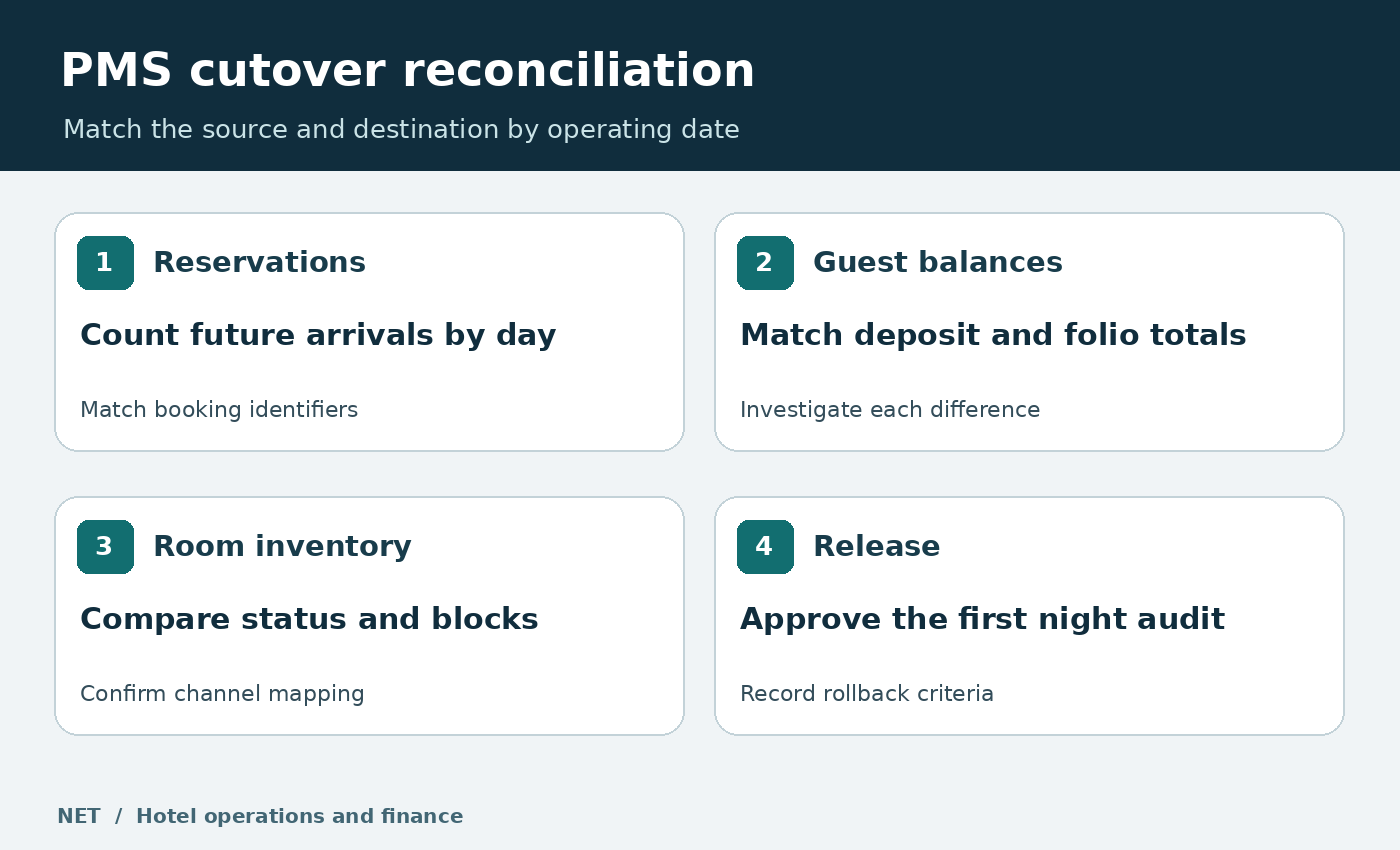
Follow data across connections before reopening sales
Make a map of the room types, rates, taxes, channels and accounting interfaces that must change together. List which system owns each field, which team checks it, and how values propagate. Identify when the old connection should stop transmitting. A second active integration can overwrite a valid inventory update after the new one is working. Choose one staging test involving the last available room of a type and check how the approved provider environment displays a rate, reservation and cancellation. Prevent test traffic from affecting real guests, inventory or payments.
Audit the direct reservation path and the most important agency and group connections. Check how the hotel handles different combinations of occupancy, room types, negotiated plans and multiple-night stays. Confirm that a group block reduces availability on the appropriate dates and unused allotment is released under the property’s actual rules. Verify that a different room type identifier did not silently map to a default. Add a short release gate with the old count, new count and the person who confirmed the source of every difference. Staff should know who can reopen or restrict inventory.
Run an in-house folio, a group bill and a refund
For an existing stay with a deposit, confirm the first night’s posting and balance after the switch. Check the business date and where the expense is coded. In a test where a group covers room and tax but not personal incidentals, use an authorized test booking to verify that the master account and the guest folio split correctly. Compare the print or export seen by the controller to the front-desk screen. If a tax code or fee maps differently, record the effect and decide whether there is a repeatable correction before staff begin closing real group bills.
A refund can be more complicated after a processor or PMS change. Trace the original capture reference and approved refund path. Confirm how it appears in the guest record and the settlement report and verify which date the controller uses to reconcile it. Put payment exceptions on a list with approved access and escalation. If the vendor cannot service an old transaction from the new platform, have the hotel identify the secure route it will use and how the update will reach the new ledger. Avoid building a workaround that relies on asking guests to send card details.
Reconcile night audit before handing over the next shift
Set a sign-off with accepted counts and amounts for room revenue, taxes, deposits applied, refunds, transfers, expected processor totals and open folios. Compare the month and day built into the general ledger export with the hotel’s chosen business date. Identify differences due to statement timing and investigate anything with no corresponding transaction. Review at least one reasonably busy day and a group checkout if these materially affect the property. Have the operator sign room and reservation results and the controller sign cash and ledger results.
Plan staffing around simultaneous work. The person checking deposits cannot process every arrival. Give the night team a named fallback for group or payment issues and the support contact approved by the hotel. Have employees document unresolved errors in one log with the affected reservation, severity and next action. Avoid several people applying a fix to the same balance while the front desk is busy. Set a time for the property to decide whether to continue, pause part of the rollout or use its documented fallback for the next shift.
Preserve the records needed after the old software closes
Before terminating old access, identify reports required for taxes, billing questions, settlement disputes and occasional audits. Ask the provider how to export each item and whether staff will need separate access. Compare a sample of the approved export with the old record while both systems are still available. Check responsibility for storage, scope and retention with the hotel’s advisers. Keep only records the property is entitled to retain. Store them under appropriate controls and identify which roles can retrieve them after the subscription ends.
Write down what a rollback means. If the new system has captured real transactions or published inventory changes, simply turning the old platform back on can produce duplicate charges, lost confirmations or conflicting room counts. Identify the point when a return would require both vendors and the controller to reconcile changes. Assign who can authorize that step and which record becomes authoritative during a fallback. Have a forward correction plan for the case in which switching again would introduce greater operational risk.
Price implementation and post-cutover support in the contract
Ask each provider to show field-level migration details with the hotel’s own complexity. Find out who prepares mapping, which records are excluded, what happens when an export fails, and how the teams coordinate the date of first live operation. Budget duplicate subscription periods and qualified support separately from the normal dollar-per-room subscription. Request a dated copy of accepted totals and a way to export the reconciliation. A demo can show how the new PMS would sell a room. The actual changeover has to explain what happened to the reservations and balances for rooms already sold.
Use a pilot arrival report with exact counts
Select a specific morning after cutover and list every expected check-in the hotel should see. For example, if the old report shows 36 reservations for 41 rooms, verify both totals and their source categories. Inspect a multiple-room reservation and one arriving a day later after a previously logged change. Confirm that the front desk can assign an appropriate room and find the relevant balance. A one-room mapping mistake can matter even when the two counts agree.
For an unresolved difference, show whether it affects a guest arrival, money, inventory or reporting. Give each high-priority issue an expected compensation or correction path and an escalation deadline. If an unreceived agency reservation can be found with the original reference, reconcile it through the approved process before releasing inventory. If accounting still cannot explain a balance, record it for finance rather than asking a receptionist to accept it. Have the night audit report record what was fixed and which exceptions need review by the next shift.
End the pilot by exporting a current inventory and deposit reconciliation from the new system. Save the agreed scope and measurements. That output becomes the reference for the next property or vendor update.
Use the hotel property management software guide for the wider buying decision, hotel PMS software pricing for small hotels for migration and support costs, and hotel channel manager software to test inventory handoffs. A useful go-live review leaves the property with matching operating counts, traceable balances and a recovery path the next shift can follow without guessing.