
Hotel payment processing handles more than a charge at checkout. Operators may collect a booking deposit, authorize incidental amounts, capture a balance, process an agency-issued virtual card, refund a canceled stay, or reconcile several batched deposits. Compare payment providers using the property’s real transaction mix and an end-to-end folio test. The goal is to understand the effective cost, keep reliable records, and protect payment data in every workflow.
List each payment activity and where it happens
Write down transactions made via the website, by phone, at a terminal, and through online travel agencies. Identify which hotel entity receives the money and which systems handle the reservation and payment reference. Include deposits, check-in authorizations, incidentals, checkout, no-show fees where applicable, adjustments, refunds, and chargebacks. Record who is permitted to perform each task.
Ask how payments are handled for rooms booked in groups, guests who extend, split folios, or third-party payers. Compare how the provider supports changes and errors under hotel policy and applicable requirements. An approved transaction at the terminal does not necessarily mean the hotel’s accounting or PMS already shows the correct result. Verify how payment status reaches those systems.
Compare statements using the same transaction mix
Request an itemized proposal including percentage charges, per-transaction amounts, terminal or gateway fees, security program charges, chargeback fees, and any related monthly charges. Ask how card-present and card-not-present traffic is priced and which categories the provider expects. Use one set of sample reported volumes and values for all proposals. Keep tax, tips, or other amounts separate in the accounting model as appropriate.
For example, for a fictional $95,000 in monthly processed volume and 430 transactions, a uniform 2.50% plus $0.15 per transaction would total $2,439.50 before any monthly charge, or approximately 2.57% of volume. Real arrangements can vary by transaction type and many other terms. Compare total costs in a high-volume month and an ordinary month. Ask the provider to explain which line becomes more expensive if more guests pay online.
Confirm how authorizations, capture, and modifications work
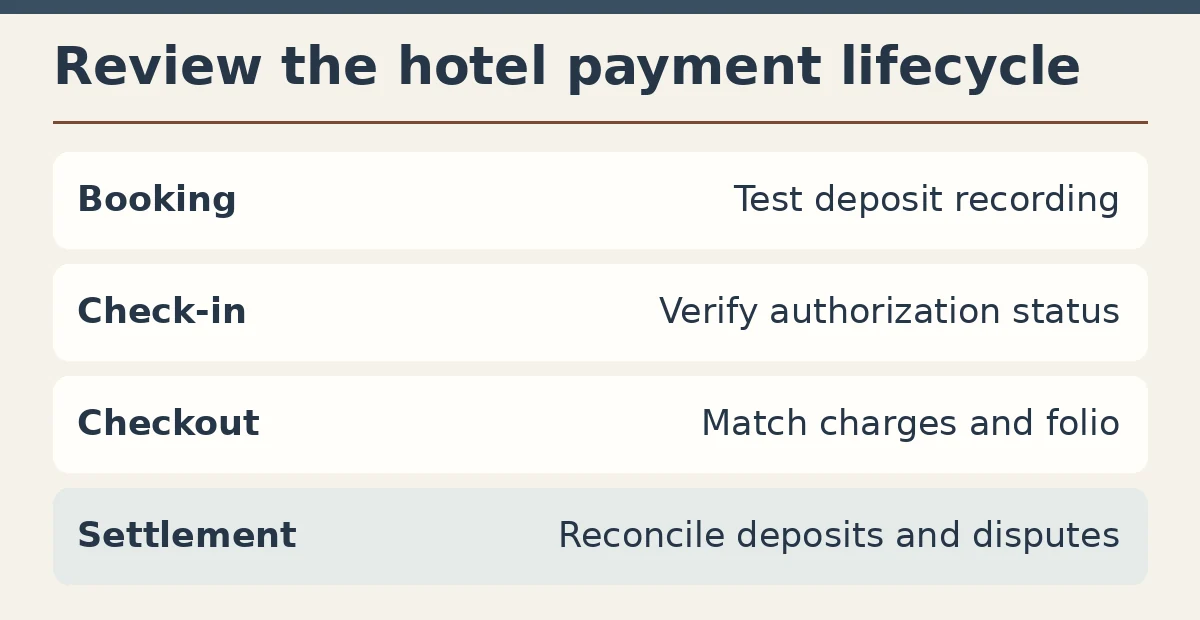
Use a test reservation with a deposit, an authorization at check-in, a stay extension, and a final payment. Ask what records identify each event and how adjustments are reviewed. Verify how the terminal or gateway reports a declined request or an unclear status. Find out who can correct a duplicate and when a refund or adjustment is appropriate under the processor’s rules and hotel policy.
Explain the property’s guest communications and request examples of what appears on confirmations and statements. An authorization hold and a final charge can affect the guest’s available balance differently. Ask the processor which facts staff can explain and what the guest’s card issuer handles. Make sure a manager can see the transaction status without looking at unnecessary payment details.
Check PCI DSS responsibilities and vendor roles
The PCI Security Standards Council explains that outsourcing processing can change which PCI DSS requirements apply directly to an environment while leaving responsibilities with the merchant. Ask the acquirer or relevant compliance party how the hotel should validate compliance and what evidence it needs from providers. Have authorized staff document which systems and people handle payment account data and the scope of that handling.
Use artificial or processor-approved test data in a demo. Ask how tokenization or hosted payment entry is provided and which systems can use a payment reference. Review role controls for refunds and reports and ask who can access support information. Follow the hotel’s established rules for handling card details and avoid moving those details into reservation notes or ordinary communications. Get the provider’s security and responsibility documentation for the actual setup.
Evaluate settlement, reconciliation, and disputes
Ask for a statement that shows a captured payment, any charge or credit, the payout date and bank deposit reference, and how a refund or dispute appears. Match the same data to a folio and daily close report. Review settlement timing for weekends or holidays and any reserve or hold policy. Verify when a transaction changes the available balance. Make sure finance can see the records it needs without relying on unnecessary guest details.
Ask who responds to disputes, who may provide records, and how deadlines are communicated. Give the vendor a fictional canceled stay and ask it to show how the hotel would find the policy shown to the guest, confirmation, and payment record. Make sure the actual reply uses the acquirer’s process and applicable rules. Train the team to preserve the correct records and follow the necessary privacy precautions.
Compare equipment, contracts, and operating support
Identify which terminals, connection fees, replacements, and integrations the provider includes. Ask if equipment can be used after changing the processor and how a device outage is handled. Request the renewal terms, termination requirements, support hours, and data export options. Verify who owns open credits or disputes if the service ends. Put those issues next to the estimated monthly effective cost.
Before launch, reconcile test bookings through terminal or online checkout, the PMS, and the deposit report. Agree on a fallback for an outage that follows the hotel’s processing and data-handling rules. Review the first statement against the quote. A useful payment processing comparison shows both the net expense and how quickly staff can explain a deposit, error, refund, or disputed transaction.
Reconcile a group reservation with two forms of payment
Create a fictional group example with a master bill for room charges and individual payments for incidentals. Use provider-approved test records. Ask how the system records payments when a guest moves rooms or a master charge is changed. Verify which transaction references appear on the group folio and deposits. Give the finance team a deposit report and ask it to match the result from a test daily close. Record discrepancies as facts for the vendor to explain.
Ask how a canceled group reserve and partial refund are handled, and who can authorize the action. The hotel’s policy, processor and applicable rules may affect what notice or evidence is appropriate. Ask how finance can confirm the final outcome in both systems after a refund. In an agreement with an outside organizer, confirm who pays each amount and where supporting references are kept. These details serve the team better than a processor comparison built only around the first screen at checkout.
Model agency-issued virtual cards and timing
If the hotel receives agency-issued virtual cards, ask which authorization, eligibility, and date rules apply under the actual agreement and processor. In a demo use an artificial record, and ask the vendor to show how a later activation date or changed balance is reflected. Check how the transaction can be matched to the originating booking and what reports are available when it cannot be processed as expected. Explain who should manage the follow-up as part of the hotel’s credit procedures.
Use a cost worksheet with different rows for payment channel, acceptance type, and cancellation or refund where relevant. Identify which records support each fee estimate. Ask whether use of a gateway, terminal, or provider connection changes how transactions are classified or charged. A processor offering a lower fee per transaction on one payment type can still cost more if the property routinely processes another type with additional charges. Compare the portfolio of actual transactions.
Confirm who owns settlement and reconciliation during cutover
Ask the two providers to show how they would handle unsettled transactions, refunds in progress, and existing dispute deadlines. Keep the report from the old service while the new service begins posting funds. Decide who checks deposit totals each day and how it identifies mixed batches. Ask about each provider’s support period after a contract ends. Verify which documentation the hotel can gather while protecting account data.
Request a supervised end-to-end test with the authorized hotel staff. Include the same common tasks and verify which permissions affect administrator and front-desk roles. Ask how role changes are logged. Discuss how hotel and vendor staff coordinate during unexpected downtime without using unapproved data handling methods. Build the launch budget with staffing time, hardware, software integration, and recurring payment cost. This gives the operator a cost and operational baseline for comparing actual statements at the next renewal.
Compare statement cost at different balances and seasons
Ask a provider to show a quiet month and a busy month with the same contract terms. Use a realistic mix of deposits, day-of-arrival authorizations, completed terminal charges, agency payments, refunds, and disputed transactions. Ask which fees change when more transactions are entered online and whether refund fees include a return of any original charges. Use the current agreement for your own arithmetic. Separate costs the hotel pays even with low volume.
Compare net deposit timing alongside fees. A delay or increase in a reserve can affect cash on hand before the busiest payroll or supplier date. Ask for a realistic example that shows the timing of deposits and any condition on use. Have finance match the illustrations to the written settlement terms. If accounts, fees, or settlement windows differ by property, get itemized results for each location. A low cost based on an optimistic mix needs a second test.
Test a delayed authorization reversal with guest services
Create a provider-approved scenario where a guest checks out early and the final charge is different from the initial amount authorized. Ask what staff can see at each stage and how the hotel follows up without handling unnecessary payment information. Check who can authorize or perform a permitted reversal or refund. Have guest services explain the on-property record while making clear when an issuer is responsible for timing.
The demonstration should include a way to correct a posting error, reconcile the amount with finance, and escalate a genuine exception. Ask what the old and new payment providers need to know when the hotel switches. Verify where support records show timing and responsibility. Keep a contract schedule containing all major costs, approved work processes, dispute windows, and settlement rules. When the first actual statement arrives, compare it against those specifics and use the difference to refine the hotel’s cost forecast.
Reconcile an adjustment that settles the next business day
For a fictional case, prepare a reservation paid in advance and a partial adjustment after checkout. Ask how the provider attaches the new accounting records to the original folio and batch. Have the front desk locate the status and finance identify the actual deposit entry. Check how weekends and holidays affect settlement under the agreement. The test should identify the evidence for a return or charge correction without using actual card data.
Compare use of the processor in the next property
Ask for a new location price that uses its real mix of terminal, online, and agency payments. Confirm whether the merchant and bank records need separate configuration and verify who can view each location. Include gateway, terminal, subscription, hardware support, and any program fees in the same quote. When the hotel changes provider, identify which disputes overlap and who continues to meet the relevant deadlines. Check that accepted data-handling documentation and payment workflows are ready before the next location starts taking guest payments.
Connect this comparison to the rest of the hotel
A good settlement test compares the charge in the booking system, the folio in the PMS, and cash in the deposit report. Tie every result to the processor’s quote and identify who resolves a discrepancy.
For related decisions, use the hotel booking engine payment workflow, the hotel PMS and folio guide, and the hotel PMS cost comparison.
Sources consulted
PCI Security Standards Council — Outsourced Payment Processing