
Hotel CRM software can organize guest relationships, communications, service recovery, and repeat-stay activity. It is worthwhile when staff can recognize the right guest, honor communication preferences, and understand the cost of bringing back a visit. Compare a CRM using realistic records, operational roles, and reporting. Ask how it works alongside the property management and booking systems without treating every collected detail as necessary.
Choose the guest activities the CRM should support
List the work you want to improve. It might include a post-stay service follow-up, returning-guest communications, lead management for a group event, or responding to a guest preference. Identify which records staff need and who is permitted to view them. Agree on which data is held in the PMS and which systems receive it. A CRM tool should add useful workflow context when staff need it.
Write down which actions are operational and which involve marketing. A reservation update and a promotional message call for different handling. Determine with the appropriate staff or adviser how applicable laws and the hotel’s privacy decisions affect communications. Ask which permission fields and suppression records the CRM can store, display, and export. Updating a preference should affect the systems that may send the next message.
Test identity and consent through realistic cases
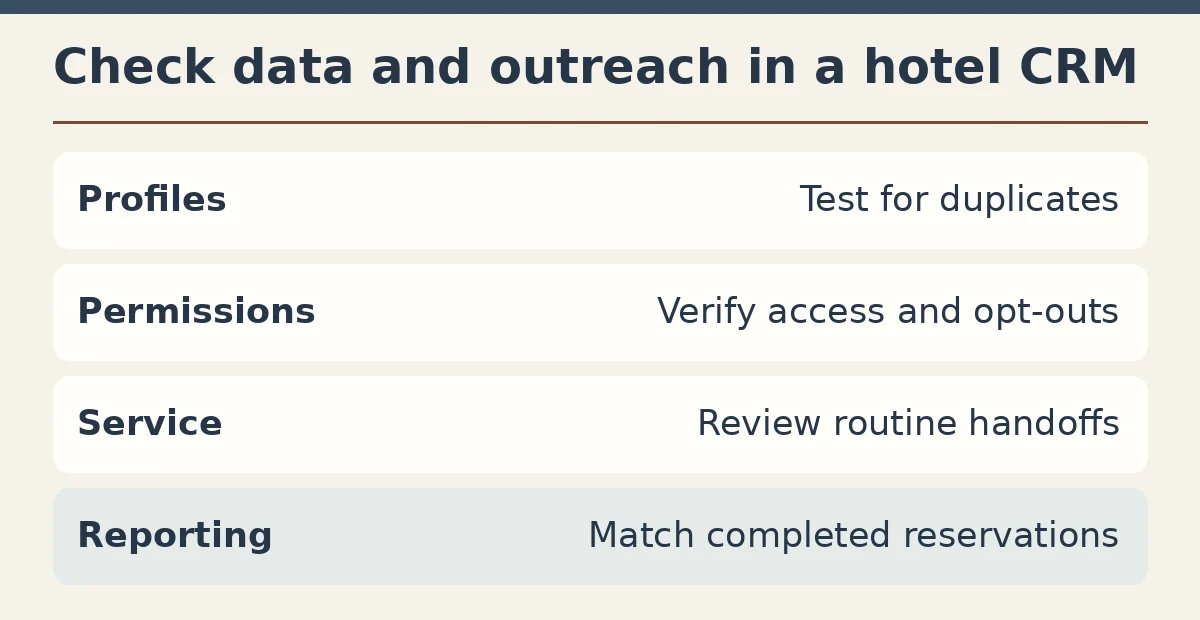
Use fictional profiles for a couple who share an email, a repeat guest using a different address, and a group organizer booking on behalf of others. Ask the vendor to demonstrate how records are matched and what a staff member can review before merging two people. Verify which values or notes are kept, and how to correct a mistake. A profile match should stay explainable when several properties use the tool.
Test a contact who unsubscribes in one system. Check how that outcome is recognized elsewhere, who can change it, and what the CRM logs. Review permission for automated communications in the actual contract and workflows. Ask what happens when data comes from a booking channel with restricted use or retention. Validate the property’s rules for export, correction, and deletion with the staff responsible for them.
Compare automated messages with staff responsibilities
Ask the vendor to demonstrate a service request, pre-arrival note, post-stay feedback request, and a carefully scoped marketing example. Define which message comes from the hotel, which system records delivery, and who handles replies. Use representative test scenarios such as a stay cancellation and a delayed arrival. Check whether automation responds to updated reservations or mistakenly uses the original dates.
Have guest services and front-desk staff use the demo. Record how they can pause or correct a communication when an issue has already been resolved. Verify how approval works for a template or campaign. Review support access and administrative rights. The system may be able to send several messages, but the operator should decide when one message is enough and when a personal reply is more useful.
Evaluate campaign results on eligible bookings
Ask what the vendor counts as a sent message, click, booking, completed stay, repeat visit, and incremental outcome. Verify how bookings match to guest records, including cancellations, prepaid deposits, and multiple rooms. Compare the CRM’s claimed outcomes with the PMS and booking engine. A guest may make a reservation after opening an email that did not cause that decision.
In a hypothetical test, 220 eligible profiles can be split into two comparable groups of 110 where appropriate. If 12 people in the messaged group and eight in the comparison group complete eligible stays, the observed difference is four stays in the example. Actual campaigns need a suitable design and enough data before conclusions are drawn. Consider margin, discount cost, delivery expense, and staffing when discussing the result.
Compare the contract, integration, and protections
Ask whether fees depend on active profiles, rooms, users, properties, channels, or message volume. Compare the modules a small hotel actually needs and the limits relevant to a multi-property group. Get the quoted cost of PMS and booking engine connections, data cleanup, template production, training, and support. Determine whether you would pay separately for exports or ending a contract.
Verify that staff can see only the data their job requires and that the hotel can audit important actions. Ask how integrations are authorized and who can change them. Discuss retention and deletion with the relevant teams. For a data event or outage, check whom you contact and which records are available. Choose a CRM only after the daily workflows, ownership, outcome definitions, and paid terms can be explained together.
Distinguish service recovery from a repeat-stay campaign
Take a fictional guest who reported an air-conditioning problem. Ask hotel staff to record the issue, route it to an authorized team member, and confirm a resolution. Check whether the CRM can prevent an automated request for a public review or routine marketing message if a legitimate workflow calls for a delay. Ask who approves such a pause and when it expires. The hotel should handle communications and reviews according to applicable requirements and its approved policies.
For a repeat guest who has agreed to receive eligible marketing messages, compare how a return offer is selected and recognized. Check whether the PMS records the completed stay and whether reports can account for a cancellation. Test an unsubscribe before approving the mailing. In the United States, the FTC’s CAN-SPAM guidance describes duties for covered commercial email. Discuss how applicable rules affect the exact messages you plan to send, including who fulfills opt-out requests when another provider sends the email.
Run a group sales and service example with realistic access
Give the demo a group contact with a request for 12 rooms, a meeting area, and one potential arrival date. Ask the vendor to show ownership of each task and the handoff between sales and front desk. If the request changes, verify that follow-up is addressed to the correct contact. Test whether an employee can see only its relevant records. A group organizer does not automatically give the hotel the same permissions for every guest in the group.
Ask what happens after the tentative lead turns into confirmed room reservations and later into completed stays. Record one state per event and decide which system owns the final value. Verify that the same contact is not counted twice because it appears in several connected systems. Compare how much staff intervention is needed to make the record usable. If the property has seasonal groups, check the timeline after a tentative request expires.
Model data cleanup and a move between systems
Before signing, sample the kinds of records you would import. Count duplicates, shared email addresses, and missing permissions fields. Do not make new marketing assumptions about records whose prior permissions cannot be verified. Ask the vendor how it separates archived and active contact profiles. Confirm the hotel’s data retention goals and applicable rules with the appropriate advisers. Test a file import on artificial records representing the intended data.
For exit, request an actual export sample and verify the fields used to reconstruct a consent or service record. Ask when the vendor deletes information and how you can verify what it still retains for a lawful, documented purpose. Ask who controls access during any transition. If the vendor requires a particular channel or payment contract to keep working, record that beyond the subscription price.
Keep the operating plan separate from the volume commitment
Compare offers for a normal month and a month with a seasonal event. Ask which costs cover messages, users, data storage, and integrations. Have a vendor specify how unused messages or fees above an allowance appear on the bill. Use sample outcomes and evaluate whether additional communications would actually help the hotel’s guests or sales team.
After launch, review complaints, data corrections, completed stays, and costs alongside campaign reports. Look for exceptions such as a repeat guest contacted through two systems or a group whose records do not reconcile. Make the configuration and response ownership clear before expanding. A CRM can support hospitality when its cost and use of guest data match a specific task the team is responsible for.
Audit a contact’s journey through three systems
Give the demo a sample guest record created at booking, modified by the front desk, and used later in a legitimate service follow-up. Ask each vendor to show which system owns the address, stay details, and permission status. Check whether data from a third party can be used for the intended action. Request the current documentation for the actual connection. Verify how an authorized employee can correct a duplicate without changing records for another guest.
Use a fictional returning guest who has withdrawn one type of communication permission. Confirm whether the CRM suppresses the relevant messages and maintains auditable evidence. Ask how preferences or updates are passed to other systems, who is alerted to a failed sync, and how staff can review it. Use protected test data rather than a copy of the hotel’s actual marketing list. The process should make it possible to explain why particular information or communications were used.
Share only what each employee needs to do the work
Build a staff role for desk employees, a manager, and someone who handles marketing or sales. Ask the vendor to demonstrate one task each can complete and one task each cannot perform unless appropriate access is granted. Review how a manager checks permission changes when someone leaves the hotel or moves between properties. Ask how incident and support teams gain or lose access to data. Record the relevant configuration and notice responsibilities in a secure internal document.
If the hotel offers service recovery from several channels, identify which information belongs in the property record and which is required for the guest’s request. Agree on permitted record types and deletion or retention procedures. Ask a vendor to explain whether a relevant restriction can apply across locations and exports. Decide who approves extensions. A vendor proposal should show both how usable the workflow is and what governance work the hotel will take on.
Calculate contribution after a repeat-stay offer
In a simplified example, four incremental stays at $180 of room revenue would add $720 in room revenue before costs. If each stay has $40 of relevant incremental cost and the campaign cost $150, the illustrative contribution is $410, before any other applicable costs. Use actual expense and booking records before making a marketing decision. If the offer gives a discount to people who would already have booked at full price, account for it separately. Choose a comparison method that distinguishes completed stays from bookings and campaign attribution from causation.
Ask who owns the guest requests at a property change
If one property is sold or changes systems, get the agreement and approved data handling process. Identify who may access old service records and which work remains with the existing operator. Ask the vendor for export and correction examples and confirm how opt-outs are handled during the transition. For a property that has several separate hotel brands, check that summaries and permissions respect each property’s responsibilities. A quote should cover this implementation work as well as an ordinary month of guest interactions.
Connect this comparison to the rest of the hotel
Decide how booking and property systems supply the guest record before choosing a CRM. Include extra licenses, message volumes, and staff effort when vendors quote an integration.
For related decisions, use the hotel PMS and guest record guide, the hotel booking engine comparison, and the hotel PMS price and integration guide.
Sources consulted
Federal Trade Commission — CAN-SPAM Act Compliance Guide for Business