
The best hotel property management software for a specific hotel is the system that can run its front desk, housekeeping, reservations, folios, night audit, and reports under realistic conditions. Reviews and screenshots can point to products worth evaluating. A live test using your property’s room types and policies will show how each product actually works. Compare core workflows first, then evaluate integration costs, data migration, and support.
Describe the property’s workflow before requesting a demo
Document room types, assigned rooms, occupancy rules, tax treatments, payment flows, booking sources, housekeeping shifts, and business-day reporting needs. Include guests who extend, change rooms, book multiple units, or use a third-party reservation. Define the people who have permission to make each change. Give every vendor the same test cases and ask the vendor to identify functions that require a separate module or partner.
Ask staff what they do during a normal shift and what is most difficult when there is a rush. A small hotel might need simple shift handoffs and scheduled messaging. A multi-property operator may need group arrangements, centralized roles, and chain-level reporting. Write down short scenarios and decide which features are essential for the hotel’s daily operations. Use a separate list for planned features that are not essential on the first day.
Test a reservation through stay, housekeeping, and checkout
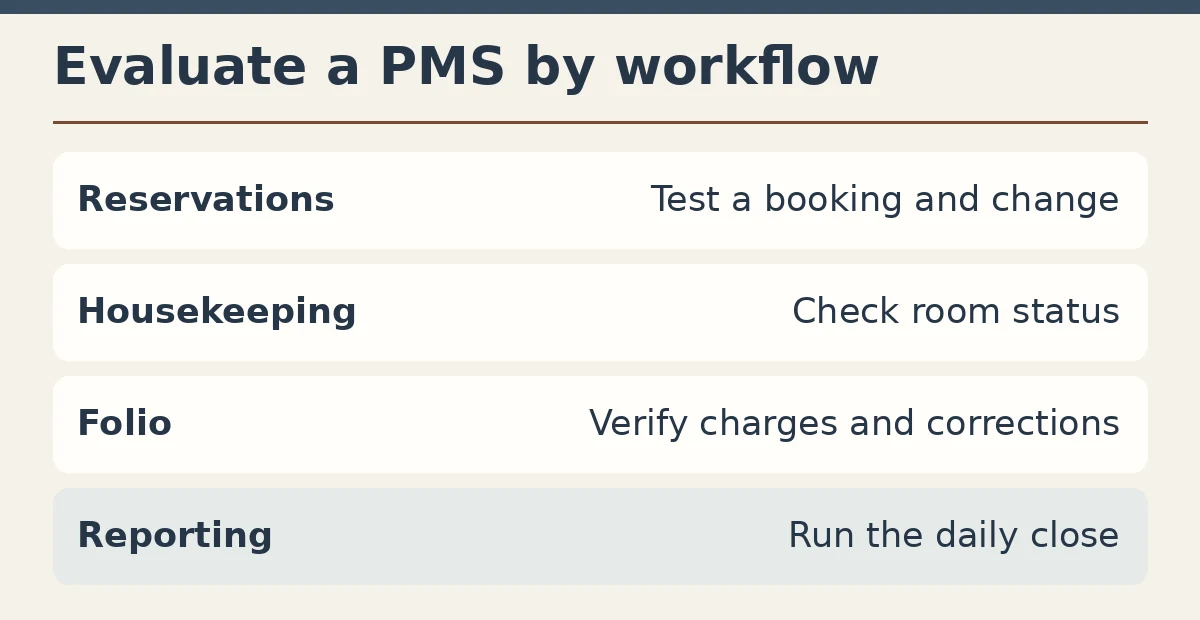
Give the vendor an illustrative two-night booking with an early arrival, a room move, a split folio, and a guest request. Ask the hotel employee who would perform these tasks to use a demo. Watch whether an update reaches housekeeping and whether the assigned room, payment record, and activity history match. Ask how front-desk staff undo or correct a mistake under appropriate permission.
Request a daily close report and a reconciliation example. If an adjustment is made in the next shift, check how the date and reporting period appear. Ask whether a payment can be issued, refunded, or viewed by users with distinct roles. Watch how the system handles an unavailable service, connection loss, or integration timeout. Record which tasks require staff to leave the property management system or reenter information.
Check integrations against your day-to-day systems
A PMS typically manages core operational records. A booking engine handles a direct booking flow, while channel connections distribute and synchronize rates and inventory. Revenue tools may recommend or publish rate changes. Confirm the appropriate system of record for each outcome and list which integrations communicate bidirectionally. Ask which integration costs are part of a quote and who is responsible for servicing it.
During a demonstration, create a reservation in one connected system and check where it appears. Change occupancy or dates and inspect the resulting status and room availability. Verify how an error is surfaced and the time for recovery. Ask who checks failed messages at night or on weekends. If your property works with an accounting system or door locks, verify the actual models or plan levels rather than relying on a broadly worded integration list.
Compare data portability, migration, and permissions
Ask what reservation, guest profile, folio, and reporting data can move from your current PMS. Request the actual migration formats, date range, and exceptions. Create an opening inventory and reconcile future reservations before cutover. Ask which data should be retained separately or excluded based on the property’s privacy and compliance requirements. Verify export tooling during the evaluation rather than relying on a future promise.
List every role with access to guest records, discounts, refunds, or reports. Ask how to set up individual access and how a manager reviews a past action. Evaluate whether a data export contains appropriate fields and whether a canceled subscription ends access before you can retrieve records. Get the return and deletion terms, uptime commitments, and response priorities in writing.
Model price with connected modules and staff time
Ask each PMS software vendor for a written proposal covering the same number of rooms and outlets. Include base fees, setup, migration, training, interfaces, payment terms, hardware, support, and renewal changes. A subscription quoted per property or per room may not include what you need for direct booking or channel distribution. Separate contract charges from staff time and the cost of changing providers later.
Estimate three years of spending using identical assumptions. Put uncertain charges in separate rows and ask the vendor to resolve them. Review notice requirements and possible increases at renewal. If a property may add rooms or locations, request a quote for that size before committing. The budget should cover the tools and workers needed to make the launch work.
Use a small test before signing and before going live
Ask for a test environment with artificial guest data and realistic room types. Define what each demo must show and score success using staff observations. Check reservations, concierge requests, night close, a disputed transaction, and a connected booking update. An in-house operator and its vendor should agree on what happens if a critical function fails on launch day. Specify who can make a change and when it is appropriate to use the fallback plan.
Before migration, reconcile confirmed bookings by arrival and make sure guests are informed only as needed through your normal process. Run agreed spot checks after cutover and record exceptions. The hotel property management software comparison is complete when staff can demonstrate core tasks, management can read the expected reports, and the contract supports a realistic operating budget.
Give a front-desk team a realistic reason to change systems
Suppose a small independent hotel has a manual room move log because its current PMS does not update housekeeping reliably. Have a desk employee move an artificial guest from a room requiring service into an available room. Watch the status in housekeeping, guest communication, folio, and the guest ledger. Ask how a correction appears to managers. A feature introduction is helpful only if the shift can use it while several guests are waiting.
Repeat with an early check-in and a late checkout. Watch whether the software blocks the same room from a conflicting assignment or allows a controlled manager override. Ask whether the team can roster roles for part-time or seasonal staff without sharing credentials. Review the resulting records. Try a similar workflow on different hardware if the property uses a mobile station or tablet. Include the real network and browser support constraints in your purchase decision.
Ask where group and multi-property complexity actually matters
If the hotel takes group reservations, set up a sample booking with an organizer, individual room occupants, a master folio, and agreed personal incidentals. Check how it releases unused rooms and what staff can adjust. Watch which payments and charges appear at the property and which are consolidated. Ask whether group features require a separate subscription.
For a second property, test which employees can access either location and how an administrator assigns permissions. Ask whether rate, guest or finance reports can be consolidated while retaining the property-level evidence. Ask how a transfer or cross-property reservation is sent to the relevant team. If the operator expects to sell or rebrand one hotel, check how its data would be separated. Get costs and restrictions in writing.
Review reliability on the days that matter most
Ask for a written support policy, escalation route, and recent examples of how service interruptions are communicated. Determine which tasks can continue during connection loss and which tasks require a separate approved process. Have finance and front desk agree on how records will be reconciled after restoration. Include a reporting or payment failure in the operational demo, with safe test data.
When rollout is near, give each department a list of fields and balances to verify. Run a trial close against a known set of bookings. Look for mismatches in dates and amounts and keep notes with the vendor. Coordinate room access and housekeeping records. When the purchase timeline is clear, document the date for the guest and folio data transfer, who authorizes the change, and how the hotel can return to the previous workflow if a critical check fails.
Watch a financial adjustment through the daily close
Create an artificial booking that includes a prepaid amount and a charge for a service. Have the desk employee correct a charge before the business day closes, then have finance make another authorized adjustment on the next business day. Record where the system shows date, reason, old amount, new amount, and user. The answer should be clear when the hotel explains a later dispute or report variance. Ask the vendor how corrected postings reach accounting through the exact plan being quoted.
If the system has a daily close that runs automatically, ask how exceptions are reported and which employee can resolve a failed close. Review how taxes or fees are exported and reconcile the treatment to the property’s current policy with appropriate advisers. Use a model of two shifts with an apparent duplicate payment and see who can verify the final status. The point is to measure financial control and staff time together.
Create a realistic migration acceptance checklist
Ask which fields are brought across for past stays, future reservations, discounts, balances, and stored preferences when appropriate. Request a short written list of values that have to be mapped manually. A property may want a separate historical archive if a particular record cannot be imported. Confirm who reviews the archive and when it will be available. Give department leads an owner and due date for each verification.
Before going live, count reservations by date and compare promised room types, payment references, and folio totals using authorized data-handling methods. Look for differences that only appear after modifications. Ask the vendor how long the old system can run in read-only mode and whether additional access is charged. Reserve a date when support is available. Decide who can pause a migration if arrival or billing records do not meet agreed criteria.
Score the systems after the full demonstration
Decide how much weight to assign to fast check-in, finance, housekeeping, data ownership, support, pricing, and the property’s necessary integrations. Rate a working test above a feature stated verbally. Record what the property must purchase or configure separately to reach the desired result. If one vendor solves an urgent operational issue but requires manual exports, estimate which staff must keep doing that work. Compare it with what another proposal covers at the written price.
Ask a supervisor from each department to review the sample results without changing the vendor’s input assumptions. Write down the leading concern before scoring convenience features. Verify the claims in the final contract and note which milestone releases implementation charges. Create a first-week check-in with the hotel’s rollout team. Staff should see an agreed method for escalating urgent exceptions until normal operations resume.
Test what the hotel can use on a busy weekend
Ask two front-desk employees to demo a reservation change and a room move while a supervisor watches reporting. Assign one employee to an ordinary role and the other to a manager role. Use fictitious data. Ask the vendor to explain a failed adjustment from the log and show what each user needs to do to correct it. Review night and weekend support terms and the limits of any offline process. Score the quote based on whether staff can complete ordinary work and recover from the exception, then include the full cost of those capabilities.
Connect this comparison to the rest of the hotel
If a new owner or brand changes reservation systems, use the demos to test which records transfer and who approves the new software. Budget for a transition that protects the front desk and verifies outstanding reservations.
For related decisions, use the hotel software guides, the hotel acquisition transition checklist, and the hotel franchise and conversion guide.
Sources consulted
Oracle Hospitality — Hotel Property Management Systems