
Hotel channel manager software connects room inventory and rates to sales channels such as online travel agencies. The best hotel channel manager for an operator is the one that accurately expresses the property’s actual rules on its important channels and helps staff handle exceptions. Test a reservation and several changes through each connection the hotel intends to use. Collect costs, support conditions, and limitations before trusting the system with live availability.
Map inventory and rate plans correctly
List room types, total room counts, occupancy limits, rate plans, and restrictions. Confirm which property system holds the authoritative record for each item. Give each vendor identical mappings, including a case where a room type has a different name on an agency listing. Confirm how the product handles a rate inherited from another plan, a minimum stay, and rooms held out of service. The channel manager should send the actual intended availability and receive a clear acknowledgment.
A hotel may sell rooms through its own booking engine and multiple agencies. Decide how many rooms can be sold and the rules for specific rates. Ask the vendor which restrictions an individual connection supports. A feature may be available in the channel manager but not supported in the same way on every partner channel. Request a written matrix for the exact systems, connections, and plan the hotel is evaluating.
Follow new, modified, and canceled bookings
Use a simulated agency reservation and verify its time, room type, dates, occupancy, rate, and booking identifier in the PMS. Modify the reservation and check the change in both records. Then cancel it and verify whether availability returns automatically under the expected rules. Include a booking with an unusual arrival or multiple rooms to evaluate more than the simplest case.
Ask how updates appear if an agency briefly does not respond or if a mapping is incorrect. Review which staff can see failed messages and whether the system retries, requests a manual response, or shows a discrepancy. An alert should tell staff what was last accepted and how to check the current record. Confirm who is responsible for the connection when both the channel and the vendor need to investigate.
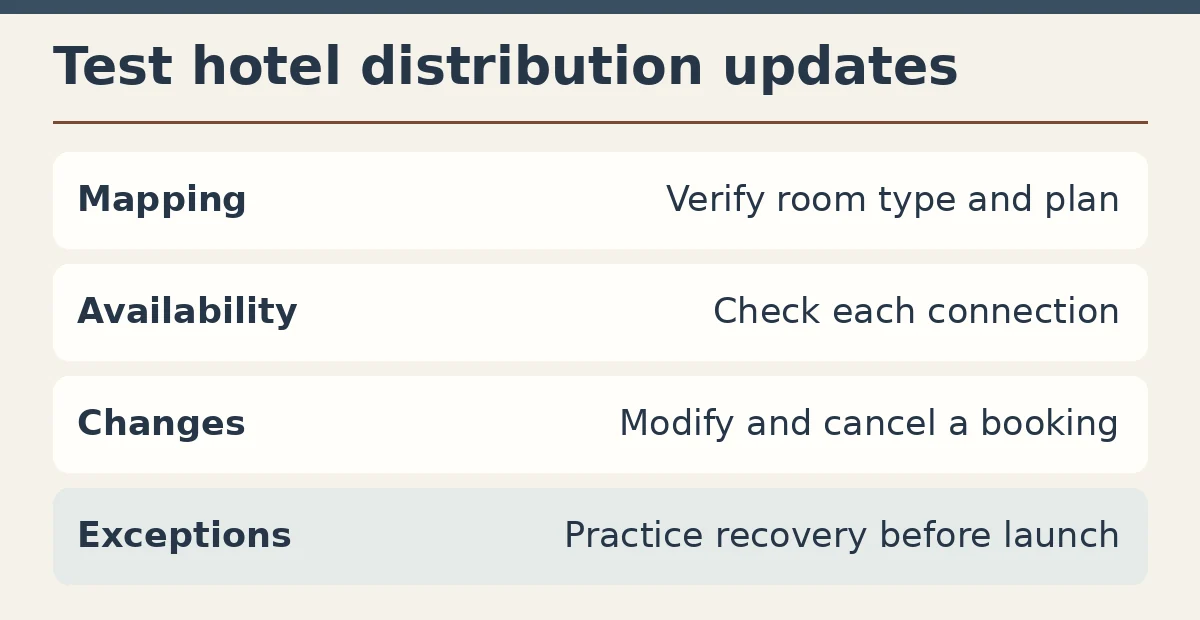
Test the last sellable room without risking a live booking
In a safe environment, simulate two channels requesting the same room type when one unit is left. Watch how the systems communicate and record the outcome. Ask about queue time, internal allocation, and what kind of synchronization each connection supports. No demo can establish that conflicting requests will always be prevented. Ask for the vendor’s documented process for handling competing bookings and evidence the team can inspect.
Discuss a fallback when the agency, PMS, or channel manager has an interruption. Find out how staff can stop sales appropriately or check current balances before making changes. Decide which records they use to resolve disagreements after recovery. Keep a clear chain of contacts for urgent incidents and reconciliation. Train staff on short connection failures as well as a lasting outage.
Account for rate, commission, and connection costs
Ask about property, room, connection, reservation, implementation, and support charges. Compare the list of actual channels used in high and low season. Map each charge to the event that causes it. Note whether charges depend on cancellations, transfers between plans, or onboarding a second property. Then model agency commission separately from the software bill.
For example, an illustrative $160 monthly fee plus a $0.75 charge for 320 eligible bookings totals $400 for the software under the assumption all 320 are billable. An alternative flat subscription might include different connections or support. Match the coverage and compare busy months before choosing. Keep the hotel’s payment and marketing charges in separate rows to see the net cost of a sold booking.
Check reports and make ownership explicit
Review updates, rejections, booking modifications, cancellations, and reconciliation records in the vendor’s reporting. Ask whether raw booking IDs and timestamps can be exported. Check which roles can change mappings or open sales, and who controls changes in restrictions. If a separate revenue management product publishes a rate, test the route to the agency and how conflicts are resolved.
Record what an acceptable sync looks like in terms of speed, accuracy, and exception handling. Use a single source of truth per field and give staff instructions for cases when systems disagree. Limit administrative rights to the roles that need them. A change in a channel contract or rate plan should prompt a review of the affected mapping before the new plan goes live.
Prepare the cutover and audit the first operating week
Save room inventory and open reservations before moving providers. List any mapping corrections to complete during cutover. Agree on when to stop sending updates from the old connection and start the new one. Verify future stays against the property record before opening all channels again. Confirm how long the vendor can provide recent records once the old account is closed.
During the first week, check booking changes and failures daily, along with rates and inventory for high-demand dates. Record which teams resolved each exception. The right hotel channel manager should let staff trace an update without guessing and handle normal reservation changes without double work. Select on that operational fit as well as price.
Check occupancy pricing and plan restrictions by channel
Suppose a hotel sells a king room and a family room with distinct occupancy rules. On one agency, rates are set per room. On another, the property uses different prices depending on occupancy where available. Ask each vendor to map the prices and restrictions using both channels’ supported fields. Confirm that room names match the correct inventory pool and ask what happens to an unintended rate when a mapping is edited. Compare the acknowledgment and test booking against the hotel’s original setup.
Choose dates with a two-night minimum and dates with a close-to-arrival rule if the property uses either. Ask the vendor to prove what each live connection can transmit in its demo. Get a list of terms that still require manual work. Ask how package rates, promotions, taxes, or meal plans are configured across sites. Identify which team has the authority to change each value and how the change can be verified.
Simulate a problem with an arrival-day modification
Use a fictional reservation whose arrival changes after the property closes sales on the original room type. Have the vendor show the effect on both booking dates, the cancellation or replacement status, and the hotel’s inventory. Verify what would happen if housekeeping and a revenue manager are also looking at the same room. Ask whether the update can be audited back to the original booking identifier.
When an update fails, the operations team needs to know whether the agency accepted the request. Ask what the hotel sees when the connection retries and when the issue needs attention. If a duplicate record is generated in a test, ask how it can be identified and corrected. Compare the time to resolve such incidents and how support handles work during busy weekends. Record the fallback in the training plan before launch.
Consider support and channel costs as the hotel grows
Start with three current connections and one the owner realistically wants to add. Ask the vendor how it verifies certification and availability of the precise features required for the new connection. Confirm how long setup could take and who reviews mapping. Compare base cost and rate for the extra connection and estimate how it would change daily reconciliation.
If the hotel adds a second property, review how agency credentials, reports, rate mappings, and support requests are separated. Ask which staff can work across locations. Keep pricing for training and migration in the proposal. A regional manager should be able to answer which source owns the correct fields and who helps if a specific agency rejects an update. The lowest subscription is difficult to evaluate if it requires daily manual work that the higher price already covers.
Test whether the mapped room rate can be reconciled at month end
Choose a hypothetical agency booking with a rate change, a commission, and a partial cancellation. Trace the reservation identifier into the front desk and finance records. Ask which system provides rate, payment, and commission information and how dates are reconciled when the guest changes the stay. Compare the billing record to the channel statement on the same guest-free example. Confirm who can export those details and which staff need access.
Ask what remains manual when the channel and property software handle a fee differently. Document how accounting receives corrections. In a hotel with several agency contracts, assign someone to check how the applicable booking details map to the portfolio’s reporting. If a connection only supplies some fields, ask where omitted data must come from. The answer can change the time and support required long after selection.
Compare a direct booking with an agency booking on the final room
Use a sandbox and stop any real-world sales activity in that test. Create a direct reservation and an agency booking request near the same time with one room left. Verify what staff see in their own tools, what the channel acknowledges, and how an exception is resolved. Ask the vendor how it identifies the sequence of updates and whether staff can review the relevant timetable. A system should expose what it knows and where it requires another confirmation.
Request the documented fallback that applies when the property plans a room maintenance closure. Confirm what happens when a reserved room is removed from service and the team needs to adjust availability. See whether the vendor can distinguish a room out of order from an inventory or mapping error. Give the desk a short workflow to identify the affected sites. Compare how quickly each proposal lets the hotel confirm its public availability again.
Put distribution responsibilities in the implementation agreement
Identify who prepares the rate and room mapping, confirms the connected partner’s features, and runs a final reconciliation. Do not choose a cutover date until the team has tested a reservation change and verified the relevant support hours. Record both the vendor and channel contacts in case an update arrives late. Check how each vendor documents outage notices and what the hotel can test after recovery.
If the hotel opens new channels or reorganizes room names, keep records of the prior and new mappings and the time they became active. Inspect the first reporting cycle for missing booking changes and unfamiliar amounts. Use production records to compare with the agreed acceptance tests. That check helps the property decide whether to expand distribution to the next connection while staff can still support it.
Audit a sellout after the channel receives a change
Use a test date with no inventory left and a reservation cancellation at the beginning of a shift. Ask the vendor to show how availability responds across the connected channels. Confirm whether constraints such as a minimum stay must be reapplied or are already in force. Check how the system handles a conflicting version of the booking and which staff member can see the evidence. In the first week after launch, choose several dates to review manually and document the fields that need better monitoring.
Connect this comparison to the rest of the hotel
A hotel can diagnose distribution problems more quickly when it knows whether rate recommendations, booked rooms, or channel mappings belong to another system. Reconcile a sample in all three tools before signing.
For related decisions, use the hotel booking engine comparison, the hotel revenue management software guide, and the hotel PMS workflow comparison.
Sources consulted
Oracle Hospitality — Hotel Distribution