
A hotel booking engine comparison should begin with a guest trying to reserve a room, not a vendor’s list of features. Test a complete mobile journey with real room types and artificial guest details. Observe how the guest sees prices, availability, cancellations, payment terms, and confirmation. Then verify that the reservation reaches the property management system with accurate dates, rate, occupancy, taxes, and billing information.
Identify the decisions the guest needs to make
A guest may search for one room for two adults, a family room, an accessible room, or several nights with different nightly prices. Match the hotel website’s room information to the live availability and policies. Ask how the engine handles minimum stays, unavailable rooms, packages, and reservations that span seasonal rates. Test links from the website and mobile entry points without assuming everyone arrives on the homepage.
Record how many steps are required to see the price and book. Check the experience at smaller widths, with zoom, and with keyboard navigation. Ask how photos and room details can be updated and who is responsible for doing it. Look for readable presentation of deposit, cancellation, and guest information. A hotel should be able to explain what a traveler has committed to using the actual confirmation.
Verify how totals, fees, and policies are displayed
The FTC’s Rule on Unfair or Deceptive Fees includes short-term lodging and addresses upfront display of the total price for covered offers, with particular treatment for certain charges and disclosures. Review current FTC guidance and state or local requirements with qualified counsel. Ask the vendor to demonstrate how mandatory amounts appear on room results and throughout the checkout. Do not assume a particular setting satisfies every applicable law.
Create a fictional three-night reservation with distinct nightly prices, required charges, and an optional add-on. Check that the totals shown at search results, checkout, confirmation, and in the PMS use the expected rules. Ask how taxes and optional charges are handled and when they are identified to the buyer. Test whether a promotion changes the intended base and whether cancellation terms remain visible.
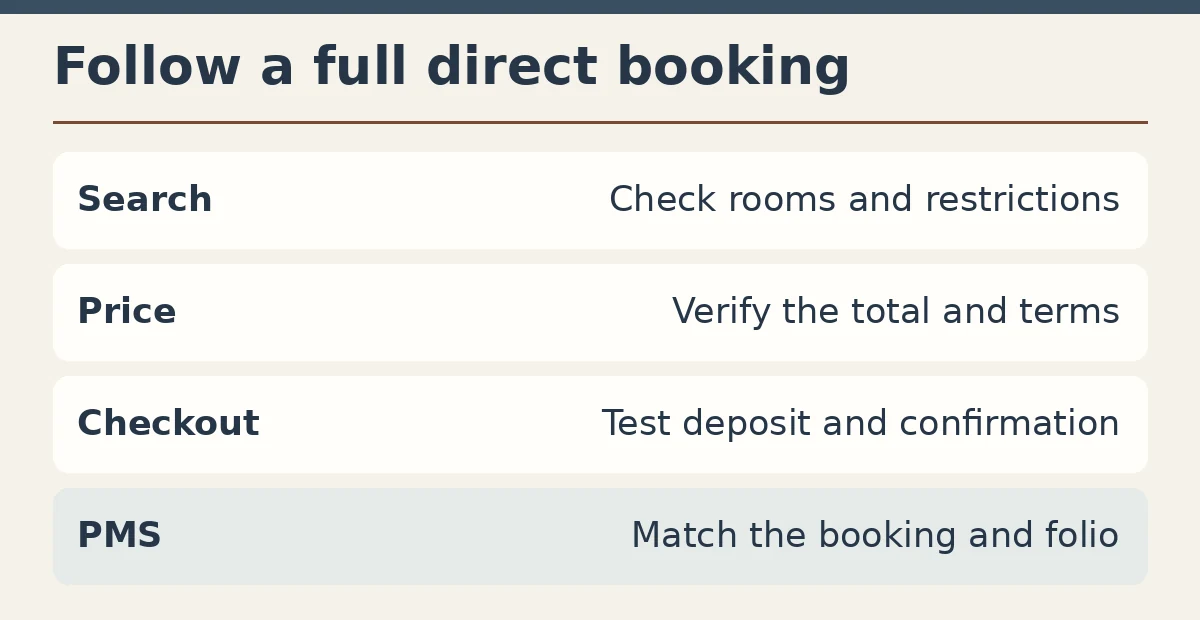
Compare guest and front-desk workflows together
Make a reservation, change its dates, then simulate a full or permitted partial cancellation. Confirm how inventory and room rate data are passed to the PMS. Check the reference in search, receipt, and staff view. If a guest makes more than one room reservation or enters a special request, see which fields arrive where the hotel expects them. Ask how errors are alerted and who can intervene.
Ask the vendor to demonstrate how booking decisions translate to payments. Check the property’s methods for deposit, preauthorization, balance, refund, and payment failure. Use safe test data. Find out which provider processes the payment and how the hotel reconciles the result. Compare how safely staff can handle a correction under the hotel’s own roles and procedures. Clarify who assists the guest if its booking receipt and folio differ.
Model the total cost of generating one direct booking
Ask about subscription, implementation, per-booking fees, revenue share, payment charges, and integration. Include the hotel’s advertising and staff costs where appropriate. Compare costs on similar booking counts and values. If a vendor charges for cancellations or bookings generated using a partner, include that in a utilization scenario.
For illustration, a $225 monthly engine and an added $1.25 charge for each of 180 bookings total $450 before related fees. Divide by actual eligible bookings or stays for a clearly labeled unit cost. A subscription showing a lower monthly total might include fewer payment or distribution tools. Get a written list of what is required for your chosen workflow.
Check analytics with privacy and reconciliation in mind
Agree on the events the property needs to measure, such as search, availability, start checkout, completion, and cancellation. Ask how the website and engine pass attribution across relevant domains and whether data can be collected under applicable consent. Test that a booking is counted once during the demo. Compare results from the booking engine with confirmed stays in the PMS rather than treating any one marketing report as final.
If the engine offers guest profiles or abandoned booking outreach, verify the communication consent and rules for data retention. Ask how data is shared and which fields the hotel can export or delete. Keep transaction identifiers separate from unnecessary personal details in reports. Get permission and privacy questions reviewed by the appropriate personnel before launching the workflow.
Use a clear selection and rollout test
Give every provider the same list of guest scenarios and score accuracy in the property and booking systems. Set priorities jointly with the front desk and finance staff. Review uptime, support coverage, and fallback steps with the vendor. Check the hotel’s work to map rooms and offers, change website calls to action, and monitor errors during launch.
After going live, compare the first confirmed reservations with the hotel’s target rates, room counts, and records. Keep a log of failed transactions, uncertain confirmations, and support responses. Test modifications and cancellation again once systems settle. The best booking engine for the property should let a guest see and reserve the right stay while reducing the staff work needed to correct avoidable errors.
Simulate a room search that changes dates and occupancy
Try a Friday-to-Monday booking with three adults and a child. Confirm which rooms can host the group and what happens if the guest changes the occupancy and stays an extra night. Use one refundable rate, one nonrefundable rate if the property offers it, and a package. Compare how the price and rules appear before checkout. Test both an ordinary room and a room the property markets for particular accessibility features. Verify that the vendor can describe those features accurately using the hotel’s approved content.
Run the same booking on a desktop and two representative mobile layouts. Test what happens when a page is refreshed during checkout and when a confirmation message arrives later than expected. Ask how the property can tell whether a booking was created once or twice. Give the employee the same confirmation and check that its policy, charges, room type, and dates match the PMS. These details matter more than a fast demonstration on a single empty browser.
Compare distribution and marketing costs on a realized stay
For a fictitious period, assume 150 direct bookings, 18 cancellations, and 132 completed stays with consistent attribution. Calculate total engine and relevant payment costs first. Then divide by 132 if the question is cost per completed stay. Ask whether canceled bookings change your bill and whether a promotional discount should be accounted for separately. Compare against other distribution channels using completed revenue, expenses, and the actual mix of rate plans.
Ask the vendor what happens when a travel marketer drives traffic to the property website but a guest completes a booking later or on a different device. Obtain a written description of the data available and check it against applicable permissions. Ask finance to verify the booking revenue independently. Missing attribution can matter, but a dashboard count should not be used to duplicate hotel revenue or replace the accepted booking records.
Verify changes to language, currency, and policies before launch
If the hotel serves guests outside the United States, ask how the engine displays currency and whether it charges in the displayed currency. Compare only proposals that can represent your actual policies consistently. Check translations and clear descriptions of what is included. A vendor might provide templates while the hotel remains responsible for configuring and maintaining effective terms.
Set up a test for an updated date, a new mandatory fee, and a canceled booking. Assign who will own the configuration and who can correct it. Save examples of confirmations for the finance and guest service teams. Ask how the engine displays a new booking policy for dates after a change. Review the proposal with the actual people who will update inventory and support guests so the selected software fits both the sales process and the staff workload.
Follow a failed deposit through both systems
Use processor-approved test data. Make a fictional booking where the original payment request is declined and the guest is allowed to try again under the configured workflow. Confirm when inventory is held, when it is released, and how the guest learns the final booking status. Ask the vendor to show how failed and successful attempts are distinguished when a front-desk employee searches for the booking. Verify payment records without relying on a screenshot that includes account information.
Repeat with a payment recognized by the processor but a delayed confirmation. Test what the hotel can check before asking a guest to try again. Have staff identify the status by booking and transaction reference using authorized access. Confirm the right support contact if the engine, processor, and PMS report different statuses. Decide what booking status or error triggers an alert and who will work it during a busy evening. Use the same demonstration with each vendor.
Model a booking flow that reduces last-minute surprises
Ask how the engine presents room occupancy, rate, required fees, payment schedule, and cancellation. Compare initial search results with the final reservation. Have a staff member evaluate how easy it is to explain a price change when the guest adds a night or another person. Verify how free or separately charged options are described. If promotional rates are available, try the same search with and without the code in the intended booking flow.
A cancellation test should produce one cancellation confirmation, a change in availability, and the payment decision appropriate to the policy. Ask who must act to process a refund if it is not automatic. Check that the amount and date reach finance. If one vendor cannot handle an important exception, estimate staff time needed for a manual process before comparing proposal prices. Include the effect on support at hours when the desk has fewer employees.
Evaluate the property’s next season before pricing the engine
Use a forecast for room nights, completed stays, transaction volume, and marketing effort. Ask each vendor to price the same normal and busy months. See how charges vary when the hotel opens a seasonal special or adds a small property. Ask whether standard features, integration fees, or commitments change at a volume threshold. Compare what work is required to configure rates and terms for the next season.
After launch, check the accuracy of the first invoice, baseline guest funnel, and booking totals. Meet with staff to identify which routine exceptions still need a workaround. Use booking records and customer reports to verify that written terms and available inventory remain aligned. A useful digital booking tool should make the guest’s decision clearer and the hotel’s operation easier to audit.
Ask which pages hand the guest to another provider
Follow the browser from a room description to checkout and receipt. Ask where the hotel can change terms and who owns the message after a guest books or abandons the flow. Confirm which domains and integrations are actually needed and use approved test data to check handoff. A good demo also shows the response when the booking is created but the confirmation email arrives late. Save the reservation and receipt identifiers so managers can diagnose discrepancies without asking the traveler to share payment details.
Connect this comparison to the rest of the hotel
Check where rates originate and where another system receives them. Many direct booking costs depend on the property’s package, so compare the guest journey and the back-office invoice together.
For related decisions, use the hotel property management software guide, the hotel software pricing worksheet, and the hotel revenue management guide.
Sources consulted
Federal Trade Commission — Unfair or Deceptive Fees Rule FAQ