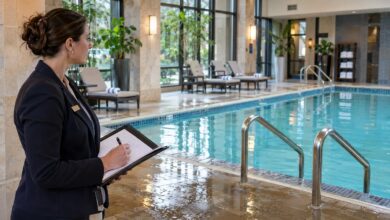
At a hotel, a guest might allege an injury near the entrance, a meeting organizer could claim damage to equipment, or a vendor might ask for a hotel to be insured under a contract. A hotel liability insurance quote should identify which business, premises, and operations the proposed form covers. Review general liability, umbrella or excess liability, and any separate coverage for hotel activities. Compare how the written forms would treat the same incidents before comparing the annual premium.
Describe how guests and contractors use the property
Give the broker a list of buildings and operations. Include restaurants, bars, pools, gyms, meeting venues, airport transfers, parking, and any retail or event space used by outside companies. Explain what the hotel owns and manages, the legal names that operate each activity, and which contracts allocate responsibility. Ask which entities and locations appear in the quote and where you can confirm them in the issued policy. Give every broker the same facts about recent changes or claims.
A third-party meeting organizer may hire the hotel’s event room while a caterer serves alcohol and other companies supply equipment. Ask what each party is expected to insure and who is responsible for reporting an incident. Ask the hotel broker to identify endorsements needed to meet a contract, such as additional insured status when applicable. Keep event agreements separate from insurance certificates so a manager can find both the responsibilities and the evidence of coverage.
Compare the limits and aggregate language
A general liability proposal can contain an each-occurrence limit and one or more aggregates. Ask how the aggregate applies to the hotel’s locations, and what happens if several losses draw on it during the same policy term. Review any separate retention, deductible, or defense-cost treatment. Ask what the carrier would evaluate if a claimant alleges injury and property damage from the same event. Request the relevant definitions and compare them across policies.
Suppose an illustrated program shows a $1 million each-occurrence limit and a $2 million applicable aggregate. If $1.6 million has already been charged to that aggregate in the term, $400,000 would be left for claims subject to it under the simplified example. Ask which costs reduce the applicable limit and whether a quote can structure the aggregate by property. Read the actual terms when there are shared facilities. An umbrella could involve distinct requirements.
Ask which hotel operations need separate protection
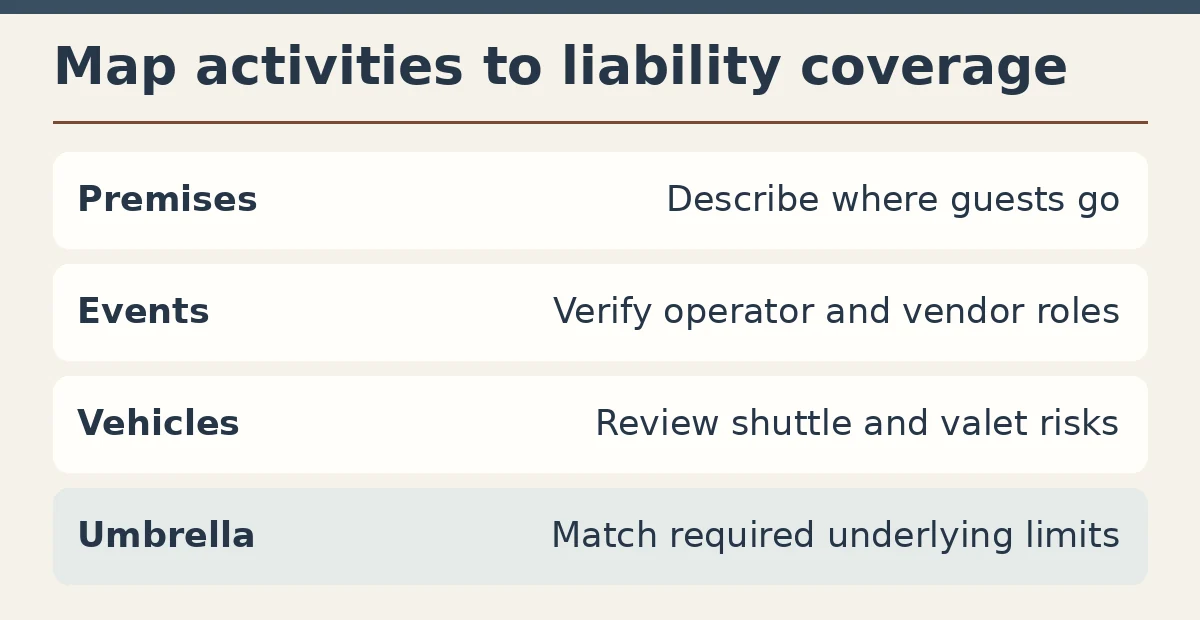
Alcohol service may raise a liquor liability question. If the hotel handles guest vehicles, review valet and garagekeepers coverage needs with the broker. A shuttle raises commercial auto questions. An employee injury should be evaluated under the relevant workers’ compensation rules and program. Ask which forms your policy uses for a pool, gym, special event, and contracted activities. Compare an example for each major operation. The buyer should be able to identify the main policy that responds to the type of loss being considered.
If employees handle booking records or payment information, examine cybersecurity liability and response costs separately. Ask about notification, interruption, and liability for a data incident and which events would qualify. Identify the contracts and vendors that process data. The general liability program and a cyber policy can have different investigation and reporting rules. Record the contact information before a real incident, then verify it whenever the hotel switches providers.
Align umbrella coverage with the actual underlying policies
Send the broker the proposed general liability, auto, and any other policies the umbrella should sit over. Ask what minimum limits the umbrella requires and which forms, entities, and activities it recognizes. Compare its exclusions and check whether a policy that generally follows the underlying form takes a different approach to a specific risk. Ask about notice when an underlying carrier changes. Record the attachment amount and the maximum available for eligible claims.
Here is a practical quote test. A hotel adds a shuttle provider midterm and also switches auto companies. Ask whether the umbrella recognizes the resulting auto policy and how notice should be made. Then ask which parties must be insured on the shuttle contract. If a lender or franchisor requires a stated level of liability coverage, send the written requirement and the proposed insurance evidence to the relevant parties before signing.
Read contracts from the hotel’s perspective
Collect the agreements for leases, management, events, and contractors. Identify the exact insured entity and whether the agreement asks for ongoing operations, completed operations, a waiver of subrogation, or other provisions. Ask the broker and a qualified adviser to review relevant contract terms. The same phrase can require different documentation under different policy forms. Request the applicable endorsement and learn how to verify it when issued. A certificate can summarize the policy’s information, while specific rights depend on applicable forms and agreements.
If the hotel is named on a vendor’s policy, confirm dates and operations and whether the coverage is available to the hotel under the relevant endorsement. For recurring vendors with multiple sites, obtain appropriate proof and verify the current records. Keep a renewal list so proof can be updated without waiting for a special event. Ask what happens if the vendor uses a subcontractor or someone else performs the work. Document what each party agreed to.
Use a consistent claims scenario to check quotes
Describe a guest fall at the entrance during rain. Record the people involved, date, area, and who maintained it. Ask brokers which policy conditions they would review, how defense works, and what records would be useful. Use another scenario that involves a people-intensive activity, such as an event vendor providing service in a meeting room. Ask which facts are needed about the contractor and premises.
Document each carrier’s explanation of retained costs and exclusions. Then compare the full yearly price. If a less expensive quote excludes something the hotel actually offers, request a revision or price an appropriate separate policy. If defense costs affect limits, compare how the hotel would fund a substantial claim. Put both numbers on the same worksheet so a renewal discussion can focus on the practical difference instead of a percentage premium change.
Train managers to preserve claim information
When the hotel learns of an incident, follow established procedures to assist guests, protect privacy, and report the incident promptly. Document facts accurately and keep relevant records such as shift logs, maintenance checklists, and contractor correspondence using authorized processes. Ask counsel and the carrier about preservation directions and what can be shared. Keep one record of which insurer or broker has received notice and when. Staff should know who can issue statements or authorize a response.
After buying coverage, check the issued names, limits, exclusions, policy period, and endorsements. Ask who takes a call after hours and how the hotel should report an incident that may involve several carriers. Review the policy when an activity changes or a new property opens. A useful hotel liability insurance quote should show why the coverages fit the exposures staff and guests face day to day.
Test the transition from a quote to a vendor contract
Before approving an event, give the broker the current contract, named parties, event dates, and operations that are contemplated. If an outside company is handling parking, ask what the hotel needs from that business and whether the activity is accepted under the hotel’s own policy. Obtain relevant proof and check the carrier, date, legal name, and endorsement. The event schedule is the common fact used by the hotel and vendor insurance teams.
If dates or activities change, update the file. A catered menu and a separately operated bar may have different operators and responsibilities. Get a written answer about the intended change. Ask how the policy treats multiple event sites if a courtyard or other location is added. Compare the additional insurance cost with the venue’s potential revenue. Record the contact who can check the policy details before staff open the new area to guests.
Check how renewals account for seasonal operations
Prepare a list of when the pool, shuttle, and events normally operate, along with any maintenance closures. Ask the broker how it reports the exposure and whether expected sales, occupancy, or payroll affect the estimate. Disclose planned new operations, including an activity managed under another agreement. If a new quote assumes work is no longer offered, make sure the assumption is correct before you use the price.
For a hypothetical hotel adding a small meeting room, an inexpensive package may quote the room but require an additional form for a planned event. Ask what is covered during setup days and teardown. Request an example of an incident that involves the hotel and two different contractors. Compare the coverage that applies during the whole event period, including any contract conditions the hotel is responsible for satisfying.
Prepare a timeline for a claim involving more than one company
Ask the front desk where it stores an incident report and which manager receives notice. In a dry run, have the manager assemble witness contact details as appropriate, the maintenance log, the agreement, and an account of who was responsible for the area. Follow the hotel’s privacy and preservation procedures. Record the insurer notification channel and avoid unnecessary sharing of the records. Have an authorized employee verify how the carrier handles urgent questions.
If the broker says a vendor needs notice too, ask what agreement controls that obligation and who is responsible. Check the deadlines and list the parties with access to the record. After the exercise, ask brokers which details assist their evaluation of the same incident. That review can reveal whether the quote assumes a different operator or excludes particular work the hotel relies on. Use the findings to update the written information behind the next comparison.
Confirm which policies handle a guest’s property
Write down how the hotel receives guest luggage or accepts items at the front desk. If the hotel issues a receipt or uses a storage room, tell the insurance adviser. Ask which form, if any, would evaluate an allegation of missing property, property damage, or a loss involving a third-party service. A high liability limit on a proposal leaves many practical questions about what property it protects. Discuss the scenarios and the policy terms together.
A valet service or an event vendor may take possession of other people’s property. Identify each party, its contract, and the insurer the hotel would notify. Compare the actual terms quoted and document exclusions or specialty coverage. Train staff on the hotel’s claims process without asking them to make coverage decisions. If the activity moves to a different location, confirm the exposure and review which insurer receives notice.
Record day-to-day decisions that affect the liability quote
Maintain a dated list of operating hours and service contracts. If the hotel takes on a recurring event or adds a new location, provide the information to the broker early. Request an example of how the insurer would handle a potential claim under the current form and a new proposal. Track any supervision or insurance obligations for third-party managers in their contracts. Review whether the hotel’s processes actually meet those obligations.
For a property comparing two offers, separate insurance premium from staffing and vendor costs. A proposed form may rely on a change to an event or activity. Draw up a realistic operating budget reflecting that change before accepting it. Use the higher-risk examples to check any umbrella or excess carrier as well. Confirm that the company shown on the accepted proposal is the insurer issuing the contract, and review the file with someone who can verify the facts for the next term.
Connect this comparison to the rest of the hotel
A single event can raise an allegation from a guest and interrupt hotel operations. Compare the property and liability forms with the hotel’s reporting plan so staff can identify which company needs each set of facts.
For related decisions, use the hotel business insurance quote checklist, the hotel property insurance and business income guide, and the hotel insurance resources.
Sources consulted
Insurance Information Institute — Understanding commercial package policies