
A hotel can have the right number of physical rooms and still be unable to honor every confirmed reservation. An agency can sell a room while an inventory message is in transit, a modification can be hard to distinguish from a new sale, or a local room status can change without reaching the channel manager. A workable hotel channel manager overbooking procedure helps a duty manager stop the shortage from spreading, reconcile the source data and take care of the guest. It should also give staff a clear way to decide when the affected inventory can safely be sold again.
Establish the affected room type and dates
Find the number of physically usable rooms in the affected type for each night. Subtract rooms blocked for engineering, approved holds and confirmed reservations as appropriate. Account for extended stays and room moves. A four-night arrival can lose its assigned room on only one night and still need a new plan for the whole reservation. Confirm which beds, accessible features or other conditions were booked. Do not infer that a different category shown as available matches what the guest needs.
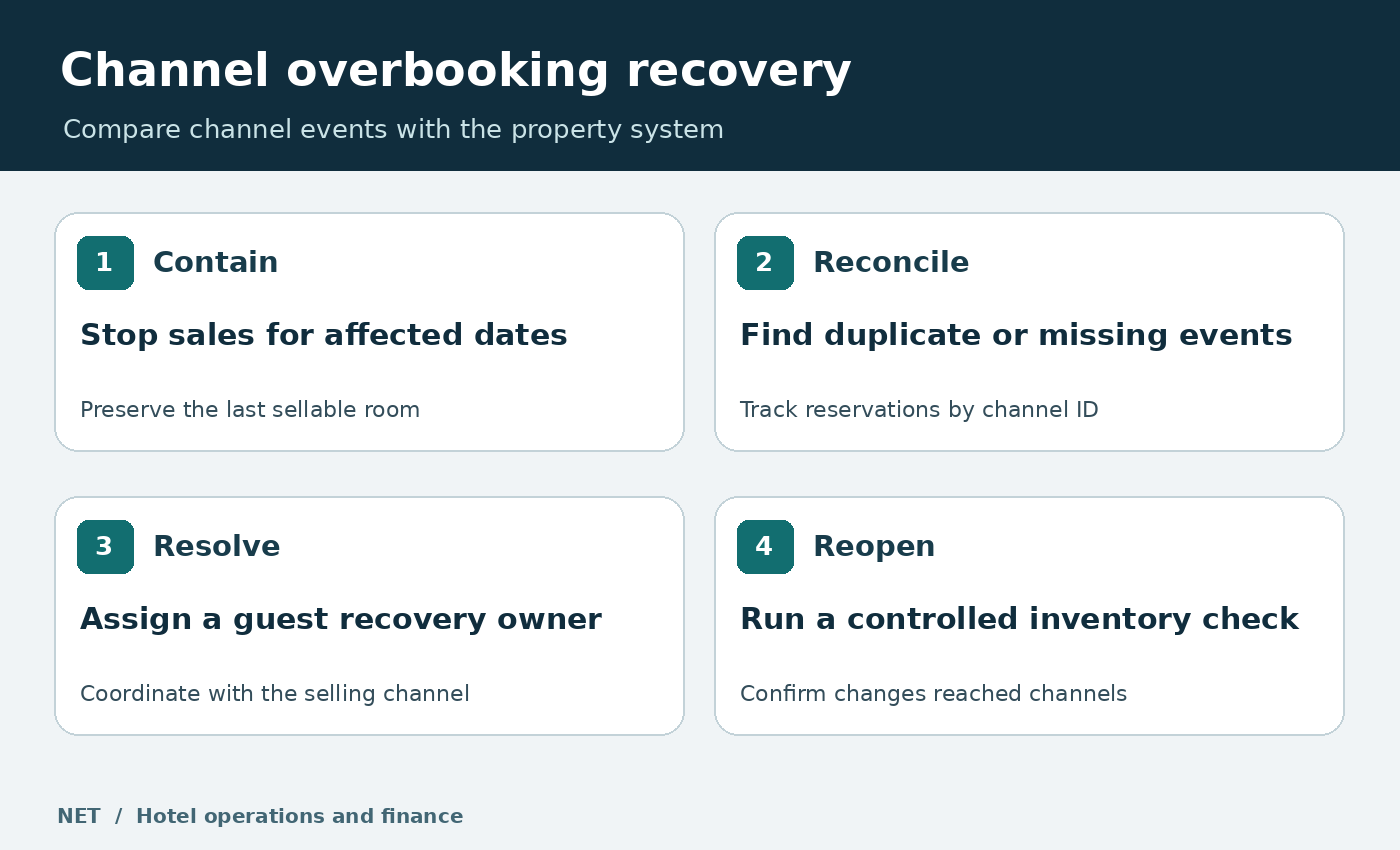
Assign the person who can stop sales for affected dates. Use the smallest appropriate restriction under the hotel’s procedures and document which systems were changed. Confirm that the restriction reached the relevant selling channels. A front-desk change in the property management system may not update all partner displays promptly. Record local time, time zone, affected room types, property and staff roles. Save the necessary status and operating records under appropriate access controls. Keep guest identity and payment information limited to staff who need it for resolution.
Reconcile events without cancelling a valid reservation
Start a working register with the source channel confirmation, property reference, status, affected dates and room types. Label whether each event is a new reservation, modification, cancellation or duplicate notification. Two entries with matching guest names can be separate transactions and two messages with the same case can reflect successive states. Review each channel’s latest confirmed record. If a status remains uncertain, ask the vendor or channel through its normal support route and give them the appropriate reference and timeline.
Booking.com's provider documentation describes how acknowledgement works for some integrations. It illustrates why the property’s view and the channel’s view can differ while a provider processes reservations. Ask what the hotel channel manager logged, which events the platform persisted, and how it handles a retry or recovery. Leave any provider-side reprocessing to authorized support and use observable reservation records to resolve the hotel file. Document what you can confirm and who is investigating the remainder.
Work a one-room shortage across weekend dates
Assume a 60-room hotel has ten deluxe queens and two go out of service for a weekend. On Saturday, eight of the eight usable rooms are booked in the PMS. A selling channel shows another confirmed reservation with a unique reference that the PMS does not yet show. Treat the event as a realistic one-room shortage while verifying it. In the same feed, a different booking may show a modification followed by a cancellation. Reconcile that status without treating the two messages as two additional occupied rooms. Counts must correspond to actual confirmed room nights.
Suppose a premium queen can cover Saturday but is already occupied Sunday, and the guest needs two nights. The first open room you find does not solve the whole stay. Check the agreed features and dates and discuss appropriate options under the property’s recovery procedures. Contact the selling channel and management early when other properties are also full or the hotel cannot offer a comparable room. Assign one person to respond to the guest and obtain any approvals, so the front desk issues no competing promises. Confirm adjustments with the guest only when the property can deliver them.
Coordinate guest recovery and payment
Follow the property’s agreement with the selling channel and its guest recovery policy. Check who may approve an upgrade, transfer, refund or relocation, and who pays each amount. Confirm travel distance, accessible features, dates, rate and payment handling with any alternate property. If a relocation is approved, record which company is responsible for transporting the guest and which company will invoice the hotel or other party. Avoid giving staff more personal information than they need. Record what was offered and confirmed, while their guest-facing message focuses on the practical arrival plan.
Reconcile the final reservation in the PMS, selling channel and payment system where appropriate. An update at the desk alone can leave an agency stay active and potentially affect settlement or other obligations. A voice confirmation might need to be followed by a change through the channel’s approved process. Verify what happened to deposits, payments and optional charges. Attach the appropriate booking and transaction identifiers to the incident and report unapproved financial adjustments through the property procedure. This gives the next shift a reliable view of the stay.
Reopen sales through explicit operating checks
Have staff verify the physical sellable count with housekeeping or engineering. Confirm reservations and correct room mapping with the PMS. Confirm the channel manager has published the intended availability, and inspect the state of the relevant channel or approved test view. Check that the change is effective for all affected plans and dates, including length-of-stay or occupancy restrictions. Record who approved reopening. If the vendor is still investigating a mismatch with only one room left, ask how the property can validate capacity safely without creating an uncontrolled reservation.
Agree on a limited fallback if the incident cannot be fully resolved on the current shift. Record which nights stay restricted, what report staff will review, who owns the next provider escalation, and when the temporary process ends. If staff are told to check inventory manually, specify what to compare and when to call the next person. A vague instruction to monitor does not provide a usable operating procedure. Look for confirmed receipt of updates after any mapping repair and record whether later messages or overrides changed the result.
Calculate incident cost and look for patterns
Separate guest counts, room nights, direct cost and lost contribution. If the hotel relocates a $150 booking to a property charging $190 and also provides $28 in transport, the illustrative incremental direct cost is $68 if the hotel pays the difference and transport. Include any actual concessions or taxes as appropriate. A vendor credit or other reimbursement should be a separate row until confirmed. Reconcile the incident and accounting records to avoid adding a refund or credit twice. Track verified cost and pending estimates separately.
Group the incident causes by booking date, stay date, channel, room type and failure mode. Determine when the room went offline, which inventory change was last successfully transmitted, and where a valid reservation was first missing. Ask whether staff saw an alert and knew what to do. Capture responsibility for any corrective work. If the issue is a room-type mapping, require an approved test for a new booking, modification, cancellation and returned availability. A vendor saying that it has reset a connection is useful context. The hotel still needs evidence that the scenario now behaves correctly.
Keep a second scenario for the overnight handoff
In testing, set up a change where a different staff member receives the alert after the day shift has left. Give the night auditor the reservation reference and the last inventory snapshot. Ask them to identify affected room nights, contact the correct people and record what is still unknown. A simulated arrival with a late check-in and a prepaid deposit tests whether the payment handling and booking confirmation are linked. Have the next duty manager use the written record to continue without reconstructing the event from messages. Debrief on missing roles, required permissions and provider response timing.
Use a post-incident timeline with the signal, actions, channel acknowledgements, guest outcome and reopen decision. Time records should show the same zone or an explicit conversion. Where two independent clocks differ, preserve their original times and note the observed offset. Define a metric such as time from discovery to containment and time from containment to verified reopening. Review it alongside the seasonal booking volume so a change in incident count does not mislead the owner. Keep de-identified examples for training and avoid copying personal records to the training file.
Check vendor defaults that can magnify a mismatch
Confirm whether the system can sell several plans from the same inventory pool, whether it creates shared allocations and how it handles rooms that are out of order. Test a newly mapped room category in the vendor’s approved environment. A provider’s default booking limit may differ from the hotel manager’s assumption. Ask where the effective last-room rule appears, how values propagate and what happens when a new connection is enabled. If the hotel controls distribution for several properties, review who may modify limits for each property and whether reports make it obvious which hotel is affected.
Verify who can close the right inventory when the front desk is busy
Exercise the contact plan with two shifts. Suppose the evening manager knows how to close the affected deluxe queen rate in the channel manager but cannot access the selling-channel extranet needed to verify the result. Identify a supported on-call role instead of sharing credentials or depending on someone being reachable informally. Tell staff the safest temporary operating state while an authorized person checks the change. If the property receives a new confirmed reservation during that window, record it and follow the agreed response. Removing a listing for one room class may leave a separately mapped package rate able to sell the same room pool.
After the incident, compare the published inventory to the booked capacity under the hotel’s configured limits. Trace what happens to an extended stay, a cancellation and room return to service. If a change was sent from more than one system, identify the order and final source. An operator can often prevent a second shortage by clarifying which application is allowed to overwrite the count. Keep a written decision for each connection rather than assuming the defaults of one vendor apply to another.
For a recurring night with tight inventory, the review should specify what improvement the property expects to see. Examples include fewer unresolved acknowledgements, a faster first alert and verified sellable count across the same set of channels. Ask the distribution lead to check results after the next sellout and report remaining discrepancies.
Review best hotel channel manager software for procurement and reporting, hotel property management software for the operating source of room status, and hotel booking engine software for direct availability and guest confirmations. The overbooking record should show why the initial count differed and who had the information to safely reopen sales.