
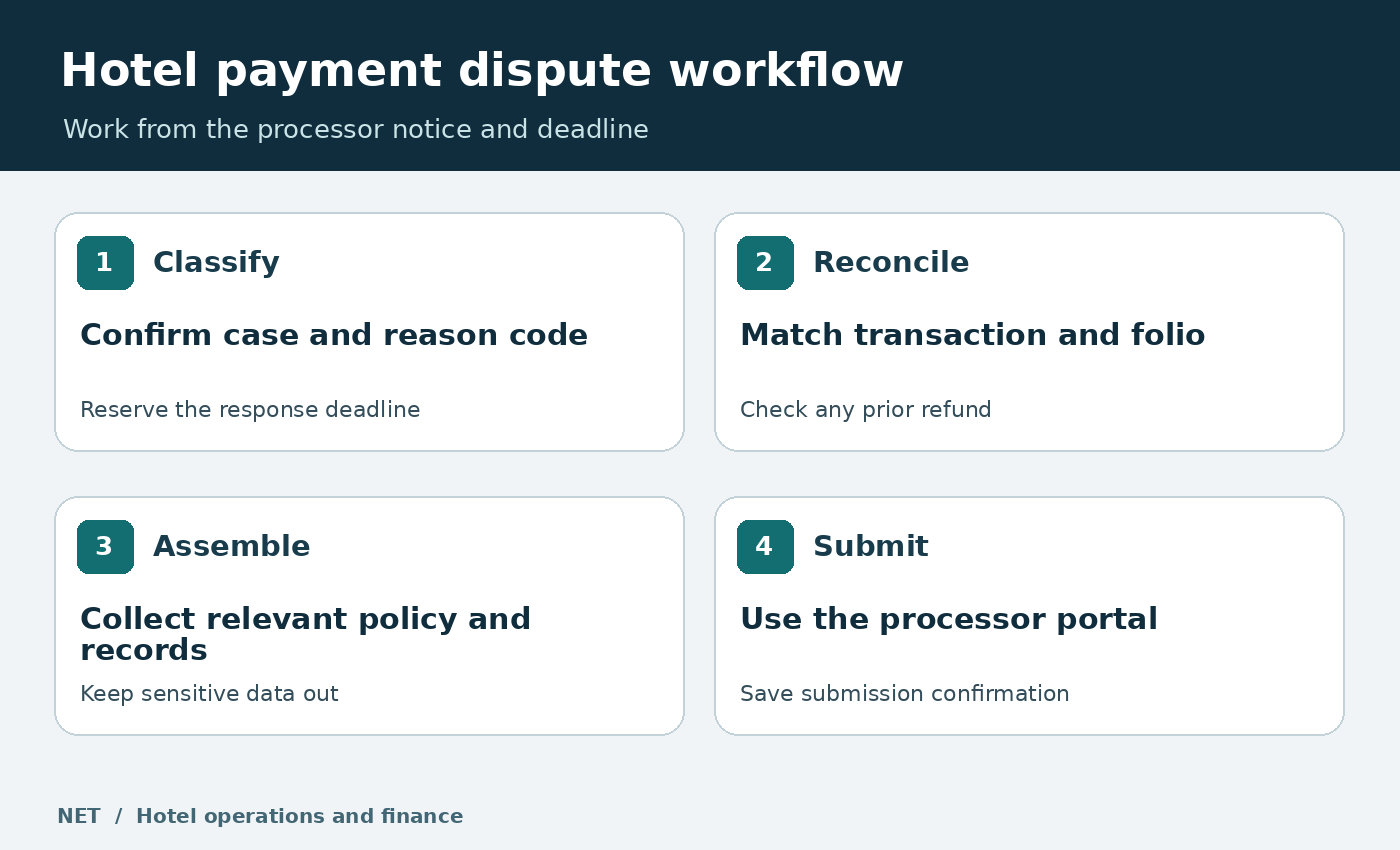
A hotel can receive a chargeback notice well after a guest left, when the booking confirmation, folio and payment trail sit in different systems. The response begins with the processor’s case and deadline. Then it reconstructs the specific charge, accepted terms, any refund and the events that support the hotel’s choice to respond or accept the dispute. A useful case file contains only relevant information and can be reconciled to the eventual settlement. Build the process before the night auditor has to assemble a response during a busy shift.
Record the notice and find the amount in dispute
Capture the processor case and transaction identifiers, disputed amount and currency, reason category, date received and exact response deadline in the applicable time zone. Use the processor’s authenticated portal and applicable contract for instructions. Timing, evidence and events vary by processing arrangement and network. Identify who can review and submit and assign a backup. Set internal review time ahead of the deadline. A calendar built from a general chargeback rule is a weak substitute for the actual notice.
Identify what was charged. A hotel transaction might be the original deposit, an approved no-show or late cancellation fee, the final folio or a different charge for incidentals. Review any authorization, capture and credit separately. If an agency arranged the stay, determine who was merchant of record and which payment method the hotel actually received. A virtual card issued for the booking can follow a different path from a guest payment. Ask the processor or channel to clarify the case through authorized channels before collecting unrelated records.
Reconcile the reservation and payment events
Match the property, booking reference, channel ID, stay dates, charge timestamp, currency and original capture. Check the corresponding PMS folio lines, applicable rate and any partial or split payments. A payment authorized on arrival may settle later, and a pending authorization can appear to a guest like a posted charge. Verify the transaction state against the processor record rather than reasoning from a screenshot or from the initial account note. Look for another record in the same amount before assuming there was only one capture.
Consider a $240 deposit with a $120 refund after the guest requested a shorter stay. A case arrives for the full $240 charge. First verify that the refund settled, and link its reference to the original charge. Check whether the amount is already reflected in processor activity for the dispute. If the hotel also took $75 on a separate transaction, identify its purpose and exclude it from this response unless relevant to the case. Ask the processor how to handle a prior refund and avoid double credit. Show the reviewer how the actual disputed balance relates to the original purchase and any hotel adjustment.
Match documents to the reason and booking terms
For a cancellation or no-show case, look for the policy version the guest was presented at the time of booking, the records that document acceptance, any confirmation and the time the guest cancelled or was expected to arrive. A current screenshot may be inaccurate if the hotel changed the rate plan after booking. A setting visible only to staff does not establish what appeared during checkout. Document whether the hotel’s actions followed its accepted terms and any applicable obligations. Ask the processor which records it expects for the particular reason category.
For a duplicate charge, prepare the references and timestamps of each transaction and match them to the relevant charges. In a service or amount dispute, confirm which components are affected, such as a deposit or an optional charge added after a price change. Preserve the written record of any customer resolution and avoid adding guest information that has no bearing on the amount. Write a chronological summary with source references. The case reviewer should be able to match the amount and lodging dates without needing the hotel’s entire reservation or accounting history.
Keep sensitive authentication data out of the case file
The PCI Security Standards Council explains that card verification codes cannot be stored after authorization, even in encrypted form. Use approved processor references and masked records as appropriate. Do not ask front-desk staff to collect or recover card verification codes for a dispute response. Check that exports, receipts and screenshots do not include full account information or adjacent reservations. Follow the hotel’s approved handling, storage and sharing process and the relevant processor instructions. Ask the hotel’s payment provider about appropriate reporting paths rather than moving payment data into a general spreadsheet.
Store the source material with controlled access and submit a scoped copy through the proper portal. If approved redaction is needed, preserve the relevant original according to the property’s retention rules. Record who reviews the submission, when it is made and the processor’s confirmation. Review the output screen if the portal limits the number of attachments or changes the order. Check that a file opens and still displays the relevant transaction reference. Set a follow-up reminder and continue watching the processing and bank records until the outcome has been reconciled.
Make the decision to contest or accept reviewable
Give an authorized reviewer the case reason, available support, any property error, amount and deadline. If the hotel made a duplicate capture or incorrectly applied its policy, route the resolution through the processor and accounting workflow. Do not duplicate credits by refunding through another route while a chargeback is under review without following the processor’s instructions. If the hotel contests, include only the supporting evidence needed for the transaction. A complicated group or long-stay dispute may justify additional review even when the initial arithmetic makes sense.
Use an internal decision record that identifies who approved the response and which alternatives were considered. Staff should be able to explain why an item is being contested without making assumptions about the consumer’s intent. Check if a policy exception, promised credit or manual upgrade changes the explanation. If a dispute is outside the normal authority of the employee handling it, escalate to the controller or designated owner before the response cutoff. Separate status in the hotel ledger from status from the processor. A submitted response means the case is pending until the processor communicates or posts an outcome.
Carry each case through settlement
Suppose the processor debits $240 of disputed principal and assesses a $20 fee. In the example, initial cash outflow is $260 before any later result. Depending on the agreement and outcome, proceeds or fees may be credited separately or remain charged. Use the actual statement rather than assuming a favorable outcome restores every dollar. Match the ledger entries for dispute principal, fees, any earlier credit and final settlement. If the original deposit was transferred from a reservation that changed dates, have accounting check that the corrected balance appears on the appropriate folio.
Maintain a monthly view of cases by payment source, property and status. Show original amounts, fees, staff effort, final result, and cases awaiting transaction adjustments. Avoid counting a chargeback as an ordinary refund if the hotel reports both categories and wants to measure operational loss. Review repeated issues separately. A confusing merchant descriptor, an old cancellation template or a series of delays issuing no-show confirmations may each suggest a different corrective action. Assign the test of that correction to the owner of the relevant system rather than asking everyone on the front desk to fix it.
Check that a booking policy can be reproduced
A useful exercise starts with an approved fictitious prepaid reservation. Record the checkout terms, booking date, confirmation ID and processor references. In the test environment, simulate a cancellation and compare how the original policy, adjustment and updated balance appear in each system. Ask a second employee to locate the same documents later using the case record alone. If the property updates checkout terms, repeat the test with an older reservation to verify that staff can still retrieve the terms actually associated with it. Limit the exercise to records and systems designated for testing.
Run a second case in which a group earns a partial credit after checkout. Validate the credit against the original capture, invoice revisions and recorded response. Test the mail or portal notification process using the hotel’s approved practice, and include the transaction currency on the worksheet. If a booking provider and processor report different dates, record one as the stay or business date and one as the payment or settlement date. A reliable handoff should make a difference of that kind explainable without exposing unnecessary records.
Plan for an exception after a change of processor
If the property replaces its hotel payment processing provider, check who retains access to processor cases for transactions that predate the handover. Record approved routing for late notices, refunds and statement adjustments. The team should know which legal or operating entity is responsible for the older payment and where it can retrieve the necessary documentation. Establish whether the hotel needs time-limited legacy access or approved exports. Update the training file when the interface, booking system, PMS or external payments policy changes.
Give the reviewer a one-page decision record
Build a cover sheet listing the exact amount under review, transaction reference, property, stay dates and processor deadline. Add one short chronological account that identifies the support for each event. Use the approved records and include the original capture, any refund reference and applicable terms. Do not attach data beyond what the processor needs. The person approving the response should be able to reconstruct the arithmetic before reviewing how the charge was described. Where something remains unresolved, mark it explicitly and assign a person to verify it.
Use the same record when an operating mistake is confirmed. Suppose a no-show fee had been planned but the guest’s cancellation was timely under the accepted rate. Verify the policy version and cancellation timestamp, then have the authorized employee decide how to handle the dispute under the actual processor guidance. Record whether a previous refund settled. That check prevents the property from treating the guest-service response and the disputed charge as unrelated finance work.
After settlement, add the outcome date, credited or debited amount, any remaining fee and where it was posted. Compare the case with the hotel’s recurring patterns and document one test or process change that would help prevent a repeat. A short verified sequence is more valuable than a large packet of unrelated receipts.
Use the hotel payment processing guide for broader merchant and settlement decisions, hotel booking engine software to trace the online terms the guest saw, and hotel property management software to track the folio. A ready response file identifies the case, reconciles the disputed amount, shows relevant support and explains how the outcome will reach accounting.