
A hotel’s purchase contract rarely describes all the cash a buyer will need. The seller is paid at closing, a contractor may need a deposit before opening, and the hotel still needs operating funds for payroll, supplies and the period before reservations translate into cash. SBA 7(a) and 504 hotel financing can serve different parts of that budget. Write down what each dollar will pay for, then ask the financing teams which uses are eligible and when the money will reach the project. That sequence gives a hotel owner a better comparison than starting with the advertised interest rate or down payment.
Separate fixed assets from the cash needed to operate
Build a project budget with independent lines for land, building, improvements, equipment, other acquisition consideration, closing costs and working capital. Attach a date, liable entity and source of estimate to each item. If the transaction includes goodwill or other business assets beyond the real estate, ask the transaction advisers to explain the purchase price allocation. Record seller credits and buyer money already deposited separately from cash still due. A financing team should be able to identify an eligible cost and its supporting document without reconstructing the purchase terms from one lump sum.
The SBA 7(a) program lists real estate, working capital and changes in ownership among allowed uses, subject to program rules and borrower eligibility. The SBA 504 program focuses on major fixed assets and excludes working capital and inventory as uses of 504 proceeds. If a proposed hotel deal needs both property funding and operating liquidity, determine what source can cover each use. A 7(a) lender or a 504 Certified Development Company can review the exact transaction against current program requirements.
Work the same hotel project under both structures
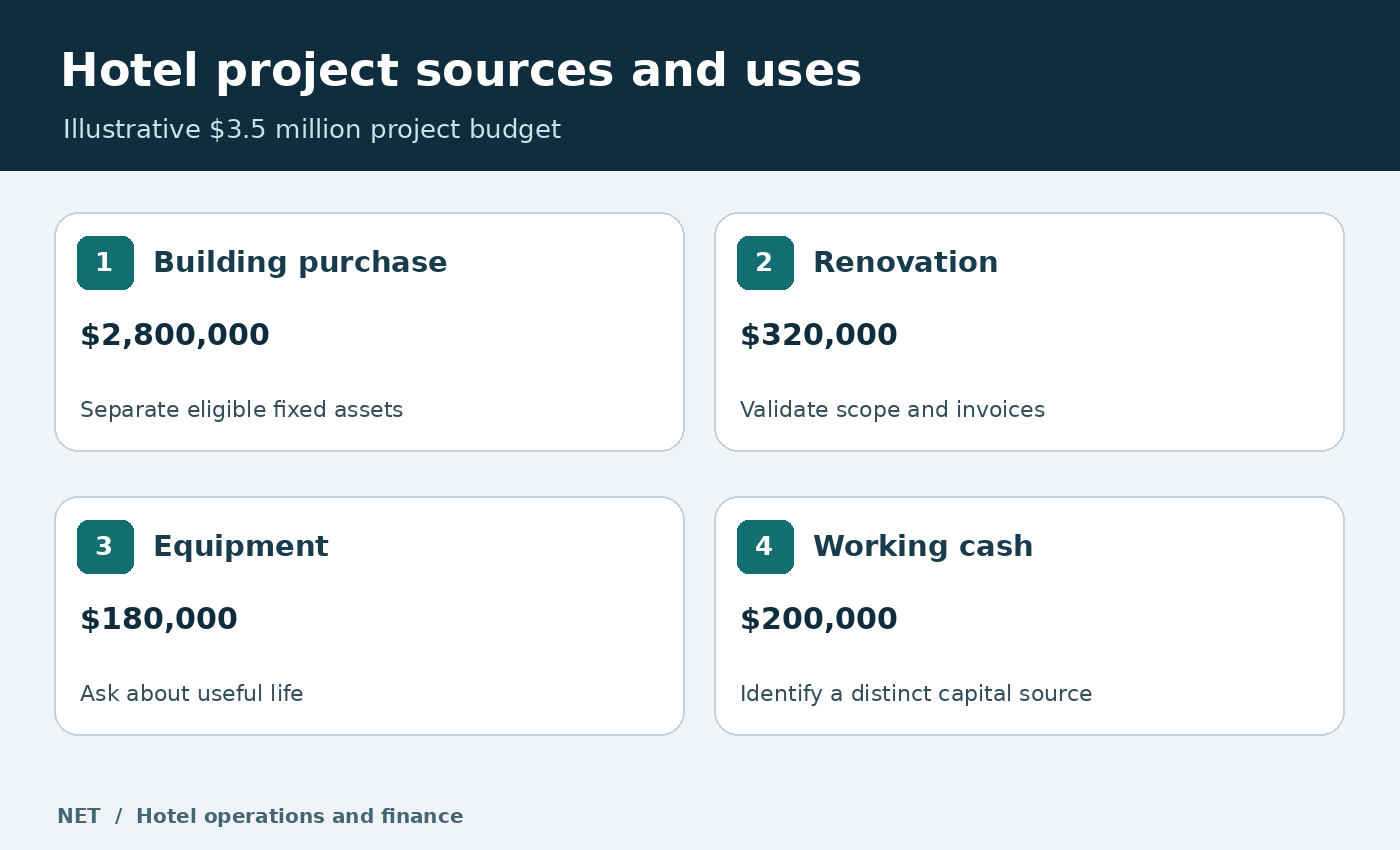
Consider an independent hotel with an allocated building and land purchase of $2.8 million, a $320,000 renovation, $180,000 of equipment and $200,000 of working capital. That totals $3.5 million before fees, contingencies and settlement adjustments. Have staff identify the items in each line. Long-lived installed equipment and supplies may receive different treatment. A required franchise upgrade might be reviewed as part of the fixed-asset project, depending on its nature and documentation. Keep the estimate, ownership details and timing at the line-item level.
If a lender and CDC conclude that $3.3 million of the budget qualifies as fixed assets, the proposed $200,000 working-capital use needs a separate source. A 7(a) proposal can be considered for more than one type of use, but its approved funding could still be smaller than the full $3.5 million. Ask both financing teams for their proposed dollar amounts, the uses they would fund and the amount the buyer would need at closing and afterward. If one proposal finances $90,000 more of the purchase but requires an extra $125,000 operating cash contribution and $20,000 more in closing costs, its cash demand is $55,000 higher in that example.
Ask who funds the renovation before each reimbursement
A renovation amount can be approved even if the contractor must be paid before funds are advanced. Define each milestone and the source of the cash that pays it. Put the expected draw date next to the contractor’s due date and record inspection or invoice requirements. If a 504 structure uses interim financing, ask who funds the interim advance, what it costs and what has to happen before the longer-term financing is in place. Ask the 7(a) lender how renovation draws and overruns would be handled under its proposal. Get answers for the same work and disbursement schedule.
Suppose an electrician requests a $65,000 mobilization payment at closing and the first draw is available only after work is inspected. The hotel needs a source willing and able to advance those dollars. Show when a receipt might reimburse the cash and who bears the expense during the gap. Model a two-week delay that overlaps with payroll, utilities, first debt payments and another vendor deposit. Ask whether unused renovation funds are restricted to project items. Cash held for another purpose may be unavailable when the operating account reaches a low point.
Track the first-month cash trough
A hotel may show positive revenue from the first week yet need to pay invoices before its merchant, agency or corporate-account receipts settle. Use daily or weekly balances in the first month and identify outflows for which no timing flexibility exists. Separate the working capital that is allowed by a proposed loan from unrestricted cash actually received by the operator. If a second entity owns the real estate, show which company receives and spends each planned source. Confirm each transfer with the people who approve it.
For example, a buyer begins with a planned $200,000 unrestricted balance. The hotel uses $35,000 for prepaid expenses and needs $40,000 for a renovation overrun it had expected to finance elsewhere. That leaves $125,000. If payroll, vendors and utilities require $95,000 before the first confirmed $45,000 settlement, the cash trough is $30,000. The end-of-month balance can look comfortable because it includes the late receipt. Bring both figures to the lender discussion. A clear cash forecast should show what would happen if a large receipt falls into the following week.
Compare repayment and restrictions on equal terms
Request written details of loan amount, borrower contribution, payment, amortization, collateral, fees, guarantees and reserves. Where a 504 proposal contains separate lender and CDC-related pieces, request the terms for each and calculate the combined payment. Ask which assumptions can change based on the property, project or borrower. Compare annual costs using the same opening date and business forecast. Include interest during construction, initial operating deficits, recurring franchise costs and any documented holdback. Identify which funds can be spent for normal operations and which require approval.
A seller’s historical hotel business may have different staffing levels, distribution expenses and capital needs from the buyer’s. Use operating statements, room revenue, taxes and channel costs to explain the change. If a franchise transfer requires a new brand fee or management contract, add it before calculating debt alternatives. A new room-rate plan rarely generates its expected income on day one. Make one low-demand case and another where work takes longer but demand is ready. The alternatives may need different funding sources.
Check business structure and eligibility directly
Give the lender a simple ownership chart for the buyer, operator and real estate company if these differ. Explain who occupies and operates the property and disclose relevant leases, tenants, management agreements and franchise arrangements. Ask each financing provider which current rules and credit policies apply. Have the lender specify how it views a particular structure rather than inferring eligibility from another hotel’s financing arrangement. A business acquisition may raise additional questions about which assets are being purchased and which document best describes each cost.
Maintain an eligibility and diligence file with operating data, support for the equity source, an annotated budget and signed transaction documents as they become available. If the seller offers a note, include its draft terms for the senior lender’s review. Ask how the lender will treat that funding and whether it requires changes. If a response is preliminary, keep it in a pending column with a date and contact. Do not add it to the funds available to close until the lender or other source actually commits to it.
Make the financing comparisons reproducible
Send the same sources-and-uses table to every financing team. For each row, request an amount, the expected availability date, conditions still to meet and the amount the owner must cover. When the equipment bid rises by $45,000, record which item changed and whether an earlier item should be removed. Ask the lender whether it needs a new review, what would change if it financed the extra scope and where to enter any difference in estimated payment. Carry the change into the post-closing hotel budget as well as the closing worksheet.
Set a deadline for obtaining any separate working-capital commitment. If the prospective lender expects documents from the buyer, assign them to the controller, title agent or adviser who can deliver them. At the last review, ask what would happen if a contractor invoice arrived early, a required escrow increased, or a funding source came in short. For a material risk, state what capital or changed scope could address it. Funded fixed assets and operating liquidity age differently on a calendar, and the last version of the budget needs to show both.
Decide which structure the property can support
One financing route might suit the real estate while leaving the owner to assemble cash for the first months. A second proposal might cover more uses under one structure while changing buyer contribution or payment. Compare the signed terms, lowest unrestricted cash balance and expected financing timetable. Be explicit about what would change your choice. A committed additional source, better evidence of stable demand or a smaller first-stage renovation can move the result. A preliminary quote and an approved loan remain distinct records.
Read the hotel financing options overview to compare conventional alternatives, then use the hotel acquisition financing guide to model the full cost to close. If a brand conversion is part of the transaction, the guide to hotel franchise financing covers improvements and franchise expenses. Your decision should survive the moment the acquisition budget becomes a schedule of actual payments.
Review a mixed-use invoice before it reaches the closing team
An equipment vendor might quote a $120,000 total for guestroom units, installation, a multiyear service plan and supplies. The hotel should ask for a breakdown. The fixed asset, labor needed to place it in service and other amounts may be treated differently by the funding sources. Decide how each line will be paid if the lender approves only part of it. Keep the proposal and updated quote side by side so the lender can identify an eligible cost without guessing where it appears on a general invoice. Do the same for temporary accommodations, preopening wages and promotional spending when preparing the working cash plan.
Prepare a fallback worksheet for financing that falls short in one category by $75,000. If the owner funds part of it from working cash, rerun the first-month cash trough. If it postpones a project line, ask operations whether the postponed work affects the first bookable dates or meeting obligations. If a separate loan is proposed, check whether both sets of documents permit it and when proceeds become available. A substitute source should be evaluated against the same project, repayment and liquidity criteria. A borrower can then explain the alternative in a meeting with one plan that shows which costs have funding and when labor and supplies are paid.