
A hotel franchise renovation can have three timelines at once. The contractor bills for work, the brand checks its standards, and the lender decides whether a cost qualifies for a draw. The dates rarely align perfectly. A property improvement plan draw packet should let everyone trace each request from approved scope through invoices, work in place and actual payment. Build the packet format before mobilization. Review it with the hotel controller, construction lead and lender so the first draw does not depend on collecting missing records while an invoice is due.
Match brand scope to approved funding
Start with the signed property improvement plan, current contractor estimates and approved loan uses. Give each significant piece of work a stable code, such as guestroom casegoods, corridor finishes, signs or fire system work. Record location, quantity, due date, responsible parties and the source of the requirement. A brand’s acceptance may depend on a specification different from an investor’s preliminary rendering. Check which company is responsible for paying each line and which amounts require a different source of funds. List out-of-scope and working capital expenses separately.
The FTC Franchise Rule Compliance Guide explains disclosure of estimated initial investment under Item 7. A franchise disclosure provides context for reviewing an opportunity. Verify actual project requirements, deadlines and costs from the applicable brand and loan documents. Obtain scoped bids for the hotel. Separate items such as freight, installation, taxes and hauling when the treatment or work schedule differs. Where a document refers to required renovations without itemizing the work, have the parties identify the exact requirements and where to confirm changes.
Reconcile the amount the contractor actually needs
Suppose the contractor bills $140,000 for completed and otherwise eligible work in an illustrative draw. The contract assumption for this example is 10% retainage on that amount. The project holds $14,000 and $126,000 is presently due. Record work previously billed, this period’s work, retained amounts, payments and reductions. Check the payment application against the approved schedule, vendor obligations and the actual contract. Specific retainage percentages, waivers and conditions depend on the documents and applicable rules. Have qualified advisers confirm the terms for the project.
If the lender allocated $170,000 to this work category and has advanced $70,000, $100,000 of approved capacity remains in the category before any reallocation. The $126,000 invoice due would then leave $26,000 to fund from another agreed source or an approved budget revision. A larger unspent amount across the entire renovation may not be available for this category. Ask which approvals are required to move funds. Confirm whether the loan pays vendors directly, reimburses the hotel after payment or uses another process, then test who has cash when the invoice comes due.
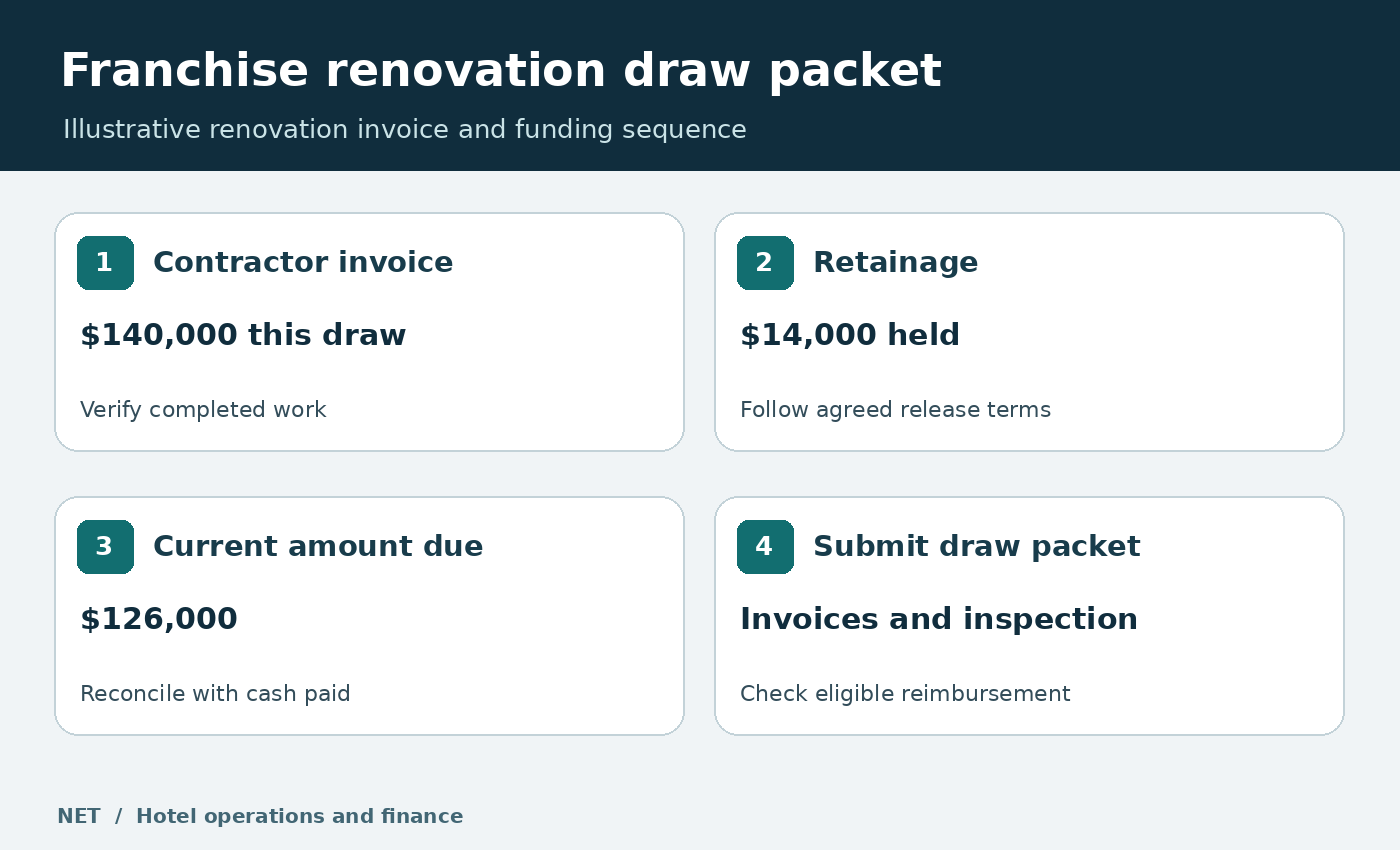
Design a packet a reviewer can trace line by line
Include a current request total, latest approved scope, draw history, inspections, invoices and required records of payment. Save the project sources and uses immediately before and after the draw. Use enough detail for the lender to identify the legal party, property address, approved cost code, prior draws and supports for the amount now requested. Map required lien waivers, inspection evidence and payment documents against the terms and applicable law with the lender and counsel. Ask what has to be conditional, what constitutes confirmation of payment, and when each item is due.
Track off-site material separately. A furniture shipment may be in a warehouse while the installation is planned for a later month. Ask whether the lender covers materials stored at that stage and what insurance, title or delivery documents apply. When a single invoice bills work on two locations or floors, allocate each portion to the correct schedule and preserve the underlying bill. Review items paid through deposits so they are not advanced twice. A controlled list of invoice numbers is more useful than attempting to reconstruct funding from balances alone.
Review a substitution before adding it to the next draw
Create a change register with price, effect on completion, scope, funding owner, required approvals and status. If a supplier discontinues an approved floor finish, the brand may have to review an alternative. If replacement materials are more expensive, the lender may require a revised budget and documented source. An owner contingency is a plan to cover uncertainty. A lender’s approval of the original scope does not establish funding for an unapproved substitute. Keep the proposed amount in a separate column while approval is pending.
Assume a $32,000 change delays corridor completion by five days. The investor originally reserved $80,000 of contingency. Check both the available dollars and conditions for approval. If 16 rooms would have been sold nightly at $125 and no substitute rooms can cover the gap, five days equates to $10,000 of gross room sales exposure in the illustrative forecast. Lower demand, new rooms brought online or lost upsells may change the actual effect. The controller should carry the revised room inventory into the operating plan while the project manager updates the cost schedule. The change can affect both loan funding and the hotel’s ability to earn cash.
Make a reimbursement delay visible on the cash calendar
Start the calendar with unrestricted cash. Add dates and amounts for contractor payments, operating expenses, utility bills, payroll, merchant settlements, expected draw requests and likely reimbursements. Model a two-week delay in an inspection or draw while the hotel is still paying vendors. Keep restricted funds in their own lines and do not assume access without the necessary conditions. Ask the lender whether it provides a customary review schedule or a specific commitment for this request. A delayed receipt can cause a real cash shortage even if every cost eventually qualifies.
If a factory requires a $50,000 deposit and later credits it against a $140,000 invoice, show the deposit and credit together. If the hotel previously requested funding for the deposit, reduce the new request to the suitable amount and explain any difference. Work from the funding records and approved lender process. If the invoice also allocates retainage, apply the correct timing and contract terms rather than imposing the earlier illustrative percentage. Ask accounts payable to mark the revised cash due and verify the approved payment source before the final order is released.
Track repairs and sellable rooms along different paths
A room wing can be complete for a contractor milestone while furniture, housekeeping, inspection or inventory setup is still pending. Give the hotel manager the last day a space must remain out of order and the expected opening date, plus the approvals required to release it. Check who updates the property system and channel manager when conditions change. Zero out estimated room sales where the work limits real capacity. For multi-night reservations, test the entire stay, not only the night on which a room returns to service.
Update the demand forecast after each schedule change. List groups, high-demand periods and guests already booked, along with how the hotel would handle them if work continues. Include transition costs where supported, whether extra laundry, staff time or relocations. Compare the benefit of a partial release with the possible cost of additional weekend labor, applicable approvals and contractor restrictions. The best choice can depend on whether those rooms are likely to sell at a rate sufficient to fund the extra work. Share the decision and rationale with the team preparing the next draw.
Collect evidence for the final draw in advance
Ask what the lender and brand require before close-out. A project may have punch-list items, final inspection records, warranties, invoices, proof of payment or scheduled completion certifications. Give each unresolved item an owner and a date. Review retained amounts, expected vendor claims and unadvanced loan capacity with the contractor. Label disputes and unverified credits. Keep original invoices intact and retain dated adjustments. Do not treat physical completion as the release of all project funds until the required parties have confirmed the conditions.
Suppose the hotel has paid $18,000 of earlier materials deposits and an $8,000 credit appears near completion. Reconcile both to the actual vendor liability. If the credit is applied to another invoice, identify when it changes cash rather than counting it as money returned twice. Have the lender explain how to reflect the revision in a previously funded category and keep evidence of the response. Build a closing cash forecast that includes any unreleased retainage and last month’s operating expenses. A holdback may survive the date when the hotel starts selling the rooms again.
Confirm who can change scope, dates and funds
Ask the project owner to write down who approves scope, who verifies completion and who can commit additional owner funds. Show when brand approval and lender approval are both required. A contractor may need a rapid answer while material is held, but a cost should not be recorded as eligible on a promise from the wrong person. Maintain a single archive for the as-approved budget and the source supporting each subsequent revision. Schedule a check after the final draw to confirm bank transactions, contractor balance and outstanding obligations.
Test a second draw without changing the scope
Use the past draw to check a different combination of timing and eligibility. For example, an approved $75,000 delivery arrives on April 22 but installation is scheduled for May. The owner funds a $20,000 deposit and the vendor requests the remaining $55,000 on delivery. If the lender only verifies installed items for this line, list the immediate $55,000 balance and any interest or new working cash needed before reimbursement can occur. If the lender instead accepts approved stored items under particular conditions, ask what record documents compliance. Track the amount applied to this budget code and check eligibility again if materials are stored in a different location.
The hotel can protect its forecast by writing a milestone date for each receipt and obligation. The field team should not have to infer from a cash worksheet whether rooms are ready, just as the accountant should not infer reimbursement eligibility from a photograph. Call out shared dates and dependencies explicitly. When the controller closes the week, compare actual room availability and vendor payables with that version of the schedule.
Retain a record of approved exceptions. If a particular inspection occurred remotely or a supplier issued a revised invoice, show how the reviewer accepted it and what is still required at the next milestone. A past exception can be useful context without creating permission to assume that all later draws can be treated the same way.
Read the hotel franchise financing overview to budget improvements and brand fees, hotel financing options to compare borrowing structures, and hotel commercial mortgage to review long-term reserve and loan terms. The renovation file works when a reviewer can trace every requested dollar and the hotel can show how the same project affects rooms sold, guest service and available operating cash.