The premium is easy to copy from a hotel property insurance quote. The more consequential number after a hailstorm may be the cash the hotel must provide before repair work can proceed. A percentage deductible can be based on insured value or another amount specified in the form. A roof may also settle differently from the rest of the building. Evaluate the quote using a realistic repair scenario and a date-by-date funding schedule. This approach helps owners choose a reserve amount, compare renewal terms and ask questions a premium comparison alone cannot resolve.
Establish the cause of loss and the deductible basis
Collect the proposed declarations, deductible endorsements, limits and valuation provisions. For every requested scenario, record whether the insurer applies the deductible to windstorm or hail, a named storm, a specified location or another defined event. Find the endorsement that defines how the deductible is calculated. Possible bases may include a scheduled value, an applicable limit or another contract-defined amount. Record a minimum or cap only if it appears in a document. Get answers in writing from the broker and request the form number, because the same percentage can create different cash exposure under two proposals.
The Texas Department of Insurance commercial property guide describes common commercial property forms, covered causes and differences between replacement cost and actual cash value. The hotel’s insured causes of loss depend on its form and endorsements. Flood, wind-driven rain, damage from hail and water coming through a prior roof defect can raise different questions. Prepare a building-by-building map showing what your hotel actually owns or leases, plus the coverage source for each location. A managed hotel with another party’s insurance should reconcile the policy with the lease or management agreement before relying on the owner’s stated deductible.
Work through a single loss using three terms
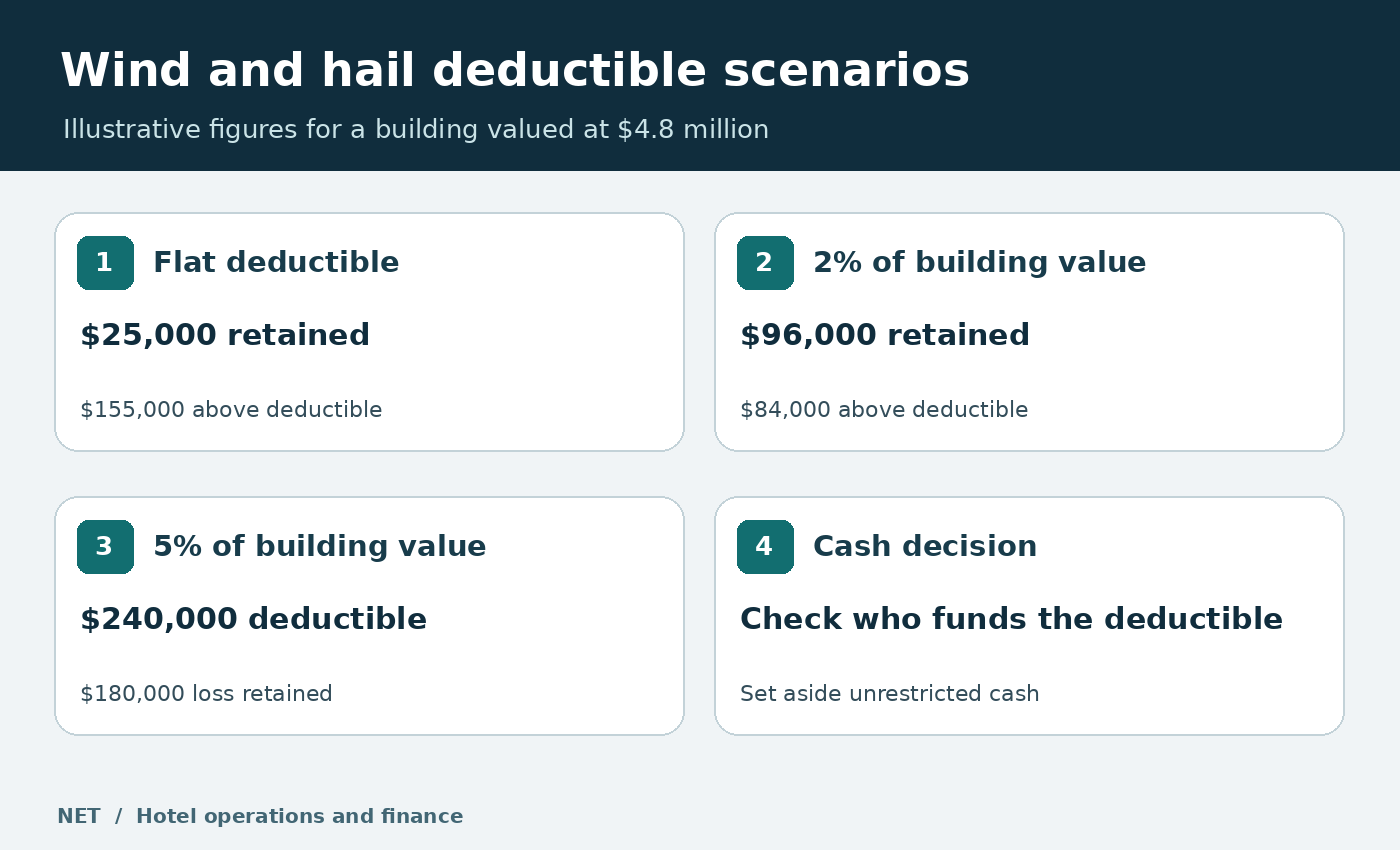
Assume that the relevant building value is $4.8 million and the illustrative covered damage estimate is $180,000. The deductible basis for both percentage options in this exercise is explicitly the stated value of this one building. A $25,000 deductible leaves $155,000 above the deductible. A 2% deductible creates $96,000 of retained exposure and leaves $84,000 above the deductible. A 5% deductible amounts to $240,000, which exceeds the example loss. Under that simplified scenario, the hotel retains all $180,000 of that loss. The arithmetic excludes any other settlement terms, sublimits, coverage disputes or taxes.
Now consider a $450,000 damage scenario while retaining the same contract assumptions. The amounts above the deductibles become $425,000, $354,000 and $210,000 respectively. The flat and 2% forms differ by $71,000 across both examples once the damage is above the 2% deductible. The 5% option behaves differently because a loss below the deductible may be fully borne by the owner. Ask the broker whether a single storm affecting the guestroom building and conference wing applies one deductible or multiple amounts and how the proposal defines the locations and occurrence.
Add roof valuation and timing to the comparison
Ask how the proposal treats different roof ages, materials and conditions. A roof-specific endorsement may affect valuation, coverage or deductible and may require a separate scenario. Ask the broker to show a settlement example for storm damage to a roof that is 18 years old, using a documented repair scope and the actual proposed language. Confirm the treatment of labor, materials and any assumptions used to calculate depreciation. If a recovery of depreciation requires completed work or supporting records, include the possible timing gap in the cash plan. The claim valuation and the contractor’s billing schedule may not match.
Keep a repair history that distinguishes roof installation, restoration, coating, inspections and patch work. Preserve invoices and dates, plus any warranty terms. If a broker asks for evidence of replacement, share what work was actually performed. A contractor invoice for waterproofing certain areas may not support a statement that an entire roof assembly was replaced. Accurate information makes proposals easier to compare and helps the property team estimate near-term repairs with or without an insured loss.
Keep coverage questions apart from the repair scope
A storm can damage a roof membrane, signage, outdoor equipment, landscaping and interior finishes during one night. Record each item separately and note the suspected mechanism from the qualified contractor or investigator. Ask which policy section applies to business personal property such as furniture in the affected guest rooms and which costs involve debris removal, code upgrades or temporary protection. A combined contractor estimate can be useful for cash planning. To review coverage, separate the components, record dates and keep assumptions identified. Ask how an adjusted scope changes the expected deductible exposure.
When a hotel must reduce room capacity for repairs, compute the operating impact independently. Closed rooms matter to room revenue only when they change what the hotel could have sold or the rate it could have realized. Identify the room blocks at risk, compare expected occupancy and rate and record mitigation expenses. Confirm whether any business income or extra expense coverage is relevant, including applicable waiting periods and policy conditions. Keep management’s operational estimate in the project budget while the insurer assesses policy treatment.
Compare the annual price with cash you can actually access
Suppose the flat deductible option costs $64,000 annually and the 2% option costs $52,000. The difference is $12,000 per year under these offers. The 2% option can expose this property to as much as $71,000 more in deductible cash for one relevant loss, under the stated example. It would take roughly six years of the stated premium difference to accumulate $71,000 before considering interest, renewal changes or more than one event. That simple ratio does not estimate storm probability. It tells the owner how large the funded reserve would need to be if it accepts the higher retained exposure.
Include realistic restrictions. Mortgage agreements and ownership arrangements can limit when capital reserves are available. A balance in a lender-controlled account may require approval and cannot always cover a contractor deposit tomorrow. Have the controller identify unrestricted funds, any committed owner contribution and approved financing. Model the cost of carrying the reserve as part of the renewal decision. Add a second scenario involving back-to-back storms or an interruption in group bookings, especially if two properties rely on one owner reserve.
Set triggers and assemble the broker packet
Keep an appraisal or statement of values, current property list, limits, deductible endorsements, roof history, recent inspection findings and known maintenance needs. Record the stated value source and when it was prepared. List planned renovations and affected square footage. If a project expands an insured building, revisit the value and track how a percentage applied to the new value changes the projected cash retention. If the loan requires certain deductible limits, verify them against the quoted structure before considering the premium. Keep the underwriting submission consistent across carriers.
At renewal, ask the broker to model two disputes before binding. First, what would happen if the main building and detached laundry suffered damage from the same storm? Second, how would the roof provision interact with interior damage following a covered event? Record the policy reference and any unresolved facts the broker would need. Share the summary with the owner, general manager and controller, keeping quote documents accessible during a storm. The finance team should know who authorizes emergency funding and which invoices must be held for the claim file.
Turn a quarterly reserve review into a funding plan
Start with an amount the property can draw without violating any governing agreement. Where the same owner has multiple hotels exposed to one storm, list separate policy deductibles and the maximum amount the group can fund simultaneously. A per-location reserve that appears comfortable in isolation can be exhausted by concurrent contractor deposits. Assign a second owner to verify the availability of cash before a policy is renewed or a project uses it. Document any leverage or approvals required so the manager on duty does not depend on a discretionary loan during emergency repairs.
Imagine a contractor asks for 30% of the illustrative $180,000 work before ordering roof materials. The initial invoice is $54,000. If the hotel also needs $16,000 for safe temporary stabilization and guest relocations, at least $70,000 would be needed quickly under those assumptions. A booked reserve of $100,000 that includes $65,000 restricted by the loan has only $35,000 freely available. Check whether the lender will permit access to its escrow, and keep that expected transfer out of immediately available funds until the restriction is cleared. Add scheduled payroll, utilities and outstanding invoices to the same calendar.
At each review, list known changes in the roof, insured values and capital budget. Test the same damage amount at last year’s and current insured values if the percentage deductible uses that value. A rise from $4.8 million to $5.1 million changes the illustrative 2% deductible from $96,000 to $102,000 even with the same percentage. Confirm that the value basis actually changes under the form. Revisit the floor for unrestricted cash when roof work makes rooms unavailable or when a lender asks for a separate reserve.
Ask the broker to identify what changes in a proposed policy would alter the funding schedule. A different waiting period can affect a business income scenario, and a change to the roof valuation clause can widen the gap between settlement and a contractor’s price. Use one sheet for the dates and amounts, a separate ledger for reduction in rooms sold, and the exact policy form references beside both. The owner can then compare quotes with the same storm and repair assumptions instead of guessing which changes the premium has paid for.
Decide when a lower premium is sustainable
A high deductible can fit the budget if unrestricted funds can cover the retained loss while the hotel pays its normal obligations. It becomes harder to justify when the apparent savings are allocated elsewhere, a lender covenant conflicts with the structure or roof terms make the settlement uncertain. Compare proposals using a fixed scope and a second downside scenario, and write the reserve amount and funding owner next to the premium. If the cash cannot be committed, revise the terms or the funding plan before renewal.
Use the hotel property insurance cost guide to compare the rest of the premium drivers, hotel property insurance for the broader property and business-income terms, and hotel business insurance quotes to normalize renewal submissions. For the actual policy, confirm the applicable form and ask a licensed broker to check the figures. The illustrative worksheet provides a repeatable cash test for the owner to bring to that discussion.