
A hotel can make every scheduled mortgage payment and still face a large balance due at maturity. That final payment has its own calendar. A replacement lender must review hotel results, obtain reports and meet closing conditions before the existing loan is paid. An extension can have a notice date weeks or months before the payoff. For a hotel commercial mortgage refinance, start with the binding deadlines and net proceeds. Work backward to the last day each dependency can be satisfied without risking the close.
Confirm the date that controls each obligation
Find the note, recorded security documents, later modifications, servicing instructions and any separate extension terms. Record the maturity date, recurring payment dates, procedures for notice and lender contacts. If the borrower inherited the terms through an approved transfer or a prior renewal, verify which document controls each obligation. Ask whether notice requires calendar or business days, which delivery methods are acceptable, and who must acknowledge receipt. Put the earliest applicable deadline on the owner’s calendar as soon as it is verified.
Request a current principal balance and an indicative payoff that covers interest through a proposed closing date, any applicable charge and the expected treatment of restricted balances. An indicative figure has assumptions and may become stale. Request final directions from the appropriate parties before funding. Put payoff, fees, taxes, initial escrows and other closing uses on separate lines. An escrow may be applied at settlement, held or returned later. Use written confirmation to decide which projected amount can reduce the cash the owner needs at closing.
Build a calendar counted back from maturity
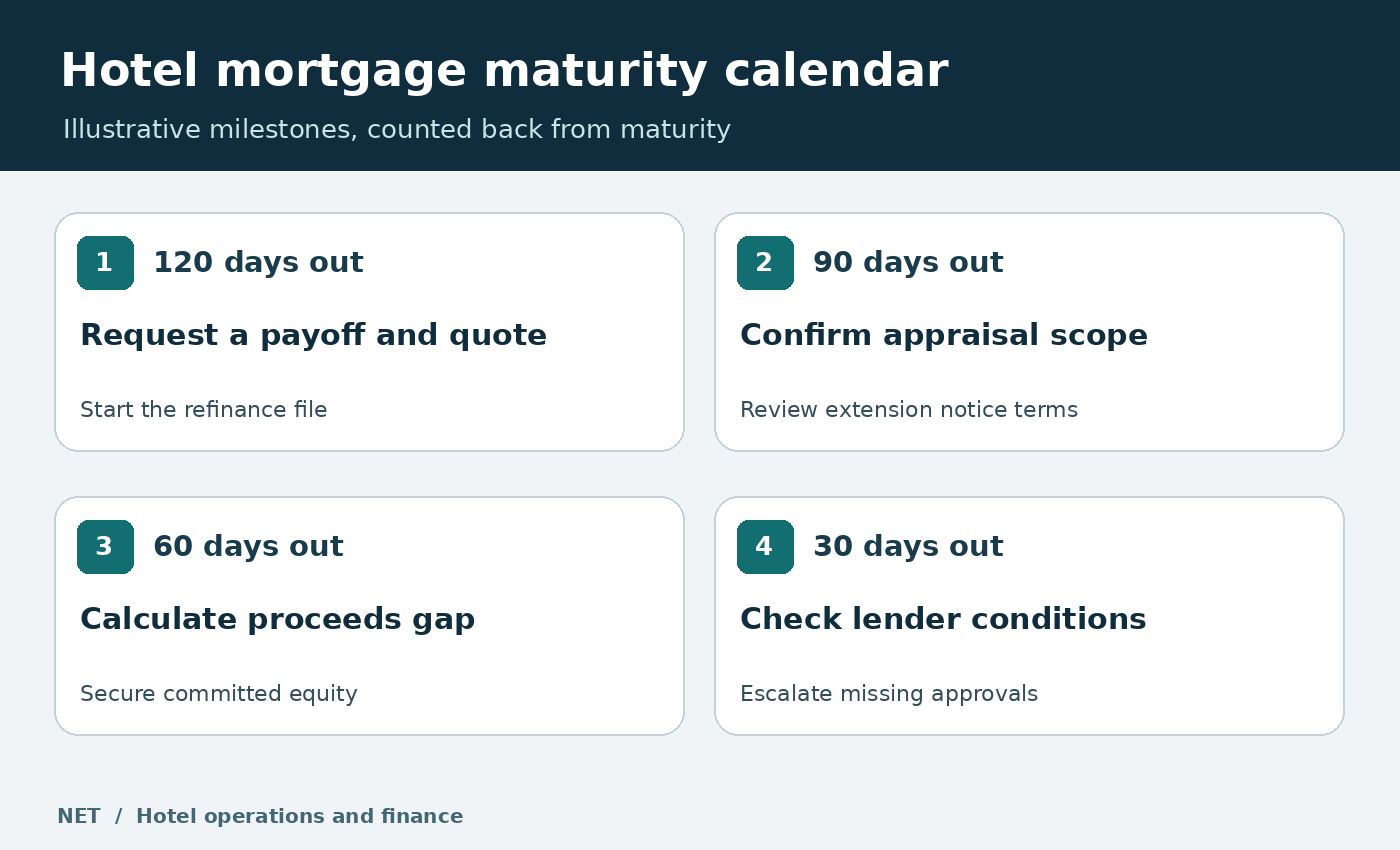
Around 120 days out, assign the refinance file to one owner. Gather recent operating statements, verified rooms revenue, recurring expenses, capital work and updated borrowing entity information. Give early prospects a complete version including significant replacement reserves, required brand work and costs expected to change. Around 90 days out, verify appraisal dates, inspections, decision timing and any extension notice. Get a written list of the reports and documents each lender needs. These intervals are planning examples and a more complex deal may need much more time.
Around 60 days out, reconcile prospective proceeds with the payoff and the minimum owner contribution. Verify who can commit cash, how it can be transferred and how much notice the investor needs. Around 30 days out, check remaining conditions against named contacts. Title requirements, surveys, insurance, entity approvals and documents from an outside partner can move independently. Assign them due dates and verify the necessary order. A deadline in the calendar should identify what must be delivered, accepted or funded. The words refinance closing by Friday do not establish that all three are possible.
Calculate refinance proceeds after fees and reserves
Assume a hotel expects a $4.1 million payoff and has a preliminary $4 million new loan offer. It expects $72,000 in closing and financing costs and $110,000 in initial reserves. The new loan would leave $3.818 million for the existing lender. The modeled equity gap is $282,000. If the outgoing lender is expected to return $45,000 of restricted funds ten business days after closing, that inflow does not reduce the settlement requirement. If $45,000 is instead confirmed available to apply at the closing, show it separately on the sources schedule.
Ask the new lender for its most recent estimated sources and uses. Distinguish funded costs deducted from the proceeds from sums payable separately. If an initial loan amount looks sufficient, calculate what can be applied to payoff after the lender collects fees and holdbacks. Ask the controller to run a lower proceeds case before the appraisal is completed. If the property needs $282,000 from the owner, a financing adjustment of $150,000 raises that contribution to $432,000 absent other changes. A conditional capital offer should remain pending until the investor commits and the funds can be delivered.
Compare property NOI and underwriting cash flow
Build a reconciliation from the trailing twelve months to the amount the lender will use. Include recurring management and franchise expenses, capital reserves and any documented adjustments. Match room revenue in the PMS to accounting totals and explain major differences. A convention month may create exceptional income without supporting a higher ongoing level of performance. Show how comparable operating periods and the current booking record inform the forecast. A borrowing entity may also incur expenses outside the hotel operating statement. Record which entity owns each item.
Suppose accounting NOI is $560,000 and the new lender deducts a $65,000 annual reserve in the example. The resulting lender-defined NOI is $495,000. Against $410,000 of annual debt service, coverage is about 1.21 times. If the lender requires 1.25 times on these same definitions, the offer falls short of the modeled test. The owner can ask about supported adjustments, different terms or a smaller loan backed by more equity. Obtain the lender’s actual calculation. Different offers may use different expenses, debt service periods or minimum ratios, so printed ratios only make sense next to their inputs.
Evaluate extension economics separately
Review any contractual option, required notice, projected interest after extension, fee, paydown and escrow contribution. Confirm how the lender assesses eligibility and who has to approve it. If there is no option under the contract, a borrower may still request an accommodation under the lender’s practices. The FDIC's interagency guidance describes supervisory expectations for prudent commercial real estate accommodations and workouts. The request itself does not promise approval. Treat the existing maturity date as operative until the proper approvals and agreements support a change.
Model an example in which an extension provides time but requires more owner funds. A three-month option could have a $25,000 fee and an additional $75,000 paydown in a particular term sheet. The owner would need $100,000 at the applicable date, beyond other scheduled expenses. Some of that amount reduces principal and should be reflected in the later payoff. Keep a timeline showing what will be paid to extend, what will be owed once the property refinances and whether funds for the hotel remain adequate. Bring an updated operating statement and cash forecast when the property’s case changes.
Keep third-party conditions and cash timing visible
Confirm which reports need physical access to guestrooms, public areas, equipment and records. Arrange dates with the hotel’s operations team rather than assuming an appraiser can tour occupied areas on demand. Share the actual lender insurance requirements with the broker and ask which items take time or require an endorsement. Ask the closing team which entity approvals and legal names need to agree across existing and future debt. Record the last acceptable date for each review, then escalate dependencies that cannot happen in parallel.
Check taxes, insurance premiums and any accrued amounts after the final closing date is known. A change of ten days can affect interest and prorations. Confirm how lenders and the closing agent will verify payment instructions, then use their approved process. Before the close, ask which documents will be available promptly, who will verify the old loan is paid and when the new payment schedule starts. After closing, reconcile actual unrestricted cash and the existing account’s status with the settlement statement.
Define an early decision point
At the first meaningful missed milestone, identify what changed. A late appraisal is a schedule risk. A different value can reduce proceeds. A lower operating measure can change the debt-service test, even if valuation remains strong. Assign an owner to update the model and state which fallback options still exist. A credible alternative might be a smaller refinance with committed equity, a qualifying extension or a sale that can close under the actual timetable. Keep preliminary conversations separate from accepted offers.
At least one review should occur early enough to meet any contractual notice deadline still in range. Prepare a concise file for the existing lender if the borrower expects delay. Include the current status, exact gating item, expected dates, updated results, solution to any cash shortfall and responsible contacts. Ask what information the lender needs to evaluate the request. Escalating while the owner still has choices is more useful than waiting for all documents and finding that the notice window has closed.
Check the hotel’s cash after settlement
Ask the controller to prepare a first-week cash view that excludes restricted funds and includes previously scheduled payroll, repairs and supplier payments. If the new debt requires a capital reserve or tax escrow, schedule the first deposit under the actual terms. A financing transaction can meet the old payoff while leaving the hotel without operating funds. Have the owner identify the source of that working balance before agreeing to a deal. Determine who compares actual receipts, reserve transfers and fees against the most recent forecast after funding.
Make lender comparisons at the same closing date
When two lenders offer different timelines, use the same expected payoff date first so their net proceeds can be compared. Then model each one’s earliest realistic funding date. An offer that closes sooner may reduce interest paid to the outgoing lender, while a later offer could require extension costs or a temporary contribution. Keep the date-specific payoff, loan costs, reserves and available equity beside the comparable lending terms. When a loan is expected to fund only after a brand inspection, put the inspection date and acceptance milestone in the lender column beside the headline rate.
Stress an expense that will survive both loans. For an annual capital reserve amount due in monthly installments, calculate the first payment after closing and include the cash needed through the first busy or quiet season. Ask if draws from the new reserve need specific approvals or cannot be used for near-term renovation. An old escrow release may arrive from a different entity than the one responsible for the new payments. Put the release and lender transfers on the accounting schedule. The hotel should be able to answer who holds sufficient unrestricted cash the day after payoff as well as who funds the transaction itself.
Document when the terms were provided and which have been confirmed in writing. Use the same spreadsheet version with the owner and closing agent. An updated appraisal or revised loan amount should result in a current calculation of the difference, with any earlier estimate retained for the record. This makes a late choice between replacement loans a comparison of actual available funds rather than competing preliminary offers.
Consult the hotel commercial mortgage overview for loan sizing and maturity terms, hotel financing options for replacement structures and hotel acquisition financing for a more detailed closing budget. A useful refinance file identifies the earliest binding deadline, the best supported expected net proceeds and the funds that can close the gap.