
A hotel bridge loan can finance acquisition work, guestroom renovation or the early period of a turnaround. The loan comes due even if the hotel needs more time to restore normal demand or a permanent lender requires a longer operating history. Before accepting a term sheet, estimate the payoff, permanent loan capacity and cash left to fill any gap. Update the same calculation as contractor dates, occupancy and projected expenses change. It is easier to choose a credible contingency while the hotel still has time to alter construction or raise equity.
Forecast payoff instead of borrowing the commitment figure
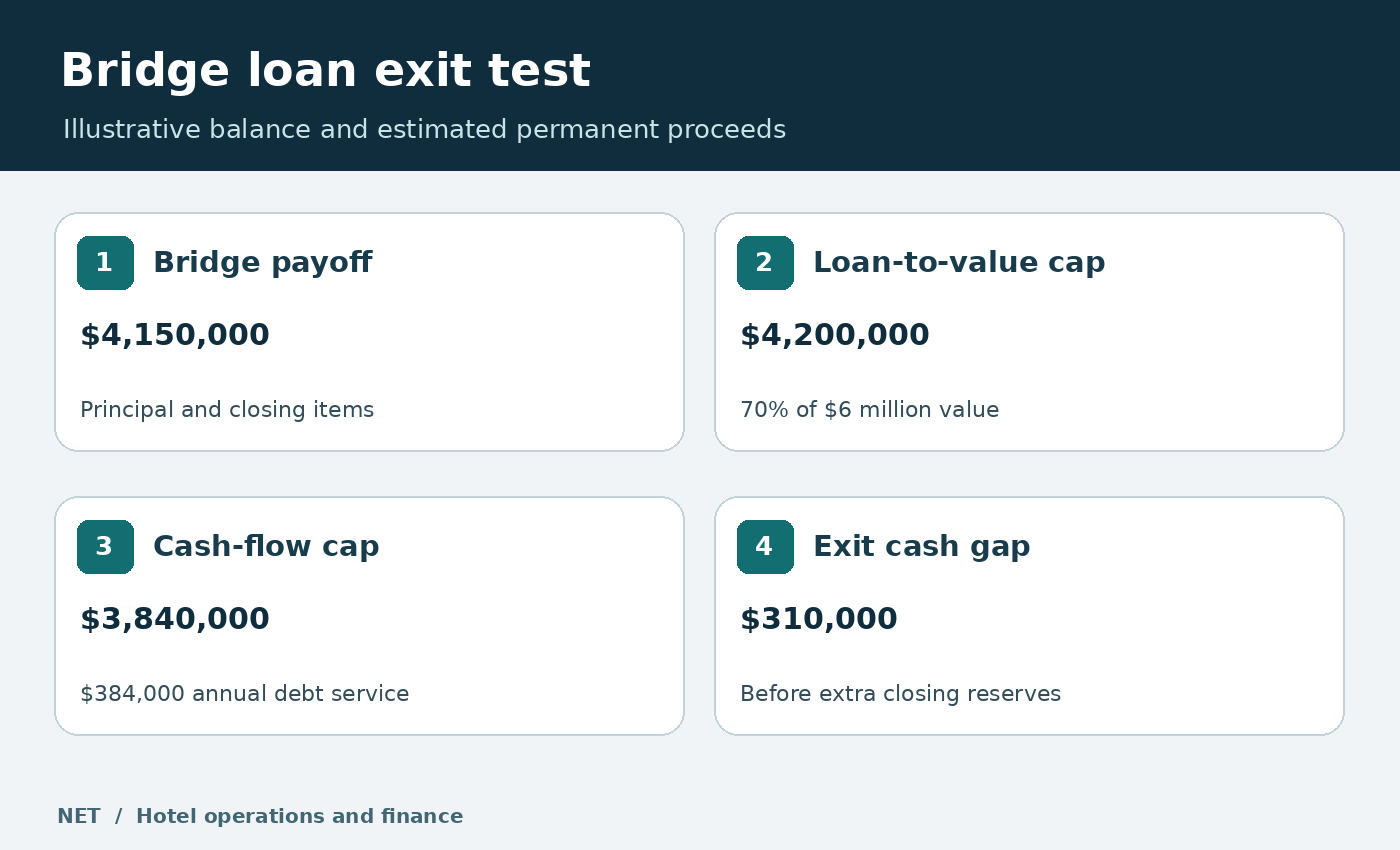
Build a timeline of expected initial and later draws, periodic interest, lender fees, escrow balances and costs due on exit. Ask the bridge lender how unused commitment, capitalized interest, extension or prepayment charges and restricted funds would be handled. Track which sources can pay costs at closing. A $4.5 million total line does not establish a $4.5 million amount due. If the owner expects to owe $4 million of principal and $150,000 of applicable interest and other amounts in an illustrative scenario, gross payoff is $4.15 million. New closing costs and reserves still need their own lines.
Request an indicative payoff early and an updated quote when the closing date is known. Estimate separate amounts for the base exit and for a delay. If the interest rate can reset, add a scenario for a higher cost and check when a reserve would be exhausted. If an owner has to advance the difference, identify its notice period and source of cash. Ask the servicer about required notice, dates on which funds may be sent and what documentation is required for release. Changes to these conditions can affect the schedule even when expected interest and principal stay close to plan.
Estimate two constraints on permanent financing
Discuss proposed underwriting with prospective permanent lenders. Ask which income they recognize, which recurring expenses or capital reserve they deduct and what period of operating history is relevant. The bridge estimate for a renovated property and the permanent lender’s acceptable cash flow can differ. Build each version on its own worksheet and show the reason for each adjustment. Then compare size under the valuation or loan-to-value limit with size under the debt-service coverage test. Model the binding limit for the scenario instead of averaging the results.
Assume an exit value of $6 million and a proposed loan-to-value ceiling of 70%. The model supports $4.2 million under that constraint. Suppose lender-defined annual NOI is $480,000 and the lender requires 1.25 times debt-service coverage. That permits $384,000 in annual debt service. If the illustrative annual payment factor is 10% of principal, the capacity is $3.84 million. The payment factor in this example includes the debt payments as a share of the loan amount. It is a modeling input and should be replaced with the actual offer terms. At the lower of the two ceilings, a $4.15 million payoff leaves $310,000 uncovered, before costs of the replacement loan.
Identify which changes would close the shortfall
If value supports up to $4.2 million but only cash flow is binding, calculate the results required for proceeds to match the existing loan. At the assumed payment factor, $4.15 million requires $415,000 of annual debt service. At a 1.25-times coverage ratio, that implies at least $518,750 of underwritten NOI, or $38,750 more than in the original model. The value ceiling still leaves limited space for closing costs and additional reserves. Ask the hotel team which rooms, rate improvements, recurring expense reductions or reliable demand would produce an incremental margin of that size.
Consider what a normal annual furniture reserve could change. If the takeout lender deducts $30,000 more than the owner assumed, maximum annual debt service at the same coverage ratio declines by $24,000. At the assumed payment factor, the cash-flow cap is $240,000 lower. Confirm how the actual lender applies its deductions. If the lender uses a different cash flow definition or calculates the ratio on a different debt service base, run a separate model and label it. The exercise reveals which assumptions need documentary support.
Tie the renovation schedule to actual sellable rooms
Keep a week-by-week schedule for key inspections, housekeeping readiness and the opening of individual room types. A floor can be physically finished while its rooms are pending furnishings, fire or building inspection, key access or setup in the hotel systems. Have operations and construction agree on the first day the hotel can accept a real reservation. List incoming groups and confirmed accounts with date and scale. Review the room count available to each major channel as inventory comes back online and the progress forecast changes.
A hotel might reopen in May but earn much of its income in June through August. A July bridge maturity may give the exit lender little actual post-renovation history. Identify how many operating periods will be observable before the lender’s cutoff and what it is prepared to review. If the hotel uses discounts to fill early rooms, model the resulting rate and contribution rather than treating occupancy as full evidence of stabilization. A construction-delay case and a slow-demand case should be tracked separately so each has an owner and a response.
Put extension gates on the finance calendar
Read the existing loan for notice and eligibility conditions. Confirm whether the extension is an option under the contract or a request requiring separate approval. Verify any fee, principal reduction, modified rate, revised reserve or required supporting information. An extension of maturity can leave an earlier deadline for funding construction draws in place. Check each accordingly. The interagency guidance on prudent commercial real estate accommodations describes supervisory expectations for lenders considering accommodations. An individual outcome depends on the financing and the parties’ review.
Model the extension as a monthly cost and timing decision. Suppose three more months cost $31,000 a month in incremental financing, while expected operating contributions are $20,000, $26,000 and $33,000. The total financing cost is $93,000 compared with projected contribution of $79,000. The cumulative gap is $14,000 before other costs such as taxes or changes to principal. The largest interim deficit may occur earlier. Verify whether the entity responsible for debt can actually use the operating contribution at the necessary time. A delayed settlement, permitted distribution or partner vote can change the funding date.
Keep a realistic downside and fallback
Run a case with a $5.6 million value at 70% and a $420,000 underwritten NOI with the same coverage and loan payment assumptions. Under the value cap the estimated maximum is $3.92 million. Under the coverage test it is $3.36 million. A $4.15 million payoff leaves a projected $790,000 shortfall. Separate additional expenses such as title, taxes and debt reserves. Have a committed investor or the owner specify what cash it can provide. Do not count a prospective equity discussion as money available when the loan matures.
Evaluate whether the property can phase work, reduce the takeout loan or change the exit date under terms accepted by its advisers. Show how each path affects room availability, cash, required franchise approvals and the borrowing entity. Assign a trigger for escalation, such as a vendor delay beyond a specific date, a gap greater than committed equity or expected underwriting NOI falling below a stated range. When progress crosses one of those boundaries, update the lender package and record whose decision is needed. Rerunning the same optimistic forecast will not resolve a cash shortfall.
Keep evidence beside the exit assumptions
Compare recent ledger entries and room data with the stabilized model. If the property expects an unusually strong upcoming event, show which bookings are confirmed. If another hotel opened nearby or a crew contract changed, recalculate after documenting the revised demand assumptions. One profitable weekend does not establish recurring performance. Explain how commission, payroll and guest supplies change at different occupancy levels. Ask the permanent lender which of these adjustments its underwriting team has already reviewed.
Give the project manager a separate list of contractor milestones, inspection gates and work still pending. Review the revised scope with the bridge lender while it can provide meaningful feedback. If new funds are conditional on specific approvals, record the required authority and when the hotel needs it. At the next owner meeting, present the payoff estimate, committed equity, lower of the two permanent loan limits and unrestricted cash under a delay. The presentation should make clear what would have to change before the exit can be funded.
Set a weekly cash and readiness checkpoint
At the start of each week, compare the expected bridge balance with the servicer or draw statement. Reconcile all funded draws with posted vendor costs and mark commitments whose checks have yet to clear. Ask the hotel team for confirmed rooms added for sale, the arrival dates they serve and the price and channel mix the property can support. Reconcile sold room nights against cancellations with one consistent business date. Use that snapshot to check which capital and operating assumptions have changed since the last permanent-lender discussion.
For the owner meeting, show the additional equity needed if completion slips two weeks, rather than reporting only that renovation is behind schedule. If a late inspection holds 30 rooms for 14 nights, 420 room nights of capacity are unavailable. The revenue effect depends on expected demand, available substitute rooms and price. Run the calendar through the extension date and show whether borrowing costs keep running while rooms remain offline. A large occupancy assumption held constant through renovation may obscure the sharpest liquidity pressure.
Write a short standby plan for a partial takeout. Identify who would fund the gap, which contractual approvals apply and whether the branch of the model assumes additional new financing. Record the source and dates for each commitment. If nothing is committed, label the option accordingly and set a deadline for making a different decision. This is especially important when the construction and loan officers are reviewing separate schedules.
Use the commercial hotel loans and mortgage guide to compare financing constraints and amortization, the hotel financing options guide for alternatives with a different timeline, and the hotel franchise financing overview when brand approvals shape the project. An exit plan is credible when the dates and dollars can be reviewed against actual room performance and the capital that is committed to the property.