
Hotel PMS software pricing can mix room subscriptions, implementation, integrations, support, and payment fees. A small hotel should compare the cost of running the same workflows for several years. A cheap room rate can be paired with expensive interfaces, while a package can include modules the operator may never use. Use a written quote that separates predictable bills from volume-dependent charges.
Establish a fair scope for hotel management software for small hotels
Record the room count, locations, active staff roles, booking sources, payment terminals, and systems that must connect. Describe front-desk hours, housekeeping, reservations, tax reports, and end-of-day review. State whether you need an integrated booking engine, channel management, revenue tools, accounting, and guest messaging. Ask the vendor to separate required modules from future options.
A 34-room property often needs the same basic reconciliation and guest protection as a much larger hotel. A small team has less spare time when software requires manual entry. Include the actual number of staff who handle reservations and refunds and ask how it changes the proposal. Ask whether a room temporarily out of service is still billable. Plan for the highest room count or staffing level you realistically expect.
Separate recurring, one-time, and usage-based charges
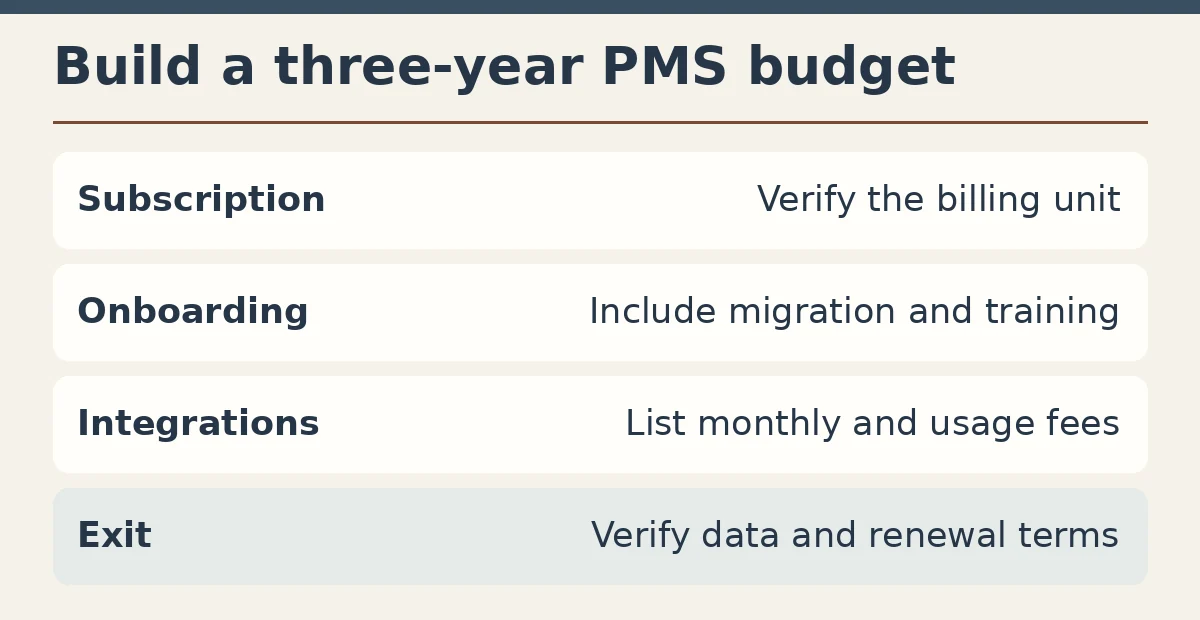
Request the base rate, billing unit, minimum commitment, and included interfaces. Then request migration, training, hardware, implementation, site visits, and data export pricing separately. Ask which hotel PMS software pricing terms depend on room count, revenue, transactions, bookings, outlets, or active users. When pricing is unclear, ask the vendor to produce an illustrative monthly invoice for a quiet month and a busy month.
For a simple fictional comparison, one vendor offers a $350 monthly base and $125 in required integrations plus $2,400 setup. Over 36 months without changes, that would total $19,500. Another proposal at $570 monthly including equivalent integrations and $800 setup totals $21,320. Hardware, changing fees, and payment charges could alter the result. This is a cost model, not a claim about any vendor’s prices.
Compare payment and booking fees from actual volumes
Ask whether the vendor requires its own payment provider or allows a separate processor. Model the type and number of transactions based on property records without exposing real card data. Include online deposits, terminal transactions, refunds, and any separate gateway fees. Check how settlement reports and payment references are connected to the folio. An attractive software subscription can be affected by a volume-based payment commitment.
For booking engine and channel fees, ask whether charges are based on completed stays, bookings, or integration connections. Include charges for canceled or modified reservations when the terms require it. Compare expected direct and third-party booking counts across the same periods. Keep those costs separate from channel commission so the operator can see the actual expense of each way a booking reaches the property.
Count migration and training time in your launch budget
Estimate the effort to validate room types, inventory, active bookings, folios, custom rates, and guest communication. Ask which of this work the vendor provides and what the hotel must do. Compare how many shifts need training and who covers regular operations while staff practice. If the software requires new terminals or network work, obtain a written price and a supported installation plan.
Use artificial guest data for demos. Require a front-desk employee to handle a change, a partial refund, a housekeeping update, and the daily close. Record both time and errors. Ask how many actions require exporting a report or bringing data into another system. Saving a few minutes per shift is useful, but a process that lets staff correct common problems without a vendor call may matter more.
Evaluate renewal terms and the cost of leaving
Ask for the initial contract period, renewal notice date, price adjustment language, and the fees for switching or ending the service. Request details about data return, format, costs, time available after termination, and which parts of the hotel’s data are included. Ask about billing if a project is delayed or if rooms are temporarily closed. Request a complete copy of support terms and identify any charges for urgent requests.
Test how to export a sample reservation and associated ledger fields before signing. Confirm whether the pricing includes support for the migration or only a file. A hotel that changes brands or adds a building may need to renegotiate its integrations. Ask for a written quote at the expected size and verify how transfers work.
Compare the total on a simple worksheet
Use one row per vendor for the initial setup, monthly subscription, required usage fees, hardware, integrations, staff time, and exit charges. Use three annual columns and show which costs are assumptions. Record an owner for each unknown line so it is resolved before selection. Match the scope on every proposal, then compare the expected cost and the upside or downside if bookings, rooms, or payment volume change.
The final decision should identify which day-to-day tasks the hotel can run and what it will pay to run them. Save the assumptions and demo notes. At renewal, compare the billed invoices with the model and request an itemized explanation for changes. Ask before making a planned migration, because software terms, integrations, and export costs can affect the timetable.
Ask for a quote in three operating volumes
At an independent hotel with 42 rooms, compare a quiet month, a busy month and a future case where the owner adds a second site. Have each vendor use the same bookings, room nights, transactions, and sales volume for the three examples. Review whether interface prices change at a threshold or whether the operator needs to switch packages. Ask what the quote calls a unit, whether unopened rooms count, and which users need individually paid access.
If one vendor discounts the subscription for signing a multi-year contract, request the detailed price schedule and the dates payments become due. Ask whether implementation delays change the subscription start date. Note whether the contract contains a minimum payment volume or training limit. Record recurring amounts and potential fees separately. Use actual hotel figures later even if your first comparison uses hypothetical numbers to see the structure.
Value staff time beside the written bill
Select three tasks that staff would carry out each shift and one that happens less often but can cause substantial corrections. An example set is canceling a reservation, assigning a clean room, reconciling an online deposit, and moving charges after a guest changes rooms. Have two employees try the work with fabricated booking records. Record errors, actions, and whether they need supervisor or vendor support.
If daily close takes 15 extra minutes per day, that represents about 91 hours over 365 days. Multiply the hours by a defensible loaded labor cost when a change actually affects staff time. Compare that amount with the recurring subscription difference. Distinguish actual time saved from time the manager can redirect to another duty. Include time for exports and resolving integration alerts.
Consider a small hotel platform that combines multiple modules
One property might prefer integrated bookings and a PMS, while another wants to keep its existing channel or processor. Ask which functions are directly included and which require another contract. Try a reservation and a refund that passes through systems. Write down the provider you call when the action fails. Ask whether an integration change affects billing, support, timing, or the ability to export a guest folio.
If the offer includes an optional revenue or guest messaging module you will not use at first, price it with and without the module. Use the same schedule of expected spending, and identify any cost that may change when the optional feature is enabled. Have staff verify that the lower package still supports ordinary work and daily reconciliation. Quote any genuinely expandable feature when the need has a likely date.
Build a three-year cost projection from real invoices
Start with your current monthly software bill and provider statements. Identify the rooms, users, outlets, and connected services billed. Ask the new vendor to write down what those same items cost at the start of service and at each renewal when terms permit. If rate adjustments are allowed, enter a separate modeled amount rather than presenting it as a guaranteed price. Capture card processing independently if the quote includes a gateway or required processor. Ask which fees can vary with transaction type.
For a three-year model, include the setup and equipment in year one and staff training, integrations, fees, and recurring charges when they are due. Use the same transaction assumptions and billable count every year for the baseline, then put a plausible increase on a second sheet. A property may add 12 rooms or another tax jurisdiction and see training, deployment, and interface costs change. Ask the vendor to show where those changes enter the proposal and how much notice it needs.
Estimate which costs stay even when sales fall
A per-room subscription can remain due when rooms are closed. A per-booking fee may fall as activity slows. Ask whether support, payment fees, and integrations keep billing even when only part of the hotel operates. Show the provider the dates of a planned temporary closure and request a quote under those conditions. Verify how the hotel can access reports if normal billing ends and whether cancellation triggers a fee.
For example, a switch to a bundle could avoid a separate $100 monthly interface charge but require a $1,500 migration job. In a simplified model it takes 15 months of that saving to equal the migration amount. Other module prices, taxes, or payment fees can change the result. Test the savings against your actual contract length and reserve. Ask what happens to those savings if the existing vendor already requires payments through the next automatic renewal.
Ask the vendor to show the bill after a support incident
Use a realistic issue, like a broken payment integration on a weekend. Ask whether the cost of the call, support tier, or replacement hardware is already quoted. Ask what response time the hotel can expect under that plan and what it would pay for a different service level. Confirm which provider takes the initial call. An integrated vendor and a standalone vendor may allocate work differently even if their published support hours look similar.
Make the next renewal date and export window visible in the buying file. Review the first new invoices against the quote and ask about differences before accounts become complicated. If a charge is usage-based, use the underlying count to reconcile it. The useful comparison ends in a cost that the owner can verify in invoices and an operational workload the team can carry.
Ask which prices are guaranteed at renewal
Create a dated worksheet showing the written payment in each contract year and what the vendor can adjust. Ask which payment and integration costs are governed by a separate agreement. Identify when a rate change must be communicated and how the hotel can act in response. Get an actual invoice example for a property with the same billing model. Check if another location, a planned closure, or a different subscription affects the minimum. The comparison should use numbers management can verify through the whole contract, including any charges for retrieving records.
Connect this comparison to the rest of the hotel
Price the core workflows before setting the recurring software budget. A change in franchise or property size can affect integrations, data migration, and which staff members need to be trained before the new bill starts.
For related decisions, use the hotel property management software comparison, the hotel conversion budgeting guide, and the hotel software guides.
Sources consulted
Oracle Hospitality — Hotel Property Management Systems