
Hotel financing options usually look different once you separate the building purchase, renovations, opening costs, and operating cash. A longer amortization can lower monthly debt service, while a near-term maturity can leave a large balance to refinance. Compare commercial hotel loans on the same uses of funds, cash requirement, and timeline. Start with how the hotel will actually earn and spend money throughout the year.
Write the sources and uses of cash first
List the purchase or construction price, renovation work, furniture and equipment, lender and closing costs, working capital, and contingency. For an existing property, add identified deferred maintenance and expenses associated with changing operators. Give the lender the expected timing for each outlay and identify which amounts require outside approval. Then list all funding sources, including borrower equity, proposed borrowing, and any seller arrangement the lender permits.
Suppose an illustrative purchase costs $4.8 million, planned work costs $600,000, opening or operating reserves run $250,000, and closing plus other costs are $150,000. Total uses would be $5.8 million. If the primary lender finances $3.8 million, the remaining documented sources would need to provide $2 million. Do not treat the loan amount as a statement of the exact cash needed. Expenses can shift and the lender may restrict which items are financed.
Compare a bank loan with SBA-backed alternatives
A conventional lender can propose its own leverage, guaranties, amortization, and servicing terms. A lender participating in the SBA 7(a) program can discuss eligible uses such as changes of ownership or working capital, subject to program and lender requirements. The SBA 504 program can help finance eligible major fixed assets, with different eligibility and permitted uses. Ask a participating lender or certified development company whether a particular operating entity, property, and use of funds qualify. Verify the current program rules as you quote.
Give both lenders the same project and borrower information before comparing the options. Ask how the property valuation and operating cash flow inform the offer. Find out what collateral, borrower contribution, guaranty, and continuing reporting obligations apply. Request the current fees and any prepayment provisions in writing. If you need immediate renovation funds or seasonal operating cash, ask which source provides it and what conditions are required before it becomes available.
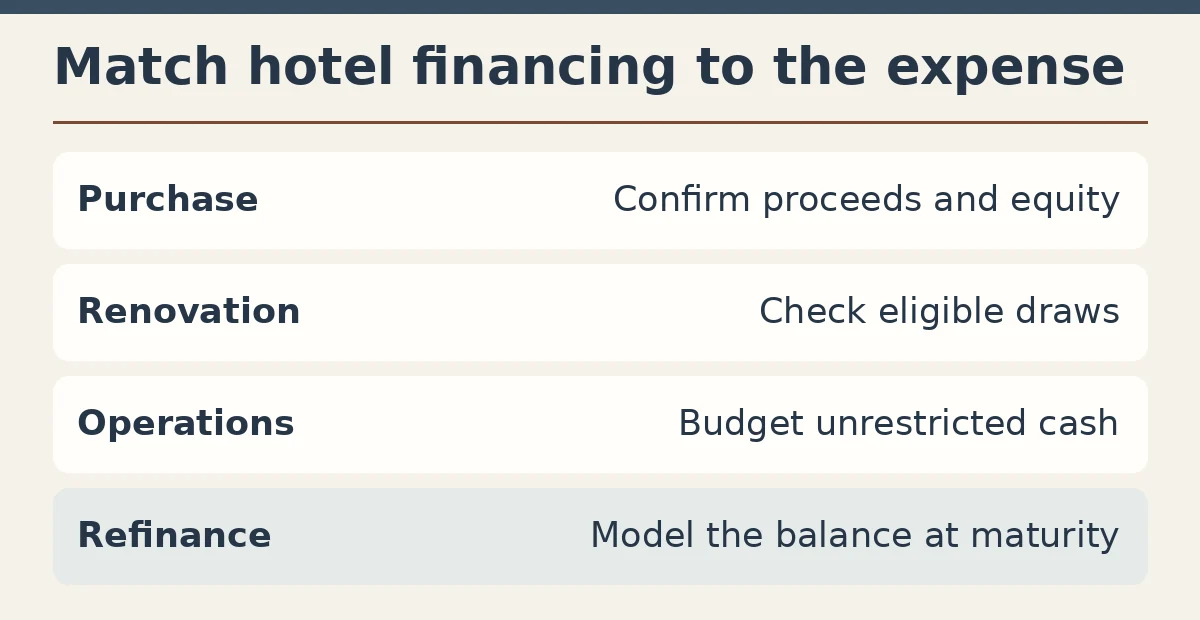
Understand permanent debt, transitional financing, and capital reserves
A stabilized hotel with consistent operating performance may seek permanent financing. A property with extensive renovations or an incomplete operating history might need a transitional structure, subject to lender availability and terms. In that case compare the interest calculation, draw conditions, interest reserve, extension options, maturity, and what counts as completion. Write down the events that must happen before you can repay or refinance the transitional loan.
For example, an operator may need to reopen the rooms, reach certain operating metrics, and produce a period of financial records before qualifying for a long-term loan. Ask both lenders what happens if work is delayed and a lender’s conditions are not met by the original deadline. Compare the cost of a documented extension against the additional equity needed. Treat a future refinancing estimate as a scenario based on future terms and underwriting.
Test debt service against a downturn
Ask what income figure the lender uses and how it accounts for franchise and management fees, replacement reserves, taxes, insurance, and owner expenses. Compare that with your actual operating statement. Debt service coverage ratio generally compares a specified cash-flow measure with scheduled debt service, but definitions can vary. Get the lender’s calculation on the same page as the ratio. Reconcile each expense it adds back or treats as ongoing.
In an illustrative case the qualifying annual income is $390,000 and annual debt service is $300,000. On that simplified basis the ratio is 1.30. If qualifying income falls to $330,000, it drops to 1.10 with the same denominator. Ask the lender which covenant it uses, how it is tested, and what remedy or reserve action follows. Use actual historical seasonality to build your own base and downside cases.
Read every term sheet beyond its interest rate
Compare the maturity, amortization, variable rate index and adjustment, floor, origination fees, third-party costs, cash reserves, recourse, and prepayment. Ask for estimated payments, principal outstanding at maturity, and how it would be calculated if the rate changes. If one quote requires escrow or a lender-controlled reserve, ask when funds go in and when they can come out. A higher reserve may affect what can be paid from day-to-day operating cash.
A fixed term with a short maturity can require refinancing despite stable payments. A floating offer may have a different cash requirement and interest rate exposure. Ask the lender to estimate a payment if the index moves and show how an interest-only period affects later payments. Record any rate cap and its price if offered. Use one common comparison date for these estimates.
Build the lender package around reconciled evidence
Gather financial statements, historical daily or monthly room performance, property tax and insurance estimates, brand and management contracts, a budget, and borrower experience. Explain one-time changes and provide records to support them. Lenders may request an appraisal, environmental or condition reports, title materials, and documentation of equity. Coordinate who supplies each item and what changes if work is under way or ownership differs from the operating structure.
Use a short list of unresolved questions for each term sheet. Review it before authorizing expenses for third-party reports or submitting nonrefundable deposits. Ask which terms are indicative, which depend on review, and who has authority to issue a commitment. A loan proposal can change before closing. Keep each written version along with the assumptions that produced it.
Separate initial equity from working capital after opening
At closing, write down the borrower’s equity, deposits, closing charges, funded reserves, and remaining unrestricted cash. Ask which expenses draw from each source and what happens if an estimate rises. A property may have much of its purchase financed but still need extra staff, inventory, and service expenses before reservations turn into bank deposits. Use a calendar of actual expected receipts and outflows, then update it when the closing or renovation date changes.
For example, look at a 10-week conversion in which rooms reopen in three phases. Put expected occupied room nights, revenue collection, payroll, and construction invoices on the same timeline. Model a phase that completes two weeks late. Ask each lender when funds can be requested and what documentation is required to release them. Keep owners’ funds and restricted lender reserves distinct so the project manager can see whether a delay creates a practical cash shortage.
Compare two loan offers with one room demand scenario
Choose one baseline using occupancy, average daily rate, applicable commission costs, and ongoing expenses. Ask lenders to build their calculations from that baseline so differences in how they treat expenses are apparent. Create a weaker month with fewer rooms sold and a second case with lower pricing. Fixed expenses may remain unchanged after demand falls. Ask the lender which assumptions affect its debt service coverage test and whether reserve contributions are included in the numerator.
Review a potential rate change if the loan is floating. A payment increase can happen while the hotel is in its weakest season. Build a list of costs to fund at maturity that goes beyond the amount of outstanding principal. Find out whether the loan allows extension or additional borrowing, and under what conditions. Put the cost and the timing on both term sheets. Keep potential sale proceeds or refinancing separate from cash the business can actually use today.
Follow each funding condition to its documents
Track which appraisal, budget, facility description, and ownership records support a term sheet. Ask a qualified professional to check liens, legal structure, and the lender’s proposed guaranty obligations. If the loan depends on insurance, ask which parties must receive documentation and how the lender will accept it. Save the target closing date and lead times from each provider. A term sheet with similar financial terms may carry a different time commitment.
Before borrowers decide on the structure, request a draft sources and uses statement and a closing checklist. Review both against the current written work scope and transaction dates. Ask whether each required expense can be paid by the proposed lender, from a separate provider, or from borrower equity. Record which amounts are estimates. A financing choice should be traceable from the bank statement after closing to the items the proposal promised to fund.
Compare financing for equipment and an operating reserve separately
A hotel that needs both laundry equipment and short-term operating cash can ask lenders for a proposal for each purpose. Explain which assets have a useful life matched to the repayment plan. Then document the business need for seasonal liquidity. Ask whether a revolver, term facility, vendor arrangement, or owner funds are appropriate and what collateral or guarantees are requested. Compare the effect on the main mortgage and who must consent to additional borrowing. The relevant structure depends on the actual use and terms.
Suppose a property can fund a $180,000 equipment purchase through one option, while another spreads repayment across a longer period and requires additional fees. Ask the lender to identify all funds due at delivery and any later balloon. Compare the estimated payment schedule with the rate at which the equipment is expected to generate savings. Review warranties, service agreements, and downtime separately from financing. For an expense that will recur within a few years, reserve room for the next replacement rather than relying solely on today’s quote.
Build a repayment plan lenders can test
Use a base and downside projection for one busy season and one slow season. Add scheduled principal and interest, any reserve contribution, and the projected cash available after operating needs. Ask each lender to reconcile its own definition of qualifying cash flow with actual hotel statements. Identify whether a cited ratio changes on an annual or rolling period and which action the documents require if performance falls short.
Track monthly interest and fees alongside obligations at the end of the term. If an alternative shifts debt maturity, show the estimated remaining principal on the date it must be paid. Ask what would happen if expected refinancing proceeds were lower than that balance. Improvements in borrowing cost should be understood along with the required equity and the risk the property retains. Bring the comparison to a qualified adviser before signing.
Separate deadlines that can be controlled from outside approvals
Property inspections, insurer evidence, third-party appraisals, and program eligibility can move at different speeds. Write down a person and a backup contact for each decision. Look for expiration dates on rates, appraisals, and financing commitments. Ask which costs can be returned if the owner does not choose the program. Keep a documented estimate of cash already spent. The final financing review is easier when each approval, payment, and backup date can be traced to a specific document.
Connect this comparison to the rest of the hotel
Update the property insurance amount before estimating debt-service coverage. A change in deductible or proof requirements can affect both operating reserves and which documents a closing team needs.
For related decisions, use the hotel property insurance cost comparison, the hotel business insurance quote guide, and the hotel financing guides.
Sources consulted
U.S. Small Business Administration — 7(a) loans
U.S. Small Business Administration — 504 loans