
A hotel commercial mortgage is a loan against an operating hospitality asset. The lender may examine both the real estate and the operating cash available to pay debt. Two commercial hotel loans can have a similar interest rate while requiring different equity, reserves, guarantees, and refinancing plans. Compare full payment schedules and the building and financial information each lender actually uses.
Start with the operating file the lender will underwrite
Collect recent financial statements, monthly occupancy and room rates, meeting or food revenue, tax and insurance costs, and maintenance records. Reconcile operator reports to the financial statements. Show whether closed rooms or a renovation account for unusual periods. Give the lender the management agreement, flag agreement if applicable, and major upcoming costs. If another entity runs a leased operation at the property, explain its revenue and contract separately.
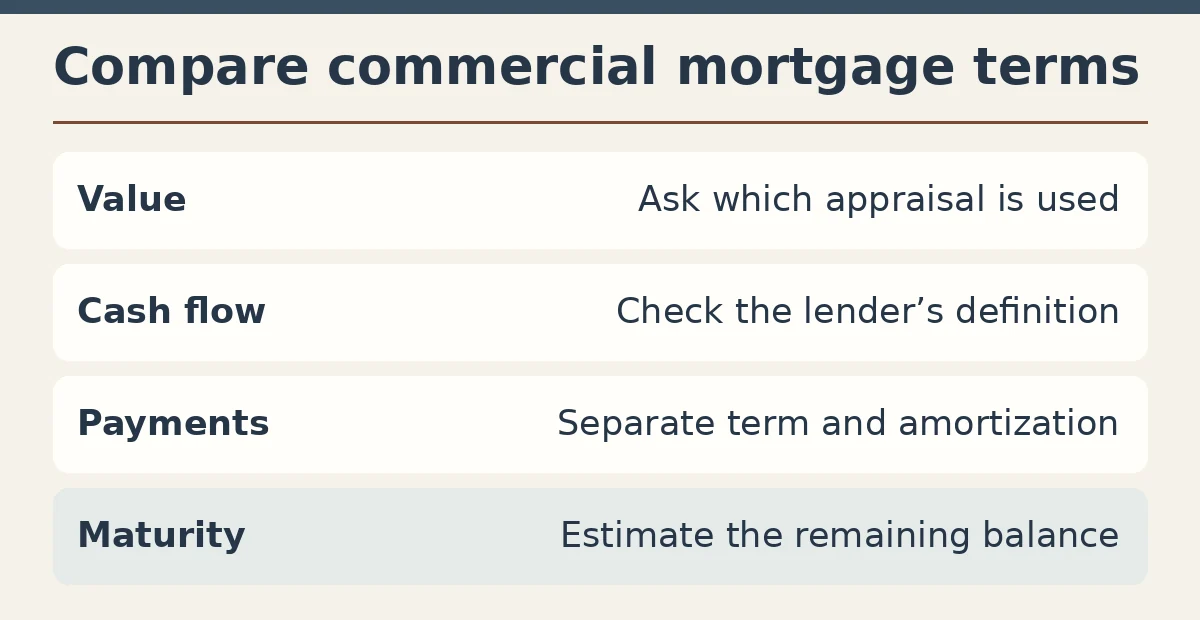
Ask which value the lender uses for its loan-to-value calculation. A purchase price, an as-is appraisal, and a projected stabilized value can be different numbers. Ask how an improvement budget is documented and disbursed. If an appraisal is lower than expected, have the lender show whether the maximum loan amount would change. Keep the breakdown for each proposal.
Compare cash flow and loan size on the same basis
Lenders may review debt-service coverage, leverage, the business’s history, and other underwriting factors. Ask each how it treats revenue base, franchise and management fees, capital reserves, property taxes, and insurance. Compare the resulting qualifying income. Ask whether parts of a prior owner’s expenses are assumed to continue and what happens if the tax or insurance bill changes after purchase or refinancing.
For illustration, a $4 million loan compared with a $6.25 million appraised value is 64% loan to value under that simple definition. If qualifying cash flow is $450,000 and annual debt service is $360,000, the illustrated debt-service coverage ratio is 1.25. These figures illustrate the math. They are not lender thresholds. Request the lender’s full calculation and the covenant testing rules on the actual contract.
Distinguish maturity, amortization, and payment dates
Amortization is the period over which payments are calculated to repay the balance under assumed terms. Maturity is when the loan is due under the contract. If maturity arrives before amortization ends, substantial principal may still be outstanding. Ask for the projected balance at maturity, the interest and principal payments by year, and any restrictions on early repayment. Compare the same financing period for offers with different payment calendars.
Use a separate row for an interest-only period. Ask whether and when scheduled payments increase, what interest rate or index applies, and whether there is a minimum rate. A payment comparison under stable rates is useful, but a variable rate loan also needs an increase scenario. Get the lender to produce payment amounts at rates appropriate to the proposed terms and assess whether the business could fund them.
Price a refinance and sale as distinct exit scenarios
Ask what would happen if the owner sells after a few years. Identify possible restrictions, notice periods, release provisions, fees, and the treatment of a prepaid amount under the actual documents. Some loans have specific prepayment provisions. Get a written example tied to your dates. Review an early payoff with counsel or advisers qualified to explain the contract.
A refinancing example should include the borrower’s projected balance, cash available for costs, and current operating assumptions. Model a lower valuation and higher debt service separately. Ask what happens if the hotel could only borrow an amount below the maturing balance. Keep a cash reserve plan or an equity contingency in the comparison. A theoretical lower interest rate is useful only when it accompanies assumptions the owner can evaluate.
Identify what reserves and guarantees actually require
Ask which operating and capital reserves the lender wants and how funds are held. A reserve for furniture, fixtures, and equipment can require regular deposits and supporting invoices before reimbursement. A tax or insurance escrow can change the cash needed every month. If a property improvement plan is required by the brand, ask when funding is available and whether it is held in a separate account.
Ask who guarantees repayment and which obligations apply even where a loan is described as limited-recourse. Have a qualified adviser review the explicit exceptions, scope, and any release conditions. Check whether management changes, ownership transfers, or distributions need consent. Compare the ongoing administrative and cash commitments with the interest rate.
Prepare for diligence before committing to dates
Request a closing checklist and name a person responsible for each item. Typical files include appraisal and insurance information, property and environmental review, title, organizational documents, operating statements, and lender-required approvals. Book time for the relevant inspections. Obtain the actual requirements and discuss whether a particular result could affect pricing, proceeds, or time to close.
Let the broker and insurer know the collateral schedule and closing deadline early. Ask which proof of insurance the lender will accept and whether it expects evidence of particular limits or endorsements. Request written confirmation once the correct documents are ready. Preserve proposed and final insurance terms so the owner can see any change made during underwriting.
Compare in dollars and keep a due-date calendar
Put loan proceeds, required borrower funds, fees, deposits, payments, reserves, and maturity balance side by side. Mark which items are paid at closing and which are collected later. Request sources for any estimate likely to change. Confirm how often financial covenants and reporting requirements are tested. If reviewing a refinance, ask how existing fees or payoff terms affect net proceeds.
For the final decision, look at both ordinary-year operating cash flow and a difficult year that might test the loan’s conditions. An offer that works at one valuation and one interest rate can still leave an unmanageable maturity balance. Keep the final term sheet, debt schedule, reserve rules, and relevant dates together after closing.
Ask how the lender treats restricted cash and new capital needs
Beginning with the same property, estimate expected recurring maintenance and major work for the next three years. Consider a reserve for furniture and equipment separately from the operating money needed each month. Ask whether the rate offer requires regular contributions or a cash balance in an account controlled by the lender. Request the formula, permitted uses, and conditions for spending those funds. Distinguish a lender-required account from the manager’s own budget.
If a renovation means a partial closure during the season, give each lender an updated estimate of room availability and how operating cash may change. Ask whether a reserve could fund the required work and what lender consent it needs. Keep the cost of restricted cash in view while comparing the interest rate and initial proceeds. The lowest nominal rate can come with upfront deposits or obligations that affect the timing of owner distributions.
Test whether an underwritten valuation leaves enough proceeds
For illustration, at a fixed 65% loan-to-value assumption, a $6 million lender valuation would imply $3.9 million of proceeds before other limits. If valuation came in at $5.4 million, the same simplified calculation would yield $3.51 million. The indicated difference of $390,000 could affect equity needed at closing. Actual approvals may also depend on debt service coverage, policy, and property review. Ask for a revised term sheet when relevant inputs change.
Have the lender state which date’s valuation and whether an as-is or stabilized assumption applies. If proceeds are advanced in phases, ask what counts as progress or completion for each. If the property will sell after a few years, include early payoff and retained cash in the projection. Treat an expected future sale price as a scenario and test how changes affect the money needed at closing or at maturity.
Check dates on a planned refinance before assuming the debt can be replaced
Write down the current loan’s notice deadlines, remaining balance, maturity, and any current lender conditions. Get a dated payoff estimate. Ask the proposed lender about property review, current income, and the earliest fundable date. A refinance can take longer if an inspection reveals work or if ownership information is incomplete. Ask what steps the existing lender allows if an extension is needed and how it would be priced.
When comparing quotes, request evidence about ongoing reporting and thresholds rather than relying on a label such as fixed or nonrecourse. Check every agreement with the appropriate adviser. Record how the owner will meet payments during the weakest season before the new lender funds. This comparison ends with a realistic timeline, a net proceeds amount, and a plan for the maturity the owner is actually taking on.
Compare two loan proceeds figures before looking at rates
One lender may apply a maximum leverage to the appraised value while another’s debt-service limit produces smaller proceeds. Ask each lender which constraint binds for your hotel and where the assumptions differ. Look at note amount, net funds after costs, funded reserves, and any amount withheld pending work. Compare the actual remaining cash needed from the owner rather than the note interest alone.
When the selected proceeds rely on a projected renovation value, ask when a particular portion can be advanced and what happens if construction or booking revenue lags. Verify who approves changes to the budget. Discuss any owner’s contribution required before the first lender advance. Write the sources of cash next to the dates when invoices need to be paid. That gives the legal and operating teams a common figure to verify.
Use closing documents to check the first year’s cash flow
Ask for a sample payment schedule showing principal, interest, escrows, and reserve deposits. Add the contractual dates for principal balance tests, insurance renewals, and financial reporting. Put unusually large expenses in separate rows so a strong summer cannot conceal a weak cash plan for winter. If a lender requires a property repair or replacement, calculate the amount of cash needed and which account can provide it.
Once a mortgage is issued, compare the actual balance and required reserves with the analysis you used. Verify if a rate reset or interest-only end date changes the scheduled payment. Check the written remedy or notice requirements if forecasts worsen. A hotel team needs both a regular report and a file it can use when discussing a future loan. Keeping the original scenario helps identify whether the next lender is comparing the same hotel and revenue base.
Evaluate loan offer expiration with the property’s actual deadlines
One quote may lock a rate early while another updates it as the lender reviews the file. Ask what changes are permitted, any upfront charges, and the conditions to recover those charges. Keep the rate lock discussion separate from approval of the property and operations. If a refinance is time-sensitive, ask counsel or a qualified adviser to review whether the current maturity leaves space for additional diligence. Compare the final calendar with the proposed mortgage’s ongoing costs.
Connect this comparison to the rest of the hotel
Put the premium, deductible and funded reserves in the mortgage cash-flow schedule. Keep the broker’s written assumptions next to the lender’s approved amounts when the policy or property changes.
For related decisions, use the hotel financing options overview, the hotel property coverage guide, and the hotel property insurance cost comparison.
Sources consulted
Office of the Comptroller of the Currency — Commercial Real Estate Lending