A hotel chiller can stop taking rooms out of service one floor at a time. The repair invoice shows only a part of what the operator faces. A rental unit may be needed to keep guestrooms comfortable, the restaurant may have reduced capacity, and guests may have to be moved before the failed part reaches the property. The renewal file should describe each obligation separately. Hotel equipment breakdown insurance may support specified sudden equipment failures under the relevant policy form or endorsement. The contract and the cause found after diagnosis determine whether any given cost qualifies.
Identify which equipment can close the hotel
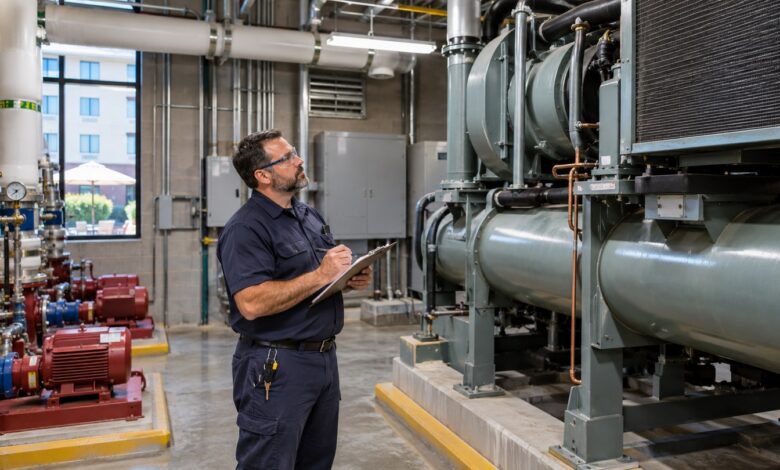
Make a property map that includes the chiller, boilers, domestic water system, elevator controls, commercial refrigeration, laundry and other critical systems. Record asset ownership, location, installation year, serial number, maintenance contractor and what rooms or revenue areas each asset serves. A machine serving a single laundry might be replaced with temporary outsourced processing. A central chiller that serves all guestrooms can pose a different exposure when a full hotel is expected during a hot week. Contrast the insured value of the asset with the business impact of losing its function.
Document the fallback path for each asset. Determine how long the hotel can keep operating safely with an affected system offline and who has authority to close inventory. Obtain a current rental lead time and repeat the check if multiple properties in the market could need the same equipment after a severe event. Record what installers need on site: delivery access, available power, compatible connections, permits and a qualified contractor. Treat estimated lead time as an assumption, and identify where in the plan a longer delay would change the decision to move guests or suspend sales.
Compare the cause, maintenance history and coverage trigger
A contractor calling a motor defective does not tell the broker whether the policy form applies. Keep the raw technician report and request a factual description of the component, observed damage and circumstances leading to failure. Freeze the timeline using alarm records, temperature readings, contractor arrival, invoices and any notifications. Distinguish an observed failure from a hypothesis. After the hotel restores safe operations, retain damaged parts when practical and consistent with insurer direction. Document disposal when a safety rule or contractor instruction requires it.
The Texas Department of Insurance commercial property guide describes the importance of covered causes of damage and flags equipment-related coverage as a separate item to review. Ask the broker which form covers mechanical, electrical or pressure equipment breakdown for the listed assets, and how the form treats wear, corrosion, corrosion-related damage, outside utility interruption and damage that results from another event. Get a written coverage explanation against a concrete scenario. A scheduled maintenance budget stays in the capital plan even if the hotel buys breakdown coverage. Equipment leases and warranty agreements can also allocate costs differently across the owner, operator, manufacturer and vendor.
Calculate the first decision in dollars and room nights
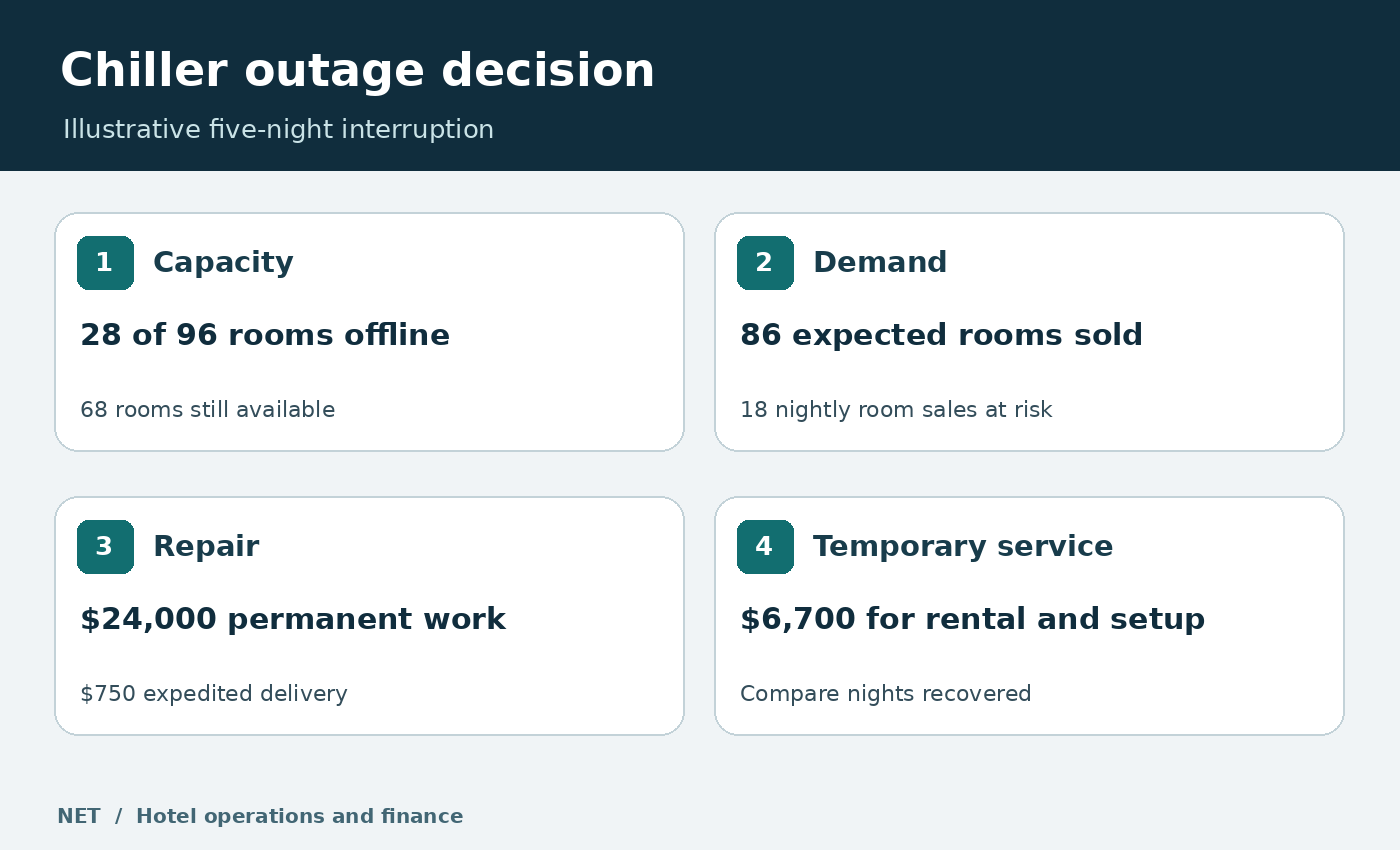
Assume a 96-room hotel loses cooling in a block of 28 rooms for five nights. The forecast for those nights is 86 occupied rooms each night at an average rate of $145. If 68 rooms remain available and all are sold at that rate, the capacity gap is 18 rooms a night, or 90 room nights. At $145, the illustrative room sales difference is $13,050. The baseline during a quiet period with 64 projected rooms occupied would yield no capacity-driven shortfall for those nights even though the repair invoice stays the same. Pull the daily demand instead of treating every out-of-order room as lost revenue.
Suppose the contractor quotes $24,000 for permanent repair, $6,700 to rent and connect a temporary unit, and $750 for an expedited delivery. The owner should compare the expected downtime with each option and the actual booked nights at risk. If temporary service restores six profitable room sales nightly for four nights, those sales total $3,480 at the stated rate. Other benefits such as guest relocations avoided or keeping enough rooms for a contractual group are separate forecast entries. List the cash timing as well. A rental deposit due tomorrow has an immediate effect even if an adjuster later considers it for reimbursement.
Check the policy line by line against the decision
Ask for the treatment of the damaged part, associated property damage, refrigerant loss, spoilage, overtime and expedited freight. If a kitchen refrigerator shares a circuit that failed, record the stock exposure and cause separately from the air conditioning loss. Some items may be addressed in distinct endorsements or subject to sublimits. Ask whether the insurer uses a dollar deductible, an hourly waiting period or different deductibles for different coverage parts. Enter the answer and form reference in the renewal worksheet, and put unresolved exceptions in a separate column. Never assume that two similar names in a quote mean the two issued forms respond the same way.
Map the claim proof to the typical expenses. The chiller service report can document diagnosis, but the accounts payable invoice shows what was billed. Record rental dates and scope, the failed component, the test that verified restoration and the exact dates each room block became sellable. If the hotel can produce separate repair and mitigation invoices, doing so makes it easier to review charges. Tie labor changes and freight to a field decision. If the invoice was later credited for a warranty contribution, keep the adjustment with the original to avoid misrepresenting the cost.
Work from an operational acceptance checklist
Write a response procedure with names and phone numbers for the manager on duty, qualified service provider, broker, owner and any franchise support desk. Record what staff may safely do, like blocking rooms, moving reservations and checking the engineering log, and what they must hand over to a qualified contractor. Maintenance should test system function under normal conditions before guestroom inventory is restored. Sales should release rooms in the booking system only after housekeeping and operations confirm readiness. Ask whoever clocks these steps to record the hotel business date and local clock time.
Use concrete service agreements to exercise the checklist. Imagine a replacement control board becomes available only in seven days. Can a supplier deliver a compatible unit? Which circuit supports it? What has the electrical contractor approved? If the hotel closes for a safety issue, who updates out-of-order rooms and coordinates accessible relocations? The insurance worksheets should be prepared beside a real operational plan. A coverage estimate cannot substitute for safe engineering or dictate whether guests can occupy an affected area.
Use the same model for a boiler or elevator failure
For a boiler, map separate functions such as guestroom hot water, kitchen needs and pool heating. A unit that maintains overnight domestic hot water may allow the hotel to operate with capped demand, whereas a failure affecting all rooms could force a different decision. Identify the units, redundancy and installation constraints in the work order. Compare scheduled repair costs against unexpected damage without relying on a narrative that every outage begins with the same cause. An outage during a planned shutdown and one during an occupied weekend will have different operating consequences.
For an elevator, the operational question is more than how many floors remain open. Review actual passenger routes, guest accessibility requirements, service elevator limits, and the time needed to call an authorized service technician. Designate an employee to record room reassignment and transportation costs without storing unnecessary guest details. Keep the failed asset, property impact and operating impact separate. Ask the broker to walk through the policy treatment in advance. Ask the technician to confirm the service plan in advance too. The two conversations solve different parts of the problem.
Compare repair options on the same restoration schedule
Create three columns for the permanent repair alone, permanent repair with a temporary system and a phased restart using existing redundancy. For each, list the date rooms could become safe and sellable, the contractor price, cancellation and relocation exposure, and the cash deposit due. Show the unit count and rate assumptions below the total. A broker may be more interested in the incremental loss reduced by the temporary option than in its rental charge viewed in isolation. Give the operations team a separate status line for guestroom availability so the finance model does not release rooms ahead of the engineers.
Suppose the hotel rents a temporary system for $6,700 and gains 24 expected room sales worth $3,480. It also expects to avoid $2,100 in lodging relocation costs and $850 for guest transport. Taken together, the scenario shows $6,430 in gross sales preserved and relocation costs avoided before variable costs and contractual considerations. If the booking team cannot show those guests were at risk of being moved, reduce that estimate and keep the original projection. The rental might still have a business rationale during a period of high demand. Record which benefits depend on the contractor’s start date.
The deductible can change which expenses justify an insurance discussion, and it may be different for the equipment and interruption portions. Ask whether a waiting period begins when the covered equipment fails, when business operations are suspended or when another defined event occurs. Compare that wording with the actual outage facts. Make the distinction visible in the ledger rather than counting hours from the first angry guest call. An outage that lasts fewer nights than expected can still pose repair expense, and an issue with repair coverage does not by itself answer all business income questions.
Finally, treat preventive work as its own capital-planning case. If two similar chillers use the same aging control boards, ask the maintenance provider to compare a current spare-parts option with an emergency purchase. Verify warranty terms, compatibility and responsible storage. Estimate the downtime risk even after buying insurance. A replacement program may make sense because equipment availability, safe operations and guest expectations matter independently of the claim. Use a separate maintenance budget for predictable work so the renewal packet reflects which risks the hotel intentionally retains.
Use the renewal review to settle unresolved items
Have the facilities director and controller jointly choose two scenarios that represent the hotel. One can be a single-unit failure with maintenance history. The other can be a failure with a related interruption such as refrigeration stock or a partially closed wing. For each scenario, review the cost estimates, policy forms, deductibles, rental availability and work authorization. Record policy questions by endorsement and retain the answer from the broker with the proposal. If the policy changes, record how the written exposure model must change.
Use hotel property insurance to review building and contents coverage, hotel business insurance quotes to align proposals with the same operating assumptions, and hotel property insurance cost to compare the cost of retaining predictable repair bills. Review the asset list after a major renovation or change in equipment ownership. A ten-minute update to the register can save an operator from making the first decision under the assumption that equipment, rental expenses and closed rooms all belong in the same coverage bucket.