
Hotel acquisition financing begins before an offer becomes binding. A buyer needs a budget for the purchase, repairs, transition, and working capital. The lender needs operating results that can be reconciled and a credible explanation of what will change under new ownership. Compare loan proceeds and timing against those uses so a low headline interest rate does not hide a cash shortfall or an unrealistic closing condition.
Set up a transaction budget with three columns
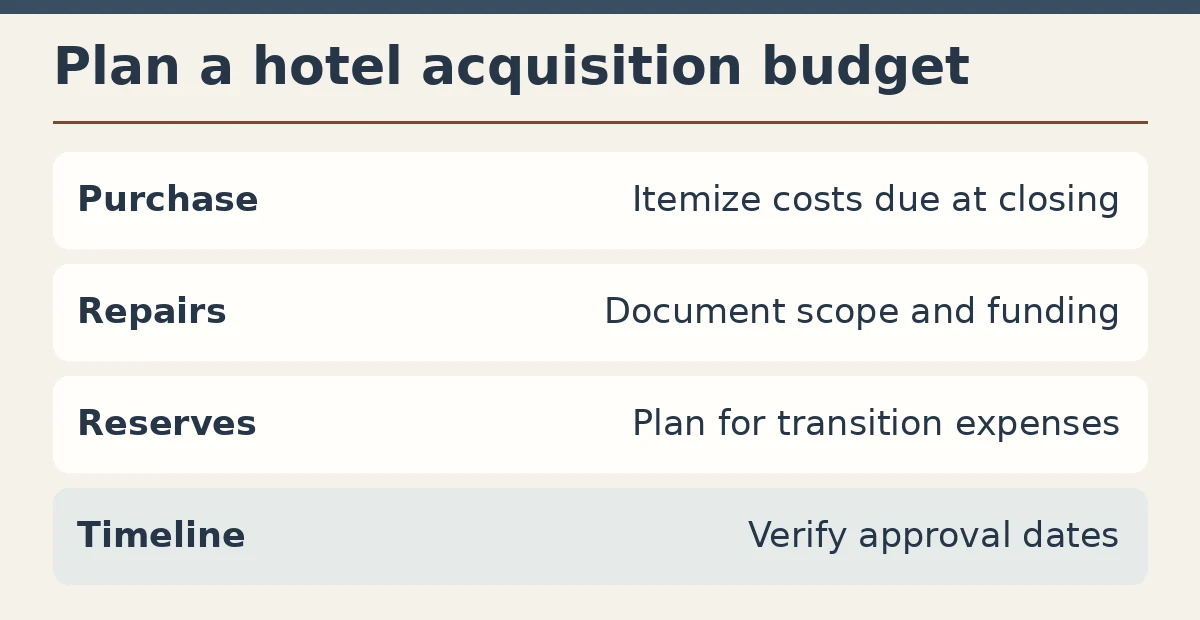
Record the costs paid at closing, the work funded afterward, and the minimum operating cash needed to run the hotel. Include professional fees, required improvements, furniture and equipment, and contingency. State who pays each cost. Then write down proposed sources, including buyer equity and any seller financing the senior lender permits. Ask how the lender treats seller debt and whether it requires deferral, subordination, or consent.
For example, a hypothetical $6.2 million purchase plus $450,000 in work, $180,000 in transaction costs, and $240,000 in reserves totals $7.07 million. If the senior loan stands at $4.7 million, the difference is $2.37 million before any eligible additional source. Confirm which expenses need cash earlier and which could be reimbursed after work. Dates matter when the seller expects a closing before construction plans are finalized.
Verify the seller’s hotel revenue and expenses
Request operating results by month, room production by channel, and records explaining tax, payroll, inventory, maintenance, contracts, and other material items. Reconcile room and ancillary revenue to financial documents. Ask why occupancy, average nightly rate, or available inventory changed during particular periods. A long room closure can make an operating statement misleading unless you can see how it was reflected in occupancy and revenue.
Distinguish expenses a new owner could actually remove from costs it must retain. Get written estimates for management, franchise expenses, insurance, and capital needs on your proposed terms. A refinancing or acquisition lender may recast operating income based on its definitions. Request the calculations so you can see if a line was excluded, counted twice, or based on a projected rather than historical figure.
Tie lender and brand approval to the purchase agreement
Identify who can approve a change of ownership, management, and brand affiliation. If the brand requires changes to the property, get the written scope, deadlines, and a qualified construction estimate. Ask counsel to coordinate lender conditions with the purchase agreement and diligence windows. Review when deposits become nonrefundable and what happens if a required approval arrives late.
Bring approval requirements to lenders early. A conventionally financed purchase and a possible SBA-backed option can involve different disclosures and eligibility. Ask a participating lender about current 7(a) program requirements for eligible ownership changes, permitted uses, and treatment of any seller financing. If the proposal uses a separate loan for eligible real estate or fixed assets, verify what other sources fund the operating and transition costs. Compare fit with the actual transaction.
Plan a reserve for closing and transition
Discuss tax and insurance estimates on the new ownership and confirm the evidence the lender will need. Ask the seller for a schedule of open reservations, event deposits, credits, commissions, and expected receivables. A reservation transferred to the buyer may bring an obligation to deliver the stay or handle a refund. Have the parties and their advisers document who receives, holds, reconciles, or returns outstanding amounts.
Prepare a first-month staffing and vendor plan. Put payroll, supplies, repairs, insurance, website and reservation changes, and a contingency on a weekly cash calendar. Ask when any lender reserve can be released and which conditions must first be met. A project can have sufficient total funding but need equity earlier while invoices and refunds are due. Get that timing in writing.
Compare lender offers after applying a downside case
Model occupancy and nightly rate separately, then estimate operating costs, expenses that cannot be cut quickly, and debt service. A one-time construction problem can reduce available rooms without changing the rates guests are willing to pay. In a demand slowdown, the hotel might have all rooms open and still miss revenue. Ask lenders which qualifying income and reserve assumptions they will use in their review.
For illustration, 60 operating rooms for 30 days create 1,800 room nights. At 68% occupancy and $132 per sold room, gross room revenue in the example is $161,568. At 60% and $124, the figure falls to $133,920. Add other supported revenues and subtract the applicable operating costs to build a cash case. Compare the cash available under the lender’s definition with debt service. A forecast is useful when you can identify the assumptions that drive its result.
Decide what evidence is required to close
Keep a written list of approvals, property and environmental reports, title and survey, insurance, licenses and vendor arrangements, property improvement estimates, financial review, and borrower equity. Identify separate tasks for the property and hotel operations. Ask who can authorize spending and what happens if a report or bid changes the plan. Get copies of final approvals and check that funds are assigned to the correct entities and uses.
After closing, preserve the opening balance and the seller’s records that explain it. Review booking and payment balances against the documented handover. Track renovation spending and room availability against the financing assumptions. Use the next lender report to identify which transition costs were one-time and which costs continue. This makes future borrowing or refinancing easier to compare against actual performance.
Decide how to bridge invoices between closing and reopening
Give the lender an invoice and milestone schedule. Ask which items can be financed, when advance requests can be submitted, and how long a review usually takes under the actual proposal. A contractor might require a deposit earlier than a draw is available. Assign a source for the deposit and check whether it will be reimbursed. If insurance, licensing, or brand requirements hold up a phase, ask how the bridge period would be funded.
Develop a downside budget where work is delayed and advance bookings are softer. Keep cash for payroll, guest refunds, maintenance, software transition, and required reserves distinct. Send both lenders the same forecast. Get the exact amount of any interest reserve and the conditions on releasing it. A full funding commitment can still leave too little spendable cash if a large portion remains in restricted accounts. Record the order in which borrower cash and loan funds would be released.
Include the property condition assessment in the purchase decision
Ask a qualified team to look at mechanical equipment, roofs, room condition, and public areas. Put essential repairs, brand-required changes, and elective upgrades in different rows so the lender can identify the source for each. Get written prices or assumptions. If a report finds water damage or other conditions that affect coverage, ask the broker for revised terms rather than assuming that the seller’s policy or premium will carry over.
Review changes in real estate taxes, utilities, vendor agreements, and staffing assumptions. Ask if the current owner has made unusual concessions or used a related vendor. Replace sums with supported post-closing estimates where appropriate. Discuss with qualified advisers whether the price or closing conditions should change if the assumptions cannot be verified. Ask for written responsibilities for each follow-up before the due diligence period ends.
Tie the financing decision to the actual closing handover
Set out when the buyer gets keys, prior records, payment reports, and the operating responsibility for future reservations. Explain the transfer to software and payment vendors so they can flag any separate merchant account setup. Check who must answer existing guest requests. Align lease, brand, insurer, and loan dates. Ask each representative to confirm how to record and correct a delay.
After review, compare the lender’s approval dates, expiry, costs and condition list to the authority the buyer has under the purchase contract. If the lender needs an updated valuation or agreement, find out who will pay for it and how long it could take. Ask the seller for allowable extensions when relevant and obtain appropriate advice. This puts assumptions about funding and timing in the same negotiation.
Compare the valuation with what you are buying
Ask the lender to specify what portion of the transaction it attributes to land, building, equipment, and operating business interests. Have qualified advisers review the proposed allocation and what it means for the purchase documents. The lender may calculate leverage from a different figure than the purchase price. If a valuation or linked insurance quote is below expectations, ask for a revised written statement of proceeds and buyer funds.
For example, the seller might include furniture and an operating business in the asking price, while a lender looks at collateral under its own policy. Make a case where proceeds are $250,000 lower than expected. Identify whether that amount can be funded without reducing the reserves needed to operate. If that is not feasible, ask what timing or agreement changes would be required. This preparation helps the buyer distinguish a valuation difference from a decision to accept more financial risk.
Check what the seller will actually hand over
Ask for a joint schedule of future bookings, settled cash, deposits that are still held, outstanding receivables, gift certificates, credits, and vendor contracts. Include the date and operator responsible for each line. Ask which parties need notice or consent under the relevant agreements. Protect guest information during the review and limit access to the authorized people. A confirmed reservation can require operational work even when the buyer has yet to receive the related funds.
Compare the current booking system records with cash and settlement documents before the handover if the parties have lawful access. Have counsel and finance check who would receive refunds, collect money, or pay commissions if a stay is canceled near the closing date. Ask what contract governs any nontransferable system or agreement. Include the cost of changing systems and training staff in the transaction budget rather than assuming prior arrangements continue at no expense.
Review buyer cash at the end of the first full month
Put property operations in a 30-day calendar with dates for payroll, insurance premium, lender fees, utility deposits, repairs, marketing, and anticipated bank deposits. Use reasonably conservative collection assumptions for third-party bookings. Check which expected revenue is actually available for use. If a lender reserve has conditions on withdrawal, keep that balance distinct. Ask who signs off on a payment after the acquisition and whether the old operator must provide further evidence to release funds.
Compare that cash plan to the amount in the lender’s approved sources and uses. When actual costs are higher, decide with the relevant advisers whether to revisit funding or adjust the process. Track each change and compare against the written closing conditions again. A plan that works on closing day should also support the next paycheck and guest arrival.
Connect this comparison to the rest of the hotel
Acquirers can compare permanent debt using the same operating statements while collecting the proof an insurer and lender request. Give both companies the same closing timeline and keep post-closing cash separate from coverage for prior operations.
For related decisions, use the hotel commercial mortgage comparison, the hotel financing options, and the hotel business insurance quote checklist.
Sources consulted
U.S. Small Business Administration — 7(a) loans