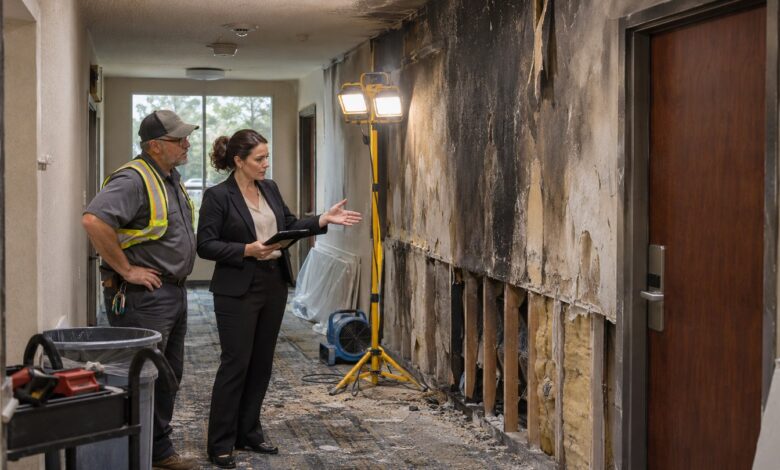
When a fire closes a wing, a hotel usually starts with a simple question: how much revenue is at risk? The harder question comes next. How much of the shortfall is attributable to the closure, how much could the hotel recover through the open rooms, and which expenses continued? Those are different numbers. A room-night forecast describes the operating loss. Your hotel business income insurance policy, its endorsements and the facts of the interruption determine what may be covered. Keep those two calculations side by side so the finance team can update its cash forecast without treating an estimate as an insurer’s payment commitment.
Draw the timeline before calculating the loss
Start with the first day physical access changed. Record the incident, affected rooms, any order restricting use, when the contractor gained access, and when individual spaces could again accept guests. Keep the engineering schedule separate from the guest sales schedule. A repaired room may still need inspection, cleaning, furniture or an inventory update before the front desk can sell it. Record the reason and the responsible party each time the dates diverge. A dated contractor email is more useful than an undated note saying that the rooms were down for about a month.
The National Association of Insurance Commissioners explains that business interruption coverage commonly addresses lost income after a covered event causes property damage and operations are suspended. Policy wording can define the restoration period and its start differently from a hotel’s financial reporting period. Request the actual form and relevant endorsements from the broker. Ask for the applicable trigger, any waiting period, the covered premises, the time limit, the business income limit and whether extended business income applies. Enter the insurer’s coverage position in a dedicated column while keeping the property’s factual chronology intact.
Estimate demand the hotel would have served
Build a daily forecast using comparable weekdays and arrival patterns. Record reservations on the books before the incident and identify contracted groups, local events and rooms blocked for maintenance that would have been unavailable anyway. Compare with a prior-year date only after checking holiday movement, weather, supply changes and renovation. Preserve a dated copy of the original forecast, plus a revision log that explains each change. If the accountant later brings in actual market data, a reviewer should be able to see which estimate changed and why.
A 72-room hotel loses access to 24 rooms for the first 30 nights. Its forecast is 58 rooms sold per night at an average daily rate of $135. If it can sell only 48 rooms, the initial capacity-constrained shortfall is 10 room nights per night. Multiplying 10 by 30 by $135 gives $40,500 of illustrative room sales exposure. Multiplying 24 closed rooms by the same 30 nights and rate would yield $97,200. The larger number treats every blocked room as sold and overstates this scenario. On individual nights where forecast demand stays below the open inventory, the physical room closure may leave room revenue unaffected. Calculate demand by day when groups and weekends differ materially.
Separate sales, avoided costs and continuing costs
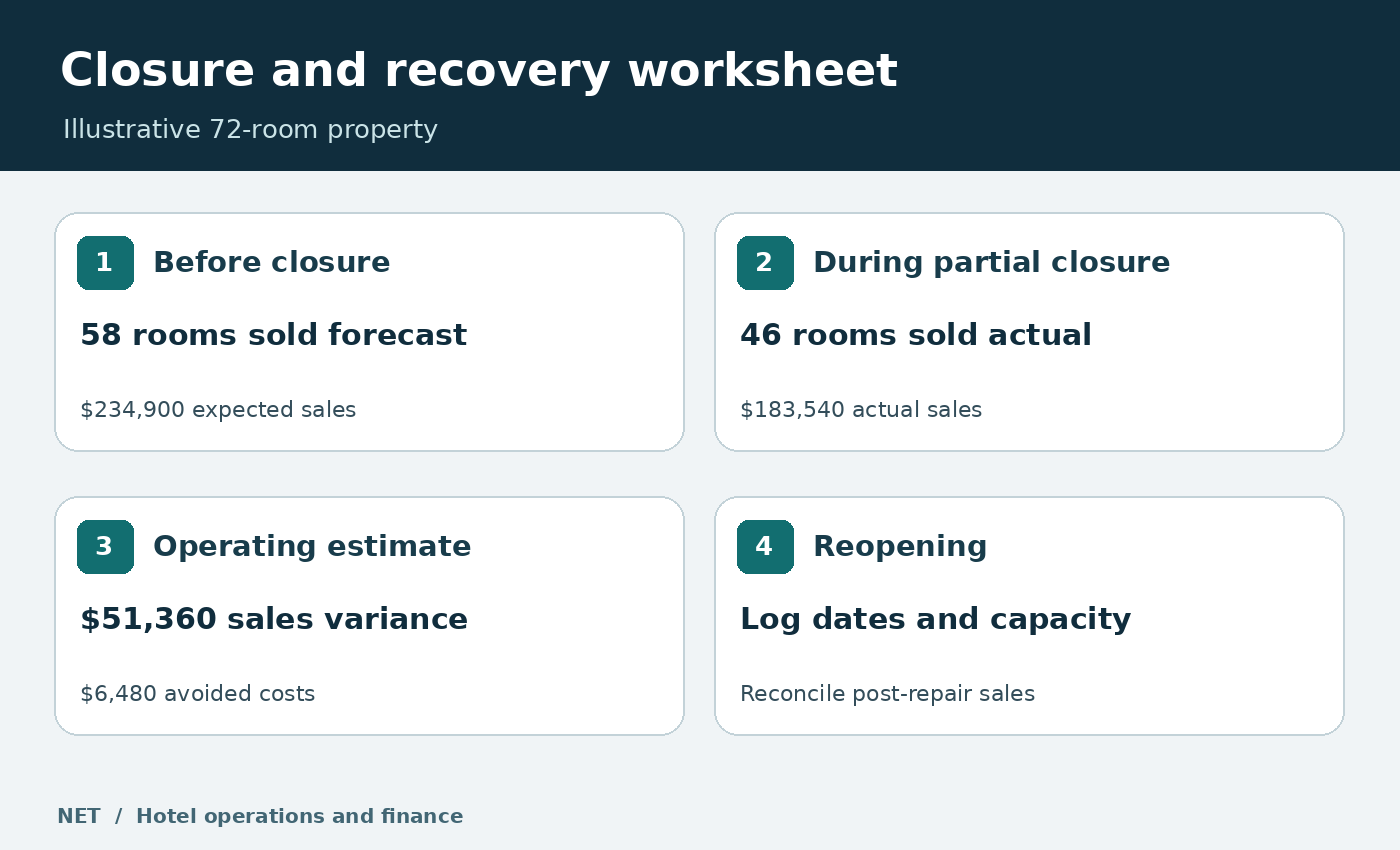
Replace the first-pass capacity estimate with actual results. If the open hotel averages 46 occupied rooms and earns $133 per occupied room, rooms revenue is $183,540 over 30 nights. The modeled pre-loss figure is $234,900, so the difference is $51,360. Explain why realized sales came in two rooms below operating capacity and why the average rate fell. Those movements could reflect room-type mismatches, guest relocations, changes to the booking mix or demand unrelated to the loss. Tag each cause separately rather than assuming that every variance belongs to a claim.
If the hotel estimates $18 of avoided variable expense per lost occupied room and 360 fewer occupied room nights, that estimate is $6,480. Validate it against laundry, housekeeping supplies, commissions and breakfast usage that actually changed. Keep amounts such as contracted security, continuing salaries and property taxes in the operations ledger even if receipts arrive later. The policy’s business income definition governs the treatment of net income and continuing operating expenses. The $51,360 sales decline less $6,480 of avoided costs is a $44,880 operational contribution estimate before other items. It is a bridge for discussion with the accountant and adjuster, not a claim decision or a reason to add continuing expenses twice.
Track mitigation spending separately
A crew may be able to open a floor earlier if it rents temporary fans, brings in cleaning labor, or moves stored equipment into an external unit. Document proposed mitigation with the timeline, cost, expected operating benefit and any needed approvals. Preserve forecasts made before the decision so you can explain why the spending was reasonable at the time. Label emergency work, permanent repairs and recovery spending separately. The property damage and extra expense sections may have different conditions, limits or accounting requirements. Confirm where to route invoices with the adjuster, and avoid counting a single invoice in two totals.
For example, an $8,400 temporary solution lets the hotel restore eight rooms ten days earlier. If only five of those rooms would be sold nightly at $135, incremental room sales are $6,750. The avoided loss analysis should also consider incremental costs, the effect on rate, relocation fees, any documented group retention and policy-specific expense treatment. The worksheet should show the actual comparison, even when the room revenue alone suggests that the temporary solution will not pay for itself. A decision may still make operational sense for guests, safety or contracts, but those reasons do not establish policy coverage.
Reconcile partial opening and the recovery period
Create a row for each operating phase: full closure if any, limited inventory, restored engineering capacity and normal operations. A phased opening creates two separate questions. The first is when the house could sell more rooms. The second is whether sales returned to expected levels. A group that has moved to a competitor may not come back immediately after repairs. A lower price may reflect a deliberate recovery campaign, a market downturn or a mix shift. Compare both occupied rooms and realized rate with the original forecast, then flag the dates after physical restoration so the broker can check whether any extended coverage applies.
Use recovery reports to avoid duplicate attribution. If a 20-room block rebooks at a sister property, retain the cancellation, replacement reservation and any hotel-paid transport or rate difference. Name the legal entity that recorded the revenue and the entity that paid the extra cost. For a management company overseeing multiple properties, a consolidated total can hide which operator actually incurred the loss. Present both a property-specific ledger and any intercompany allocation. Ask the adjuster how to document mitigation without duplicating amounts across insured entities.
Build the monthly review packet
Have the controller own a workbook with one daily row per revenue center. Include forecast occupancy and rate, actual occupancy and rate, revenue variance, preliminary cause, variable expense adjustments, ongoing expense notes, and supporting files. Add a separate invoice register with authorization date, service dates, category, net cost, allocation and paid status. Store records under the same date convention as the property management system’s business date. If the night audit closes after midnight, bank posting date and operating date can legitimately differ. Cross-reference both where it changes the analysis.
Ask operations for records the ledger cannot explain. Keep out-of-order room history, reservation denials if reliably recorded, group correspondence, construction logs and available inspection milestones. Take periodic exports before a vendor overwrites history. Give every file a stable name and record who pulled it. For cancelled reservations, retain only the guest information necessary for the review, and keep the working set in the hotel’s restricted claims workspace. Provide appropriately scoped supporting records when requested, following the broker’s or adjuster’s secure intake instructions.
Stress-test the finance forecast independently
Model how the hotel will pay payroll, debt service and emergency vendors if insurance proceeds arrive later than expected. Use a weekly cash schedule and record funds available after lender or owner restrictions. Track insurer advances only after they are confirmed, and keep expected but unconfirmed receipts out of the cash available column. Run three scenarios using different restoration dates or room capacities. Weekends, group dates and recurring contractor milestones matter more than a straight-line monthly average when they contribute disproportionate cash.
Suppose an additional ten-day delay affects 12 expected rooms nightly at $130. The gross room revenue exposure is $15,600 before demand, avoided cost and recovery adjustments. If the extra ten days have low midweek demand, the prospective loss may be much lower. Put the busy-date scenario beside the low-demand scenario and connect both to the owner’s funding decisions. A reserve request can then be sized from a documented downside rather than the maximum policy limit. Once the hotel knows what the insurer has accepted, reconcile the claim tracker with the finance forecast entry by entry.
Reconcile guest deposits and refunds outside the rooms-sales estimate
A deposit posted before the interruption can later be refunded, transferred to a sister hotel or applied to a new stay. Keep the reservation identifier, payment date, refund or transfer reference, amount and final disposition. Ask accounting to reconcile the movements against the processor statement without assuming a refund date is also the date when the hotel lost the reservation. Identify amounts that were still guest liabilities at the time of the loss. Build a second line for bookings recovered on a future date and explain how the forecast treats them. This makes the operating variance reproducible without counting the same deposit once as lost room sales and a second time as a refund cost.
For example, a group prepays $9,000, moves all rooms and receives its deposit back. If the room revenue forecast already includes the affected group nights, putting the full $9,000 refund into extra expense would generally overstate your operational worksheet. The refund is a cash movement that must be reconciled with the underlying reservation and ledger. A nonrefundable venue cost the hotel agreed to pay the replacement property would be tracked separately, with its own agreement and invoice. Validate attribution and any insurance treatment with the accountant and adjuster.
Questions the owner should settle in advance
Can the hotel use the last month’s sales as its baseline? Sometimes it is a useful starting point. An airport property that just lost its crew contract or a hotel facing next month’s festival needs an additional adjustment. Preserve the source figures and the reason for each adjustment.
Do unsold rooms automatically equal covered loss? An interruption estimate starts with demand, pricing, actual sales and applicable policy terms. Separate evidence of unusable capacity from the expected sales for that night.
Which related policies should the owner read? Review the building, contents and policy terms in the guide to hotel property insurance, then use hotel business insurance quotes to compare the terms offered at renewal. The hotel property insurance cost comparison helps distinguish the premium budget from the cost of retaining risk. Before a renewal, rehearse the worksheet with last year’s figures and give the broker a concrete interruption example to explain in writing.