
A hotel revenue management system can make an appealing rate recommendation from a forecast that performs poorly on the dates that matter most. A promising monthly average can hide recurring misses on weekends, when a group cancels or when a convention changes dates. Evaluate the forecast before automating prices. Give the provider and in-house baseline the same information available at each forecast date and measure results for the way your property sells rooms. Then test whether staff can make, review and reverse a rate decision using the actual distribution path.
Define the prediction and date on which you can act
Choose the property, stay date, room type or segment, and the forecast lead time. Ask whether the system predicts revenue, rooms sold, occupancy or demand without an inventory constraint. A hotel that sold out cannot use final rooms sold to establish how much more it might have sold. Keep those cases distinct and explain how the vendor evaluates them. Mark nights affected by room closures, group inventory releases and changes in how the PMS records direct or agency reservations. Use a consistent definition of actual rooms sold before recognizing any improvement.
Save forecast snapshots for selected lead times such as 14, seven and two days. Record the business date, time, source system and room scope. Preserve the snapshot so it cannot silently update after outcomes arrive. If a provider tests historical dates, ask which facts were available on the hypothetical forecast date and which dates were used to tune the approach. More recent information such as a cancellation or market event may be appropriate in a current forecast and inappropriate in a backtest of an earlier decision. A comparison needs both models evaluated against the same information cutoff.
Give the current method a fair benchmark
A useful baseline is current rooms on the books plus expected net pickup from reasonably comparable dates. If the property knows which groups are expected to cancel, maintain a separate documented adjustment. Select comparison dates with comparable weekday and seasonal patterns. Preserve the basic forecast and the manual adjustment independently. That lets the team see whether value comes from the candidate, judgment or access to better information. Avoid choosing a weak baseline that staff would never use just because it makes the vendor appear stronger.
Evaluate representative periods rather than one arbitrary month. Include weekdays, weekends, events, shoulder periods and nights when out-of-order inventory matters. Compare group and transient demand separately where size allows. Track which patterns matter commercially. If a hotel usually sells all its rooms during concerts, predictions far above the property capacity need a suitable evaluation distinct from quiet-week forecasts. A reduction in errors across ordinary dates can coexist with worsening results on dates that account for much of the season’s operating contribution.
Calculate an error measure that is easy to audit
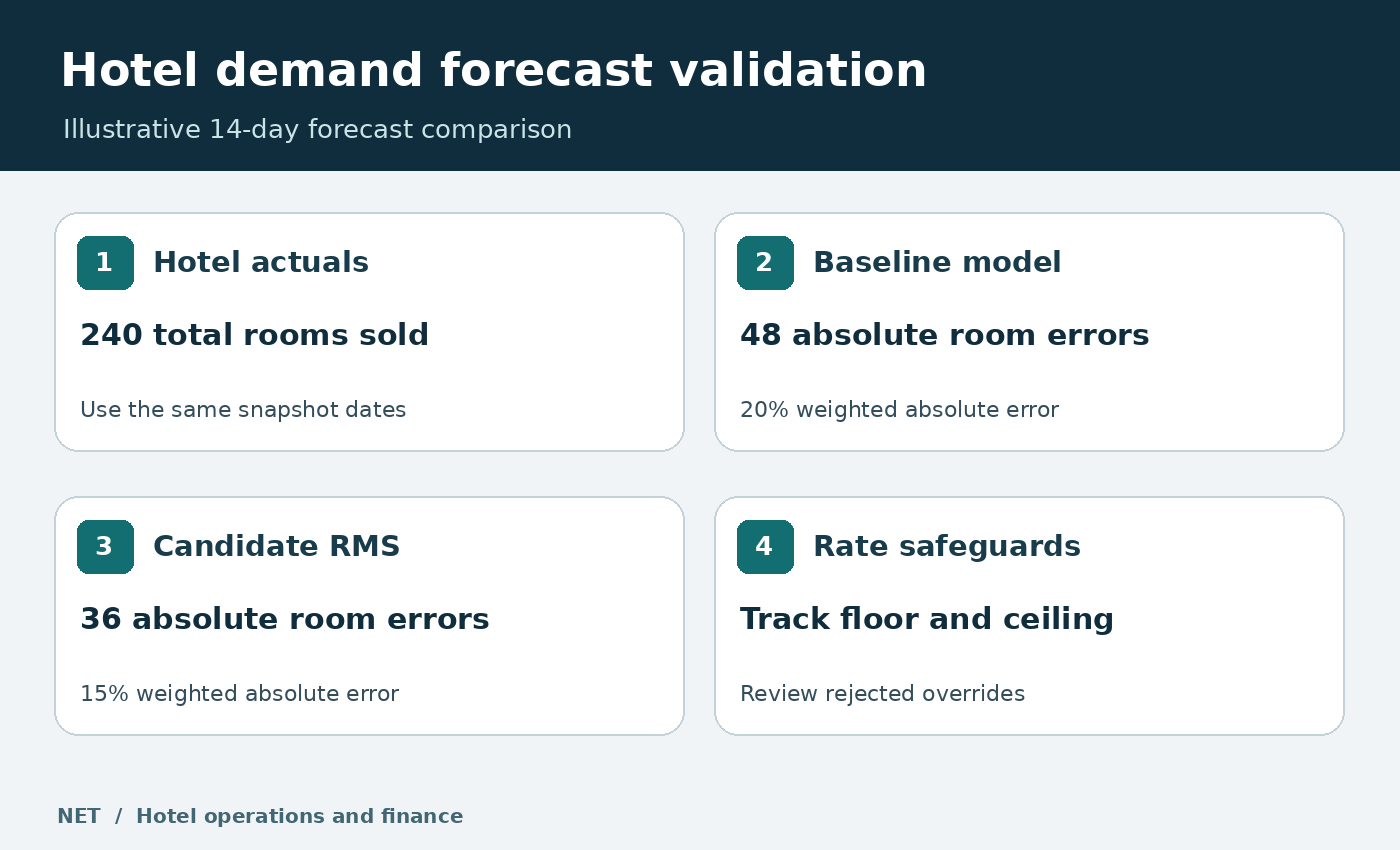
In an illustrative 14-day trial, actual rooms sold total 240 in the selected scope. The baseline’s daily absolute errors add up to 48 room nights, so weighted absolute percentage error is 48 divided by 240, or 20%. If the candidate totals 36 room-night errors, its equivalent score is 15%. A smaller number describes forecast accuracy in this scope. It does not establish increased profit or performance during another season. Retain both the daily errors and their aggregate. If actuals total zero in a scope, a percentage with zero denominator is undefined. Report the absolute amounts or the limitation.
Also calculate bias with the sign convention defined. Sum forecast minus actual for the dates. If an engine repeatedly underestimates demand by six rooms on five busy nights, it may encourage a rate lower than the property’s market can support. Errors that cancel in the signed sum still matter when the operation must respond. Review absolute errors, signed bias, the affected nights and credible causes. Give the vendor at least one example where the same error occurs across several dates. Verify that calculations use stays and dates in the same units.
Test an event the software learns about late
Try an example in which a local convention is announced after the seven-day forecast. Preserve the prior forecast, publish a test override in approved conditions and record supporting information about the event’s timing and likely segment. Estimate which room types and arrival dates would benefit from a higher rate. Check whether an earlier high quote on an unrelated day stays unchanged. Staff should be able to see when the new information was entered and why its effect was limited to specified dates. Keep the data change separate from the final operating decision.
Now simulate a late group cancellation. Ask whether the model can correctly incorporate released rooms and changes to expected pickup. A larger availability figure does not prove more demand. Verify the recommendation on the affected nights and the ability to restore prior rates on other dates. If the hotel overrides a rate, give it an owner, an expiration and a clear reason. Verify how the system records whether a change was received at the booking engine and selling channels. An accepted recommendation is different from the rate a guest can actually book.
Define limits and responsibility before enabling changes
Document rate floors and ceilings, which plans are eligible, which roles can approve exceptions, and when existing overrides expire. The hotel might use automation for a flexible transient rate while retaining contract or group rates under separate management. Mark the affected property and room types on every decision. Require a second person to review changes that cross an owner-defined boundary. Give staff an approved way to pause publication if the system recommends an unlikely rate during an outage or incoming reservations do not match reported demand.
Run a short shadow trial during which the system records recommendations but does not change public rates. Compare each recommendation, authorization and intended channel price. Give each vendor the same test. Ask how staff would tell if an important rate update failed and how to restore an approved rate across channels. Test a rejected or delayed update in the provider’s approved environment and require observable confirmation. A recommendation can be reasonable while distribution has a separate failure. The operating report should distinguish which component actually failed.
Compare hotel margin alongside forecast accuracy
A higher rate can reduce rooms sold yet improve room revenue. Net results depend on commissions, concessions and expenses as well as the timing and mix of demand. Using illustrative figures, one event night sells 40 rooms at $180 for $7,200 in room revenue. A comparison night sold 43 rooms at $165 for $7,095. The $105 difference can be erased by a distribution or promotion difference. Calculate the costs of occupied rooms, account for commissions, and use the same recognition rules. Note outside changes before assigning a performance gain to the system.
A hotel could report a favorable aggregate impact because it piloted the product during a strong local event. Use comparable dates and separately document conditions that are not comparable. Record where a price or restriction followed a recommendation, manual override or commercial commitment. Pick an evaluation period and acceptance measures before seeing results. If practical, compare outcomes using controlled rules and evaluate limitations such as overlapping demand and different groups. Include a measure of time the staff spent reviewing changes and responding to exceptions.
Use a scorecard that distinguishes errors the hotel can fix
Give the owner one row per forecast date and horizon, with the state of the actual outcome, room category, load and exclusions. Keep a separate rate event log with the approved price, source, affected plans, timestamp and whether the channel delivered it. A provider that shows exportable snapshots and a repeatable audit path lets the hotel explain a miss without relying on a screenshot of the latest dashboard. Ask how long the history can be retrieved and whether later versions of the software preserve the records the hotel needs.
Write acceptance rules around the decisions you will actually automate. A property might accept software that beats the existing approach on core stay dates and has clear override controls, while keeping special events in manual review. Document how it would expand automation after more results or roll back when problems appear. For example, track a concentrated bias in the near-arrival forecast despite a lower overall weighted error. Keep the affected decisions controlled while the hotel tests a remedy. This prevents one impressive aggregate score from overruling practical operating needs.
Verify the first sale date after a configuration change
If a new rate floor or room mapping is approved, test one future arrival and a multi-night stay before relying on the change. Record what the revenue management system recommended, what was approved, and what arrived in each tool selling the room. Run the same comparison after the vendor updates its integration. Keep the price source and configuration dates against the original forecast results. That record lets the property distinguish forecasting improvement from a change in room availability or selling rules, and helps staff recover an earlier setting when the property’s policy calls for it.
Compare rate actions on the nights with the largest errors
Take the ten nights with the biggest forecasting misses and classify them before discussing a faster rollout. Determine whether a group changed, the hotel closed rooms, a report captured modified bookings late or a price reaction changed what guests actually booked. Then ask what rate each model would have proposed using information available at the time. One approach can underforecast a night and still price it reasonably because a rate floor or manual review intervened. Another can generate a close forecast but an unacceptable price because a restriction was configured poorly.
For an illustrative decision, imagine the hotel forecast 45 rooms at the seven-day horizon and ultimately sold 51. An error of six rooms could be tolerable on a weekend with 80 rooms available. It may be much more consequential with 52 sellable rooms or a group block that is about to release. Record the remaining inventory and room-type mix beside the numerical error. Estimate how each proposed action would affect net room contribution, and indicate what assumptions require supporting evidence.
Audit the rate decision in separate steps. Verify which channel actually received the approved amount, which restrictions were applied, and whether the action expired as intended. If a correction is needed, keep the approved original and replacement prices by channel. The property’s ability to reproduce a rate change from these records is a practical requirement for frontline support even if forecast error is already improving.
Read the broader guide to hotel revenue management software for purchasing criteria, hotel channel manager software for distribution checks, and hotel booking engine software to review how a guest sees the published rate. Require the trial to answer three questions about forecast accuracy, operating supervision and correct transmission. An error score is one input in that decision.