
Seller financing can help a hotel buyer reduce the cash paid at closing. It can also create a second set of payment obligations just before the new owner starts covering payroll, replacing equipment and learning how quickly room revenue turns into cash. Model a seller note alongside senior hotel acquisition financing and working capital. Disclose the structure to the senior lender early. The deal should be able to support the full capital stack on the signed terms and during a slower transition than the buyer expects.
Separate the purchase price from the cash to close
Prepare a purchase schedule with the amounts for real estate, furnishings and equipment, other business assets, and any additional consideration. Ask transaction advisers to support the allocation and identify amounts that require separate handling. On a financing schedule, show senior proceeds, buyer equity and seller principal. Add closing costs, owner cash for repairs, settlement adjustments and opening working cash. Track which entity owes each amount. The company operating the hotel may differ from the one acquiring the property or borrowing from the seller.
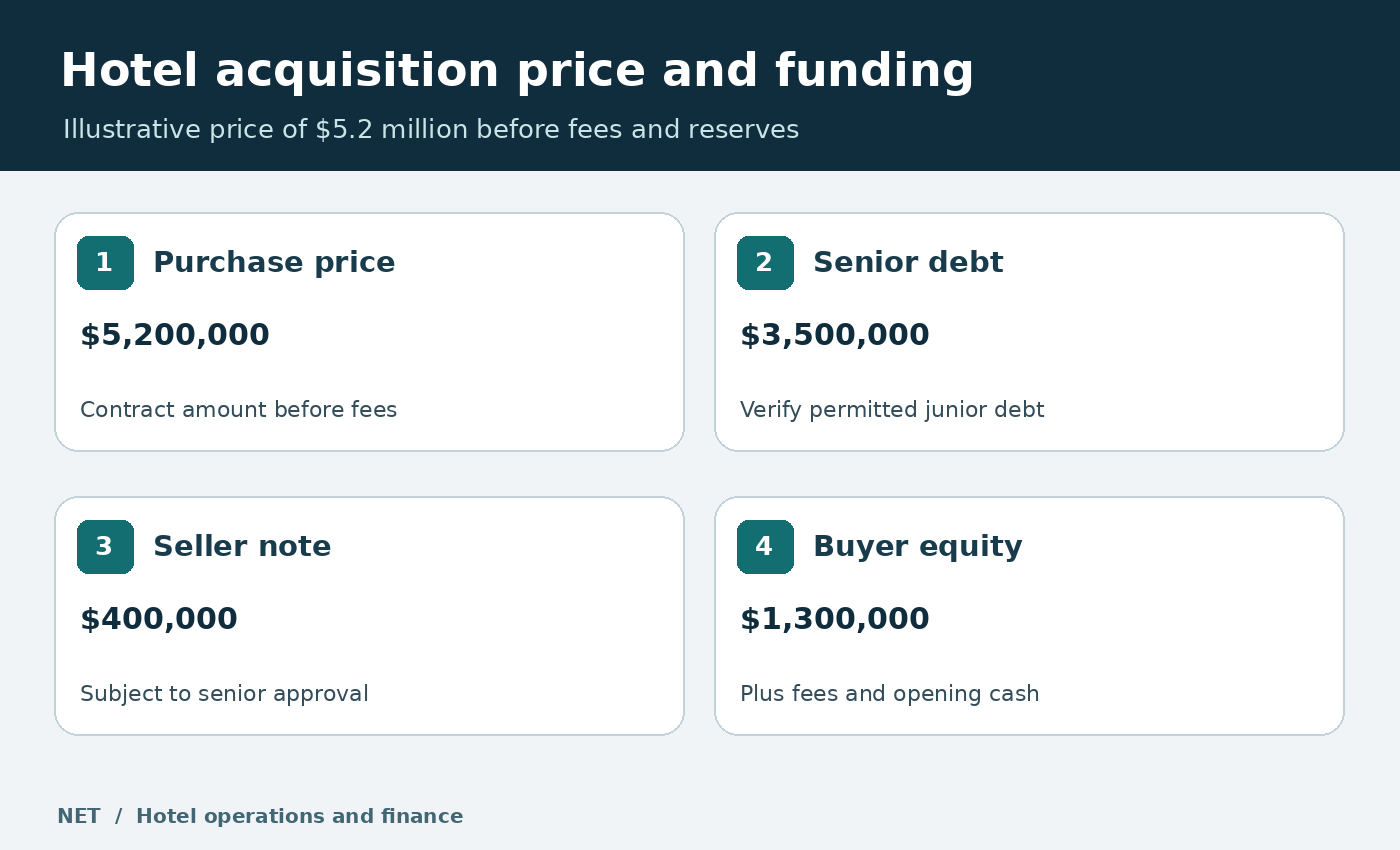
Consider a $5.2 million agreed purchase price, with $3.5 million expected from a senior lender, a $400,000 seller note and $1.3 million in equity allocated to the price. If closing expenses are $160,000 and the operator needs a $240,000 opening balance, total required buyer funding is $1.7 million unless it has another permitted source for those costs. If the senior lender accepts only $250,000 of seller debt, the same price and costs would require another $150,000 of funding. Check whether the current owner commitments cover the revised balance and when it must be available.
Ask the senior lender to review the seller terms
Provide a draft note or term sheet early enough for underwriting and counsel to review it. Describe the amount, interest, term, amortization, maturity, planned payments and any collateral. Explain whether the seller expects interest to accrue, whether any payments are blocked, and which parties need to consent before the note can be repaid. Disclose additional obligations in the purchase or side agreements. A senior lender may require a different structure before approving proceeds. Ask it to identify exactly how it counts seller financing when evaluating buyer contribution and debt service.
Where SBA-backed financing is proposed, the SBA 7(a) program overview gives general context for ownership changes and borrower eligibility. Have the participating lender identify applicable current rules and any requirements for standby, subordination or payment terms in the actual transaction. The buyer’s and seller’s understanding has to fit the written senior approval and final documents. Qualified counsel can reconcile payment, collateral, assignment and potential default terms. Update the preliminary budget whenever a change to one agreement affects the others.
Calculate coverage on both payments
Assume underwritten annual operating cash flow of $490,000, with $350,000 in annual senior payments and $55,000 in annual seller payments. The two loans together require $405,000. Illustrative coverage of total obligations is about 1.21 times. If lender-defined cash flow falls to $425,000, that ratio falls to about 1.05 times. A property may satisfy a senior loan calculation and still lack enough money to absorb a modest operating shock alongside its junior payments. Record the lender’s actual debt-service coverage definitions separately from the hotel’s cash model.
There are costs a simple annual ratio does not show. Build a quarterly forecast with the actual dates of lender payments and the operating receipts the buyer can verify. Include renovations, replacing a failed asset, taxes and temporary payroll before a busy season. A large account whose invoice settles next month may contribute to earnings now without being available to pay the seller. A buyer should also identify how it will cover any large amount due when the seller note matures. Maturity can arrive before the senior lender permits a refinance or before new annual results are available.
Price a payment deferral over more than one year
Suppose the $400,000 seller note bears 7% annual interest and permits simple interest to accrue unpaid for the first year. With principal unchanged, $28,000 accrues in the example. The loan agreement determines whether the amount is paid later, added to the balance or otherwise handled, and whether any consent is needed. Ask the buyer to calculate debt service in the first two years and at maturity. Compare paying from closing, using a permitted deferral, and reducing the note with more buyer equity. Apply the same room demand and renovation figures in every version.
A deferral can make the working balance more comfortable during transition. Check whether the cash saved early can cover the later obligation once routine bills and senior payments resume. If payments depend on senior-lender permission, put the notice and consent requirements in the calendar. Ask which report would show the approved note balance after each payment, and who is responsible for reconciling it. Keep the current principal and accrued interest visible next to the real estate loan balance. Tell the seller and senior lender how the owner will document those funds.
Compare fixed and contingent purchase terms
A fixed seller note defers part of agreed consideration. A contingent purchase-price payment can depend on agreed performance or other conditions. A lower purchase price changes consideration at closing. If the transaction discusses more than one alternative, compare effects on buyer cash, seller proceeds, risks and approval. The parties should have legal and tax advisers review any contingent terms. Lender treatment of these amounts can affect funding. Record how a proposal would be measured before assuming it will solve a price disagreement.
For example, the seller expects a crew account to produce $180,000 in yearly room revenue after closing, but the buyer sees the account is up for renewal. Prepare both renewal and non-renewal forecasts and check who can approve an assignment if one is needed. If the parties consider a contingent payment tied to performance, define which property and periods count, how refunds or cancellations are handled, what evidence the buyer will provide, and who reviews the amounts. Assign ownership of the reporting file. Different definitions of revenue can change the same payment even when the booking totals are identical.
Confirm cash obligations the hotel inherits
Review group deposits, direct reservations, prepaid amounts, agency settlements, receivables and pending refunds before the operating handover. Identify which company has custody of guest funds and which company will owe a refund or deliver the stay. Review settlement terms and post-close adjustments with the closing team. Actual processor cash may be received on a different day from the transaction. A hotel can inherit operating work even when the seller receives the cash. Record the liability and corresponding funding so that neither the closing statement nor the owner forecast hides it.
Model working cash for the first months using the expected settlement dates. Combine a hotel payroll cycle, a contractor invoice and one delayed agency receipt. Check whether staffing and guest-service obligations can still be met when seller payments are due. Include buyer deposits already applied and avoid counting escrowed funds as available working cash without written support. If the seller note carries a balloon due during the next slow season, prepare an independent funding decision well before the maturity date.
Make the closing packet reviewable
Include the signed terms when available, proposed documents otherwise, the purchase budget, monthly cash forecast, proposed payment schedule and owner commitments. Make the status of each document clear to everyone. Reconcile changes to price, junior principal and closing cash across the whole file. If the seller reduces the face amount and asks for a larger early payment, model both alongside the senior terms before returning a response. The best record shows the dates and dollars of every promise without assuming that confirmation from one party binds the others.
For the hotel controller, add a short post-close checklist. Verify the actual funds received, the property and company that owe each scheduled amount, and which account can be used to make each payment. Set review dates for reporting and maturity. Determine what happens if a right needs to be exercised or consent obtained before maturity. Retain the settlement and closing cash schedules so the operator can explain any open difference. These items belong in the first-week calendar even where the seller payment begins later.
Choose the lowest cash requirement the hotel can sustain
A lighter closing contribution comes with a trade-off if the hotel becomes too sensitive to a lost contract or renovation delay. Quantify the working reserve under a moderate downside and reduce the assumed funding if commitments remain uncertain. If the existing arrangement leaves too little cash in operation, test a lower price, a different senior loan, different note terms at approval, or more equity. Consider how much post-close work the owner’s finance team can manage, including accounting for notes, deposits and agency settlements. Be explicit about which verified change would make a different structure preferable.
Reconcile owner contributions with the handover estimate
Create one scenario where the purchase terms stay fixed but closing adjustments increase. If the purchaser needs an additional $40,000 for settlement adjustments and the plumbing contractor requests a $35,000 deposit on the first week, identify which money covers both. A seller note sized to close the transaction does not fund such expenses automatically. Check the balance after each scheduled transaction. Record expected receipts from the property separately from equity that is already committed. Assign the opening forecast to a named employee and ask that person to verify its inputs before the closing documents are finalized.
Also review what would happen if a permitted senior refinance moves the seller payoff later or earlier than originally expected. The parties should understand approval conditions, any additional interest and the effect on available capital. Ask the owner to compare at least one conservative future valuation and income case against the expected payoff rather than assuming another buyer or lender will take out both balances. If any amount has to be reserved as a condition of the purchase, carry it through the monthly cash model rather than treating it as unrestricted.
Give the seller and senior lender the same latest written assumptions as appropriate through the approved transaction channels. An updated draft note should identify which change affects price funding, repayment dates or owner capital. Keep the revised numbers and approval beside the version supplied at underwriting.
Use the hotel acquisition financing guide for the full transaction and transition budget, commercial hotel loans for senior mortgage terms, and hotel financing options to compare other sources. The practical test is whether the hotel can make the documented payments and maintain enough cash to run the property in months that do not match the base forecast.